
North Africa (244–255 CE) Crisis, Plague, …
Years: 244 - 255
North Africa (244–255 CE)
Crisis, Plague, and Resilient Communities
Deepening Roman Imperial Strain
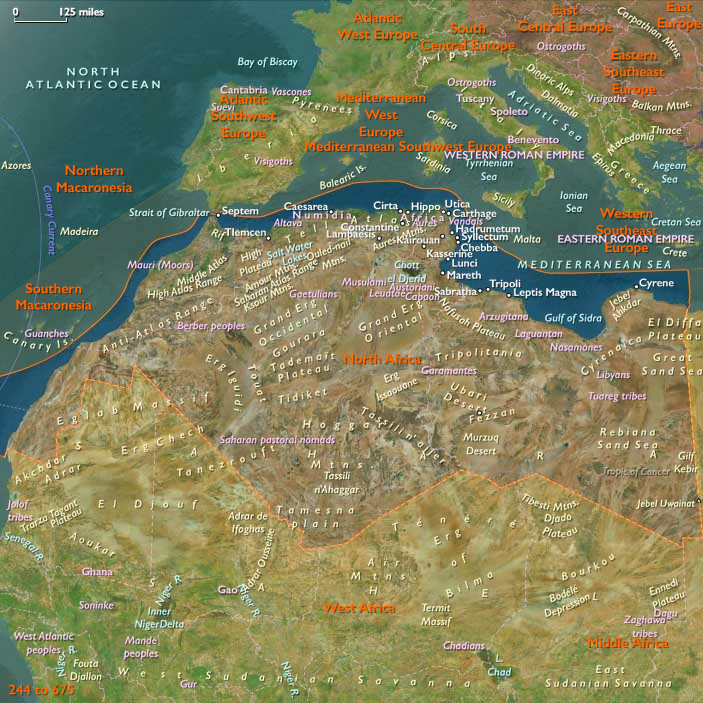
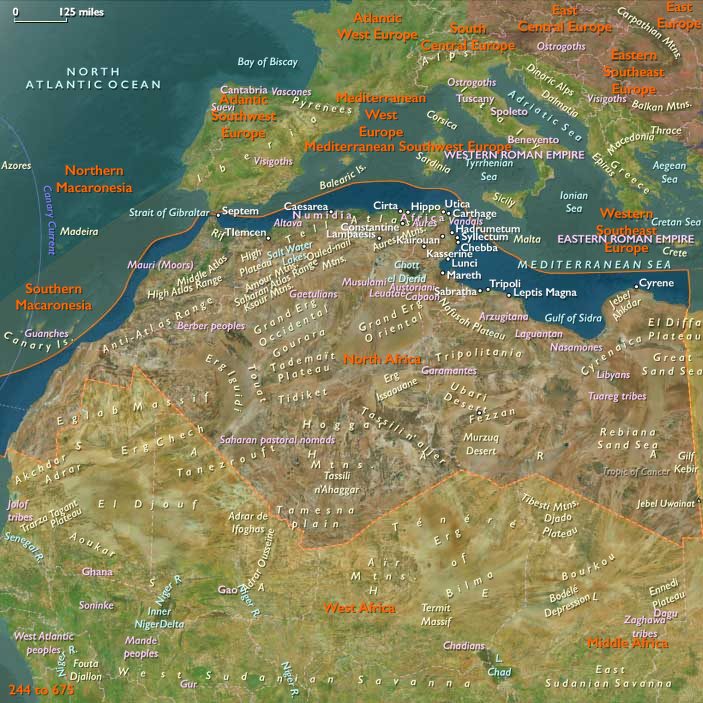
From 244 to 255 CE, North Africa feels the growing pressures of the Roman Empire’s wider instability, the early stages of the Crisis of the Third Century. Administrative inefficiencies, increased taxation, and periodic disruptions in Mediterranean trade networks create mounting challenges. Nevertheless, Roman administrative structures, urban centers, and local governance remain relatively robust, allowing North Africa to sustain substantial economic resilience despite the emerging strains.
Military and Frontier Stability
The Roman military presence in the region, comprising locally recruited legions and auxiliaries—approximately twenty-eight thousand troops stationed primarily in Numidia and Mauretania—faces increased pressures from persistent Berber resistance and desert incursions. Frontier fortifications established in earlier centuries, extending from Vescera (Biskra) to Ad Majores (Hennchir Besseriani), continue to play a critical role in maintaining security, protecting vital agricultural regions and trade routes from potential disruptions.
Economic Vitality Amid Instability
North Africa retains economic strength, anchored by its status as a key supplier of grain and olive oil, the empire’s vital commodities. Despite emerging crises, cities such as Utica, Leptis Magna, and Caesarea (Cherchell) remain vibrant commercial hubs, facilitating essential trade and supporting broader regional stability.
Numidia and Mauretania: Stability Through Integration
Numidia continues its pattern of resilience, leveraging Roman-supported infrastructure and agriculture. Indigenous traditions and Roman governance remain harmoniously integrated, ensuring stable economic growth and cultural cohesion.
Mauretania flourishes through sustained commerce in grain, olive oil, and luxury goods, with Caesarea maintaining its critical role as a thriving economic center. Continued Roman investment further solidifies Mauretania’s strategic regional importance.
Cyrenaica: Scholarly Influence and Economic Recovery
Cyrenaica steadily recovers from earlier devastations, preserving robust economic networks in grain, wine, and livestock trade. The Greek Pentapolis—Cyrene, Barce (Al Marj), Euhesperides (Benghazi), Teuchira (Tukrah), and Apollonia (Susah)—remains active and continues as a significant Mediterranean scholarly and cultural center.
Tripolitania: Economic Prosperity and Punic Heritage
Tripolitania maintains its economic prosperity, driven by exports, notably olive oil, gold, and slaves traded by the Garamantes. The Punic cultural character persists strongly, particularly in cities like Leptis Magna, which continues as a vibrant cosmopolitan center enriched by amenities such as forums, baths, and marketplaces.
Plague and Crisis in Carthage
This era witnesses a devastating plague outbreak, vividly recorded by Pontius of Carthage, biographer of Bishop Cyprian. He describes the horrific scenes of suffering and despair in Carthage, a significant center of early Christianity:
"There broke out a dreadful plague, and excessive destruction of a hateful disease invaded every house in succession, carrying off numberless people daily. All were fleeing, shunning the contagion, exposing even their own friends. Bodies lay about the city, abandoned and unburied, a grim reminder to passers-by of their own potential fate."
Despite such devastating human losses, Christian communities notably respond with charity and resilience, enhancing their social influence.
Berber, Garamantian, and Saharan Communities
Berber communities remain active in coastal trade centers such as Oea (Tripoli), and inland Berber tribes retain traditional governance and cultural practices. The Garamantes persist in facilitating robust trans-Saharan trade, connecting Mediterranean markets with sub-Saharan resources.
The Mauri (Moors) maintain their diplomatic and economic prominence in western North Africa. Saharan pastoral nomads further secure extensive trade and cultural connections across diverse ecological zones.
Christian Expansion and Cultural Syncretism
Christianity experiences continued expansion and deepening influence across North Africa. The devastating plague in Carthage and the community responses strengthen Christianity’s social role and visibility, consolidating its growth despite the period’s hardships.
Interactions among Berber, Roman, Greek, Jewish, Garamantian, Musulami, Gaetulian, Mauri, and Saharan communities continue enriching regional traditions. Cultural and religious syncretism remains vibrant, blending diverse beliefs and practices, contributing to a resilient and dynamic cultural fabric.
Foundation for Continued Resilience
By 255 CE, despite deepening imperial challenges and the severe impact of plague, North Africa demonstrates remarkable economic vitality, cultural resilience, and adaptive governance. Its enduring strengths underscore the region’s continued strategic significance within the increasingly strained Roman Mediterranean world.
People
Groups
- Polytheism (“paganism”)
- Berber people (also called Amazigh people or Imazighen, "free men", singular Amazigh)
- Numidians
- Garamantes
- Jews
- Tripolitania (Roman province)
- Africa proconsularis (Roman province)
- Crete and Cyrenaica (Roman province)
- Christians, Early
- Mauretania Tingitana (Roman province)
- Mauretania Caesariensis (Roman province)
- Roman Empire (Rome): Non-dynastic
Topics
Commodoties
- Fish and game
- Gem materials
- Grains and produce
- Fibers
- Textiles
- Ceramics
- Strategic metals
- Salt
- Slaves
- Beer, wine, and spirits
Subjects
- Commerce
- Architecture
- Sculpture
- Public health
- Faith
- Government
- Scholarship
- Custom and Law
- Catastrophe
- Metallurgy
- Theology
- Philosophy and logic
Regions
Subregions
Years: 244 - 255
People
Groups
- Polytheism (“paganism”)
- Berber people (also called Amazigh people or Imazighen, "free men", singular Amazigh)
- Numidians
- Garamantes
- Jews
- Tripolitania (Roman province)
- Africa proconsularis (Roman province)
- Crete and Cyrenaica (Roman province)
- Christians, Early
- Mauretania Tingitana (Roman province)
- Mauretania Caesariensis (Roman province)
- Roman Empire (Rome): Non-dynastic
Topics
Commodoties
- Fish and game
- Gem materials
- Grains and produce
- Fibers
- Textiles
- Ceramics
- Strategic metals
- Salt
- Slaves
- Beer, wine, and spirits
Subjects
- Commerce
- Architecture
- Sculpture
- Public health
- Faith
- Government
- Scholarship
- Custom and Law
- Catastrophe
- Metallurgy
- Theology
- Philosophy and logic
Regions
Subregions