
North Africa (1540–1683 CE): Ottoman Regencies, Saadian …
Years: 1540 - 1683
North Africa (1540–1683 CE): Ottoman Regencies, Saadian Morocco, and Corsair Empires
Geographic & Environmental Context
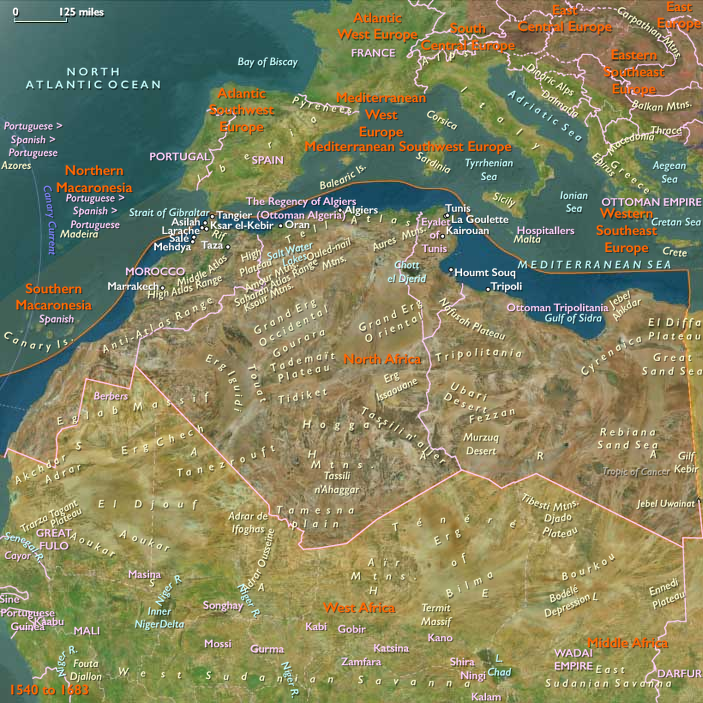
The subregion of North Africa includes Morocco (together with the Western Sahara), Algeria, Tunisia, and Libya.Anchors included the Atlas Mountains, the Tell plains, the Saharan oases and caravan routes, the Western Sahara desert corridor, and the Maghreb seaports of Algiers, Tunis, Tripoli, Marrakesh, and Meknes. By this period, Ottoman power extended across Algiers, Tunis, and Tripoli, while Morocco retained its independence under the Saadian dynasty, tied to Saharan trade.
Climate & Environmental Shifts
The Little Ice Age continued, producing cycles of drought and famine in the Maghreb and Western Sahara. Agricultural yields shrank in dry decades, leading to hunger and rural unrest. Oases and irrigated plains buffered some shocks, sustaining date groves and wheat. Coastal cities remained resilient, sustained by Mediterranean provisioning and piracy revenues.
Subsistence & Settlement
-
Morocco: The Saadian dynasty rose to prominence, with Marrakesh as its capital. Agriculture in the Central Valley and oases sustained cereal and sugar production. Control of Saharan caravans enriched the dynasty.
-
Algeria, Tunisia, and Libya: Ottoman regencies developed around Algiers, Tunis, and Tripoli. Agricultural hinterlands supplied wheat, olives, and livestock. Urban populations grew in fortified port cities that became bases for corsair fleets.
-
Western Sahara: Nomadic Maqil and Sanhaja tribes maintained camel herding and salt-gold-slave caravans. Morocco’s Saadians extended authority over Saharan trade routes, competing with local tribes and European smugglers.
Technology & Material Culture
Ottoman artillery and fortification technology reshaped coastal defenses. Corsair fleets deployed galleys and sailing ships armed with cannon. Urban guilds produced textiles, leather goods, ceramics, and manuscripts. In Morocco, monumental Saadian tombs and mosques in Marrakesh displayed ornate tilework and marble. Firearms, increasingly available through Mediterranean trade, altered warfare along the steppe and frontier.
Movement & Interaction Corridors
-
Ottoman regencies: Algiers (under Barbarossa and successors) became the hub of corsair fleets, raiding European coasts. Tunis and Tripoli followed suit, mixing piracy with trade.
-
Spanish enclaves: Spain maintained fortified ports such as Melilla, Oran, and Ceuta.
-
Morocco: The Saadians secured Saharan caravans and defeated Portugal at the Battle of Alcácer Quibir (1578), ensuring Moroccan independence.
-
Saharan caravans: Continued to bring gold, salt, and slaves northward, linking Western Sahara oases to Maghreb markets.
-
European maritime trade: France, England, and the Netherlands began to trade directly with Maghreb ports, bypassing Iberian monopolies.
Cultural & Symbolic Expressions
Islamic scholarship flourished in madrasas of Fez, Tunis, and Algiers. Sufi brotherhoods such as the Qadiriyya and Shadhiliyya grew in influence, spreading devotional practices across desert and steppe. Oral traditions celebrated corsair captains and saints, reinforcing popular Islam. The Saadian court in Marrakesh sponsored poetry, learning, and architecture. Christian symbols loomed in Spanish forts, while European captives in Algiers and Tunis contributed memoirs that shaped North Africa’s image abroad.
Environmental Adaptation & Resilience
Communities managed drought through irrigation, terrace cultivation, and reliance on caravan trade. Nomads adjusted grazing circuits in the Sahara, while urban dwellers relied on waqf endowments and Sufi lodges for famine relief. Corsairing supplemented economies when crops failed, sustaining urban populations through maritime predation.
Transition
By 1683 CE, North Africa had been divided into distinct powers: Ottoman regencies at Algiers, Tunis, and Tripoli; an independent Moroccan kingdom under the Saadians (soon to be replaced by the Alaouites); and Spanish strongholds along the coast. The Western Sahara remained under Moroccan suzerainty but functionally tribal and caravan-dominated. The region was a nexus of Saharan trade, Ottoman power, and European naval rivalry—poised for further contest as Atlantic empires expanded.
People
Groups
- Arab people
- Berber people (also called Amazigh people or Imazighen, "free men", singular Amazigh)
- Tuaregs, or Touareg, people
- Jews
- Sanhaja (Berber tribal confederacy)
- Kutama
- Maghrawa (Zenata Berber tribe)
- Miknasa (Zenata Berber tribe)
- Masmuda (Berber tribal confederacy)
- Islam
- Muslims, Sunni
- Muslims, Kharijite
- Muslims, Shi'a
- Zenata (Berber tribal confederacy)
- Sufism
- Muslims, Ibadi
- Sijilmassa, Berber state of
- Barghawata Confederacy (Masmuda Berber tribal confederacy)
- Christians, Roman Catholic
- Zayyanid dynasty
- Tlemcen, Kingdom of
- Marinid Dynasty (Sultanate of Morocco)
- Egypt and Syria, Mamluk Burji Sultanate of
- Portugal, Avizan (Joannine) Kingdom of
- Morocco, Wattasid Sultanate of
- Moriscos
- Spain, Habsburg Kingdom of
- Ottoman Algeria
- Morocco, Sa'di Sharifate of
- Spain, Habsburg Kingdom of
- Alawi dynasty
- Morocco, 'Alawi (Filali) Sultanate of
Topics
Commodoties
Subjects
Regions

Subregions
Years: 1540 - 1683
People
Groups
- Arab people
- Berber people (also called Amazigh people or Imazighen, "free men", singular Amazigh)
- Tuaregs, or Touareg, people
- Jews
- Sanhaja (Berber tribal confederacy)
- Kutama
- Maghrawa (Zenata Berber tribe)
- Miknasa (Zenata Berber tribe)
- Masmuda (Berber tribal confederacy)
- Islam
- Muslims, Sunni
- Muslims, Kharijite
- Muslims, Shi'a
- Zenata (Berber tribal confederacy)
- Sufism
- Muslims, Ibadi
- Sijilmassa, Berber state of
- Barghawata Confederacy (Masmuda Berber tribal confederacy)
- Christians, Roman Catholic
- Zayyanid dynasty
- Tlemcen, Kingdom of
- Marinid Dynasty (Sultanate of Morocco)
- Egypt and Syria, Mamluk Burji Sultanate of
- Portugal, Avizan (Joannine) Kingdom of
- Morocco, Wattasid Sultanate of
- Moriscos
- Spain, Habsburg Kingdom of
- Ottoman Algeria
- Morocco, Sa'di Sharifate of
- Spain, Habsburg Kingdom of
- Alawi dynasty
- Morocco, 'Alawi (Filali) Sultanate of
Topics
Commodoties
Subjects
Regions
Subregions