
North Africa (1396–1539 CE): Dynastic Fragmentation and …
Years: 1396 - 1539
North Africa (1396–1539 CE): Dynastic Fragmentation and Imperial Incursions
Geographic & Environmental Context
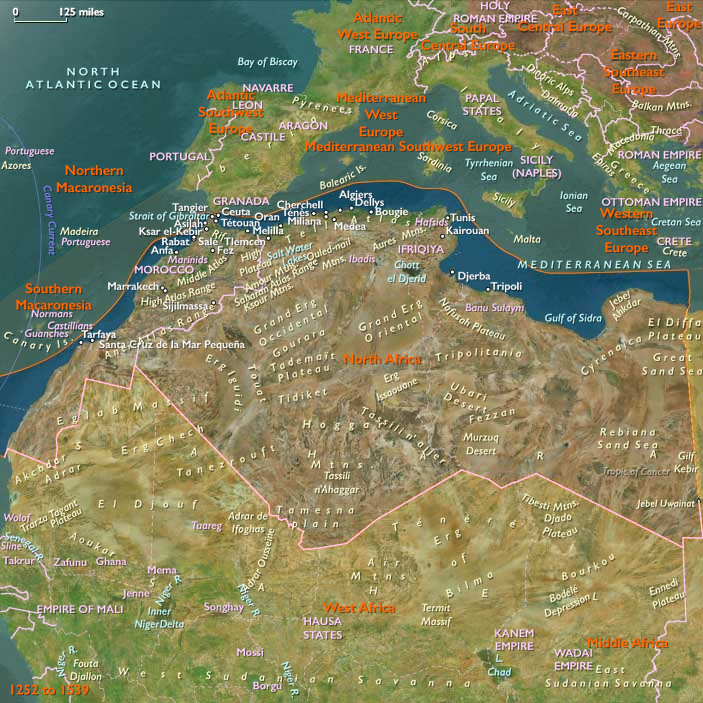
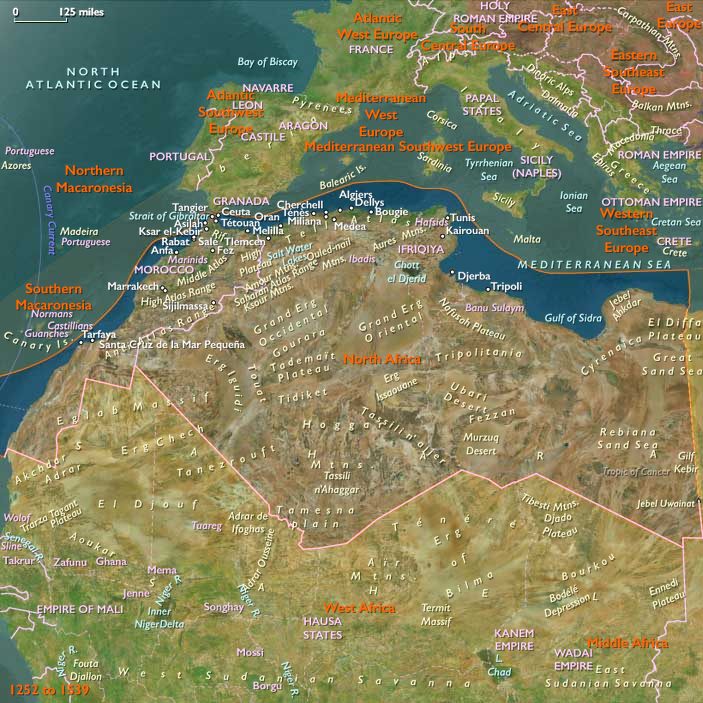
The subregion of North Africa includes Morocco (together with the Western Sahara), Algeria, Tunisia, and Libya. Anchors included the Atlas Mountains, the Tell plains, the Saharan oases and trade routes, the Western Sahara corridor linking to the Sahel, and the Maghreb seaports of Fez, Tlemcen, Tunis, Tripoli, and Ceuta. This was a region where desert, steppe, and sea converged: caravan roads from Timbuktu and Gao brought gold and slaves across the Sahara, while Mediterranean ports tied the Maghreb into the larger Islamic and Christian worlds.
Climate & Environmental Shifts
The Little Ice Age brought cooler winters and erratic rainfall. Drought cycles struck the Western Sahara and Maghreb steppe, tightening dependence on oases and irrigation. Locust invasions and periodic plague outbreaks compounded crises, shrinking urban populations. Yet fertile plains along the Tell and Atlas valleys sustained wheat, olives, and fruit production. Coastal fisheries provided further resilience.
Subsistence & Settlement
Agrarian villages cultivated cereals, olives, and figs, while nomadic herders managed sheep, goats, and camels across steppe and desert. Oases of the Western Sahara sustained date palms, cereals, and salt trade. Cities like Fez and Tunis thrived as centers of crafts, scholarship, and trade, while Tripoli and Algiers connected desert routes to Mediterranean shipping.
Technology & Material Culture
Workshops in Fez, Tunis, and Tlemcen produced fine textiles, ceramics, and leatherwork. Goldsmithing and manuscript illumination flourished in urban centers. Zawiyas (Sufi lodges) served as nodes of education, manuscript copying, and devotion. Camel caravans remained the backbone of Saharan commerce, though firearms began to trickle into the region via European trade, altering the dynamics of warfare.
Movement & Interaction Corridors
-
Western Sahara caravans: Carried salt, gold, and slaves from West Africa northward, exchanging for horses, textiles, and metal goods.
-
Mediterranean seaports: Linked Maghreb cities with Italy, Iberia, and the Ottoman Levant.
-
Portuguese expansion: Ceuta fell to Portugal in 1415; Tangier, Asilah, and other coastal strongholds soon followed, embedding Iberian enclaves along the Atlantic littoral.
-
Spanish expansion: After 1492, Spain joined in the seizure of Melilla (1497) and Oran (1509).
-
Ottoman interest: Algiers increasingly leaned toward Ottoman protection against Spain, foreshadowing Ottoman conquest.
Cultural & Symbolic Expressions
Madrasas in Fez and Tunis trained scholars in Islamic law and sciences, while Sufi brotherhoods expanded across steppe and desert, binding rural populations into ritual networks. Oral epics of tribal champions and saints’ legends circulated widely. Decorative tiles, stucco, and calligraphy adorned mosques and palaces. Christian forts along the coast embodied rival European claims.
Environmental Adaptation & Resilience
Nomadic tribes shifted grazing routes in response to drought. Farmers rotated cereals and legumes, relying on irrigation and terrace cultivation in mountain valleys. Caravan merchants diversified routes to avoid conflict and secured oasis rights through diplomacy or tribute. Waqf endowments and Sufi zawiyas supported the needy in times of famine.
Transition
By 1539 CE, North Africa was politically fragmented but geopolitically pivotal. The Wattasid dynasty in Morocco struggled to defend Atlantic ports against Portugal. The Hafsids in Tunis and Tripoli balanced diplomacy and piracy. The Ottomans, through corsair captains like Barbarossa (Hayreddin Pasha), were entering the scene, soon to secure Algiers. Spain and Portugal pressed inland from fortified ports, foreshadowing centuries of contest between European powers, Ottoman regencies, and Indigenous dynasties across the Maghreb and Sahara.
People
- Abu Al-Hasan 'Ali ibn 'Othman
- Abu Yusuf Yaqub ibn Abd al-Haqq
- Hayreddin Barbarossa
- Henry the Navigator
- Ibn Battuta
- Ibn Khaldūn
- Muhammad I al-Mustansir
Groups
- Arab people
- Berber people (also called Amazigh people or Imazighen, "free men", singular Amazigh)
- Tuaregs, or Touareg, people
- Jews
- Sanhaja (Berber tribal confederacy)
- Kutama
- Maghrawa (Zenata Berber tribe)
- Miknasa (Zenata Berber tribe)
- Masmuda (Berber tribal confederacy)
- Islam
- Muslims, Sunni
- Muslims, Kharijite
- Muslims, Shi'a
- Zenata (Berber tribal confederacy)
- Muslims, Ibadi
- Sijilmassa, Berber state of
- Barghawata Confederacy (Masmuda Berber tribal confederacy)
- Abbasid Caliphate (Baghdad)
- Christians, Roman Catholic
- Aragón, Kingdom of
- Almohad Caliphate
- Venice, (Most Serene) Republic of
- Aragon, Crown of
- Ifriqiya, Hafsid (Banu Hafs) (first) Caliphate of
- Castile, Crown of
- Zayyanid dynasty
- Tlemcen, Kingdom of
- Marinid Dynasty (Sultanate of Morocco)
- Sicily, Aragonese Kingdom of
- Ottoman Empire
- Egypt and Syria, Mamluk Burji Sultanate of
- Portugal, Avizan (Joannine) Kingdom of
- Ottoman Empire
- Ottoman Empire
- Morocco, Wattasid Sultanate of
- Spain, Habsburg Kingdom of
- Ottoman Algeria
Topics
Commodoties
Subjects
Regions
Subregions
Years: 1396 - 1539
People
- Abu Al-Hasan 'Ali ibn 'Othman
- Abu Yusuf Yaqub ibn Abd al-Haqq
- Hayreddin Barbarossa
- Henry the Navigator
- Ibn Battuta
- Ibn Khaldūn
- Muhammad I al-Mustansir
Groups
- Arab people
- Berber people (also called Amazigh people or Imazighen, "free men", singular Amazigh)
- Tuaregs, or Touareg, people
- Jews
- Sanhaja (Berber tribal confederacy)
- Kutama
- Maghrawa (Zenata Berber tribe)
- Miknasa (Zenata Berber tribe)
- Masmuda (Berber tribal confederacy)
- Islam
- Muslims, Sunni
- Muslims, Kharijite
- Muslims, Shi'a
- Zenata (Berber tribal confederacy)
- Muslims, Ibadi
- Sijilmassa, Berber state of
- Barghawata Confederacy (Masmuda Berber tribal confederacy)
- Abbasid Caliphate (Baghdad)
- Christians, Roman Catholic
- Aragón, Kingdom of
- Almohad Caliphate
- Venice, (Most Serene) Republic of
- Aragon, Crown of
- Ifriqiya, Hafsid (Banu Hafs) (first) Caliphate of
- Castile, Crown of
- Zayyanid dynasty
- Tlemcen, Kingdom of
- Marinid Dynasty (Sultanate of Morocco)
- Sicily, Aragonese Kingdom of
- Ottoman Empire
- Egypt and Syria, Mamluk Burji Sultanate of
- Portugal, Avizan (Joannine) Kingdom of
- Ottoman Empire
- Ottoman Empire
- Morocco, Wattasid Sultanate of
- Spain, Habsburg Kingdom of
- Ottoman Algeria
Topics
Commodoties
Subjects
Regions
Subregions