
Norsemen had first begun raiding in what …
Years: 1036 - 1036
Norsemen had first begun raiding in what became Normandy in the late eighth century.
Permanent Scandinavian settlement occurred before 911, when Rollo, one of the Viking leaders, reached an agreement with King Charles the Simple of France, who surrenders to him the county of Rouen.
The lands around Rouen had thus become the core of the later duchy of Normandy.
Normandy may have been used as a base when Scandinavian attacks on England were renewed at the end of the tenth century, which would have worsened relations between England and Normandy.
In an effort to improve matters, King Æthelred the Unready took Emma of Normandy, sister of Duke Richard II, as his second wife in 1002.
Danish raids on England continued, and Æthelred had sought help from Richard, taking refuge in Normandy in 1013 when King Swein I of Denmark drove Æthelred and his family from England.
Swein's death in 1014 had allowed Æthelred to return home, but Swein's son Cnut had contested Æthelred's return.
Æthelred died unexpectedly in 1016, and Cnut became king of England.
Æthelred and Emma's two sons, Edward and Alfred, had gone into exile in Normandy while their mother, Emma, became Cnut's second wife.
After Cnut's death in 1035, the English throne had fallen to Harold Harefoot, his son by his first wife, while Harthacnut, his son by Emma, had become king in Denmark.
England remains unstable.
Alfred returns to England in 1036 to visit his mother and perhaps to challenge Harold as king.
One story implicates Earl Godwin of Wessex in Alfred's subsequent death, but others blame Harold.
The father of Godwin was probably Wulfnoth Cild, who was a thegn of Sussex.
His origin is unknown but 'Cild' normally refers to a man of rank.
In 1009, Wulfnoth had been accused of unknown crimes at a muster of Æthelred the Unready's fleet and fled with twenty ships; the ships sent to pursue him were destroyed in a storm.
Godwin was probably an adherent of Æthelred's eldest son, Æthelstan, who left him an estate when he died in 1014.
This estate in Compton, Sussex, had once belonged to Godwin’s father.
Although he is now always thought of as connected with Wessex, Godwin had probably been raised in Sussex, not Wessex and was probably a native of Sussex.
After Cnut seized the throne in 1016, Godwin's rise was rapid.
By 1018 he was an earl, probably of eastern Wessex, and then by around 1020 of all Wessex.
Between 1019 and 1023 he accompanied Cnut on an expedition to Denmark, where he distinguished himself, and shortly afterwards married Gytha, the sister of the Danish earl, Ulf, who was married to Cnut's sister, Estrid.
A the death of Cnut on November 12, 1035,his kingdoms had been divided among three rival rulers.
Harold Harefoot, Cnut's illegitimate son with Ælfgifu of Northampton, had seized the throne of England.
Harthacnut, Cnut's legitimate son with Emma of Normandy, reigns in Denmark.
Norway had rebelled under Magnus the Good.
The throne of England was reportedly claimed in 1035 by Alfred Ætheling, younger son of Emma of Normandy and Æthelred the Unready, and half-brother of Harthacnut.
Alfred had landed on the coast of Sussex with a Norman mercenary body guard and attempted to make his way to London.
Godwin is reported to have either captured Alfred himself or to have deceived him by pretending to be his ally and then surrendering him to the forces of Harold Harefoot.
Either way, Alfred was blinded and soon dies at Ely, probably on February 5, 1036.
During the 1920s, the remains of several hundred soldiers, probably Normans, were found to the west of Guildford.
They were bound and had been executed.
The grave has been dated to about 1040.
It is believed to be likely that they were the guards of Prince Alfred.
Locations
People
- Alfred Ætheling
- Edward the Confessor
- Emma of Normandy
- Godwin of Wessex
- Harold Harefoot
- Harthacnut
- Magnus the Good
- William the Conqueror
Groups
- Anglo-Saxons
- Denmark, Kingdom of
- Danes (Scandinavians)
- Normandy, Duchy of
- Normans
- England, (Danish) Kingdom of
- Norway, independent Kingdom of
- England, (Anglo-Saxon) Kingdom of
Commodoties
Subjects
Regions
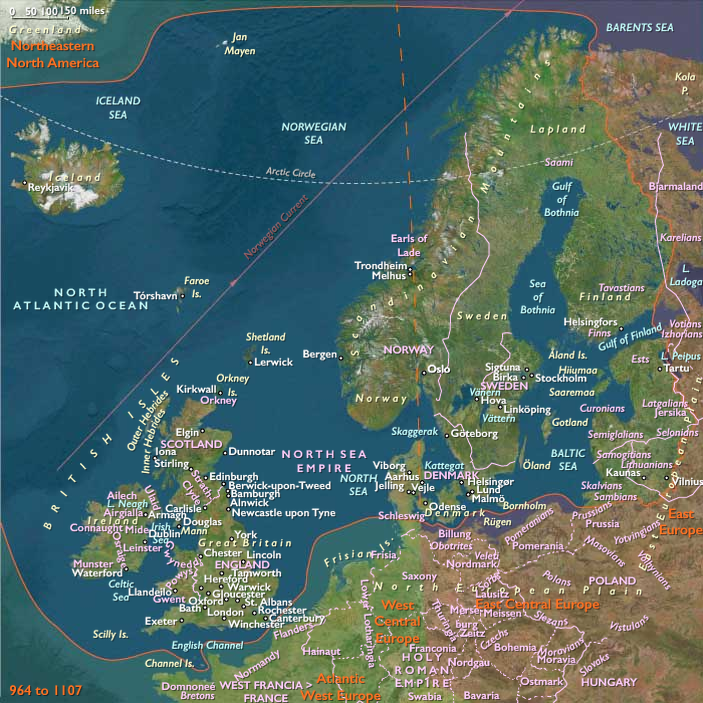
Subregions
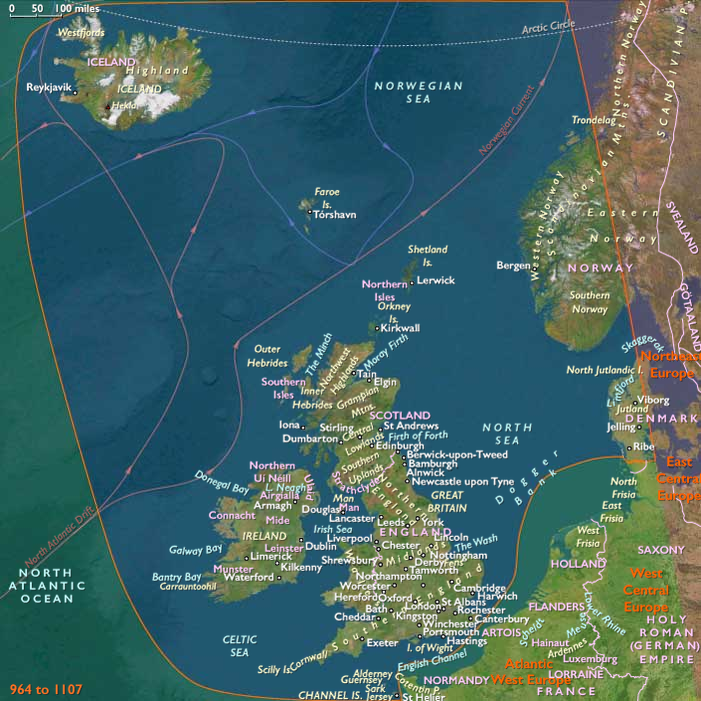
Related Events
Showing 10 events out of 51469 total
Years: 1036 - 1036
Locations
People
- Alfred Ætheling
- Edward the Confessor
- Emma of Normandy
- Godwin of Wessex
- Harold Harefoot
- Harthacnut
- Magnus the Good
- William the Conqueror
Groups
- Anglo-Saxons
- Denmark, Kingdom of
- Danes (Scandinavians)
- Normandy, Duchy of
- Normans
- England, (Danish) Kingdom of
- Norway, independent Kingdom of
- England, (Anglo-Saxon) Kingdom of
Commodoties
Subjects
Regions
Subregions