Nomads overrun the independent Greek kingdom of …
Years: 128BCE - 128BCE
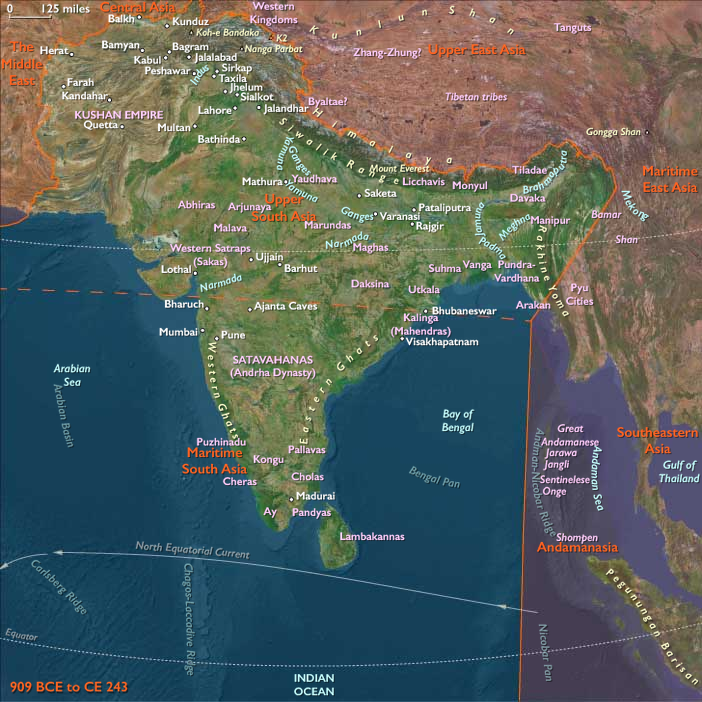
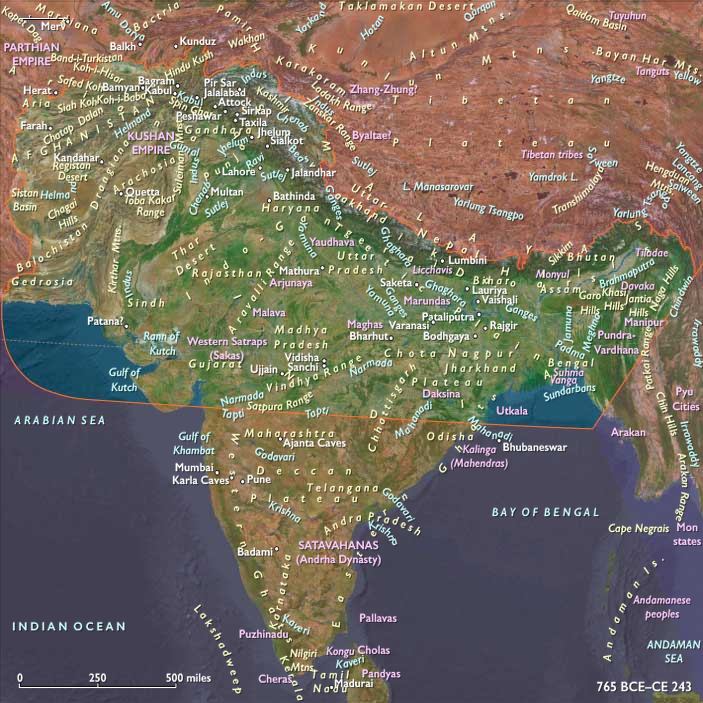
Nomads overrun the independent Greek kingdom of Bactria in 128 BCE.
Locations
Groups
Topics
Commodoties
Subjects
Regions
Subregions
Related Events
Filter results
Showing 10 events out of 63004 total
Phraates, weakened in his struggle against Antiochus, had called upon the powerful Saka nomads to the north of his frontiers for aid, promising them payment.
The reinforcements having arrived too late to be of use, he sends them back, which provokes them to revolt and pillage the countryside.
The Greek prisoners drafted by Phraates into his army participate in the pillage, and Phraates loses his life fighting them in 128 in a great battle inside and around Media.
His uncle succeeds him as Artabanus I.
The reign of Menander I over the Indo-Greek kingdom long and successful.
Generous findings of coins testify to the prosperity and extension of his empire (with finds as far as Britain): the finds of his coins are the most numerous and the most widespread of all the Indo-Greek kings.
Precise dates of his reign, as well as his origin, remain elusive however.
Guesses among historians have been that Menander was either a nephew or a former general of the Greco-Bactrian king Demetrius I, but the two kings are now thought to be separated by at least thirty years.
Menander's predecessor in Punjab seems to have been the king Apollodotus I. Menander's empire will survive him in a fragmented manner until the last Greek king Strato II disappears around 10 CE.
The first-second century CE Periplus of the Erythraean Sea further testifies to the reign of Menander and the influence of the Indo-Greeks in India: "To the present day ancient drachmae are current in Barygaza, coming from this country, bearing inscriptions in Greek letters, and the devices of those who reigned after Alexander, Apollodorus [sic] and Menander."
—Periplus Chap.
47.
Menander is the first Indo-Greek ruler to introduce the representation of Athena Alkidemos ("Athena, savior of the people") on his coins, probably in reference to a similar statue of Athena Alkidemos in Pella, capital of Macedon.
This type will subsequently be used by most of the later Indo-Greek kings.
The Samaritans are outside the pale of Judaism in most, though not all, respects: like the Sadducees, they refuse to recognize the validity of the Oral Law.
Like the later so-called Qumran covenanters, the monastic group with whom are associated the Dead Sea Scrolls, the Samaritans are opposed to the Jewish priesthood and the cult of the Temple, regard Moses as a messianic figure, and forbid the revelation of esoteric doctrines to outsiders.
The break between the Sadducees and the Samaritans occurs during the conquest of Shechem by John Hyrcanus in 128, when Jewish forces destroy the temple built by the Samaritans on Mount Gerizim (built in the first place because the Jews had refused to let them participate in building the Second Temple in Jerusalem).
Manius Aquillius, on his return to Rome from Pergamon, is accused by one Publius Lentulus of maladministration in his province, Asia, but is acquitted by bribing the judges.
He obtains a triumph on account of his successes in Asia, but it will not be held until 126 BCE.
The Seleucid kingdom is now but a shadow of its former glory, and Demetrius has a hard time ruling even in Syria.
Recollections of his cruelties and vices—along with his humiliating defeat—cause him to be greatly detested.
Cleopatra Thea's mother, Cleopatra II of Egypt, in rebellion since the winter of 132/131 BCE against her brother Ptolemy VIII, flees in 127 to her son-in-law’s court in Syria.
The Egyptian queen sets up an army for Demetrius, hoping to engage him in her civil wars against her brother, but this only adds to his grief.
The troops soon desert, and Ptolemy reacts by setting up yet another usurper, a man named Alexander II Zabinas, against Demetrius.
Zabinas, a false Seleucid who claims to be an adoptive son of Antiochus VII Sidetes, seems to have been the son of an Egyptian merchant named Protarchus.
Antioch, …
…Apamea, and several other cities, disgusted with the tyranny of Demetrius, acknowledges the authority of Alexander.
The name "Zabinas" means "the purchased slave", and is applied to him, deprecatingly, in response to a report that he had been bought by Ptolemy as a slave.
For reasons unknown, Alexander II is the only late Seleucid not to use epithets on his coins.
Several of his coins are extant.
The Seleucid kingdom, prevented from retaking the Parthian lands it once controlled, begins to rapidly disintegrate.
The defeat of Antiochus has finally ended Seleucid dominion over the countries east of the Euphrates River, and marks the beginning of small principalities in both the north and south of Mesopotamia.
In Mesene (also called Characene, Persian Meshan), a Seleucid satrap with an Iranian name, Hyspaosines (also called Aspasine, or Spasines, who reigns from 127 BCE to about 121 BCE, refortifies Antiochia, a town originally founded by Alexander the Great near the junction of the Eulaeus (Karun) and Tigris rivers, and calls it Spasinou Charax (“Fort of Spasines”).
Zabinas at a battle in Damascus in 126 BCE manages to defeat Demetrius II, who flees to Ptolemais but his wife Cleopatra Thea closes the gates against him.
He is killed on a ship near Tyre, after his wife deserts him.
His miserable death, after being captured and possibly tortured, is a fitting epitaph to the many shortcomings of his reign.
Demetrius II was certainly incapable of handling the developing threats to the Seleucid empire, but his reputation for cruelty was probably undeserved.
He was only around fourteen at his coronation, and the real power was in the hands of others.
He is succeeded by his queen Cleopatra Thea and then by two of their sons, Seleucus V Philometor and Antiochus VIII Grypus.
The Yuezhi are visited by a Chinese mission, led by Zhang Qian in 126 BCE, that is seeking an offensive alliance with the Yuezhi to counter the Xiongnu threat to the north.
Although the request for an alliance is denied by the son of the slain Yuezhi king, who prefers to maintain peace in Transoxiana rather than to seek revenge, Zhang Qian makes a detailed account, reported in the Shiji, that gives considerable insight into the situation in Central Asia at this time.
Zhang Qian, who spends a year with the Yuezhi and in Bactria, relates that "the Great Yuezhi live two thousand or three thousand li (832-1,247 kilometers) west of Dayuan (Ferghana), north of the Gui (Oxus) river.
They are bordered on the south by Daxia (Bactria), on the west by Anxi (Parthia), and on the north by Kangju (beyond the middle Jaxartes).
They are a nation of nomads, moving from place to place with their herds, and their customs are like those of the Xiongnu.
They have some 100,000 or 200,000 archer warriors."
Although the Yuezhi had remained north of the Oxus for a while, they have apparently obtained the submission of the Greco-Bactrian kingdom to the south of the Oxus.
The Yuezhi are organized into five major tribes, each led by a yabgu, or tribal chief, and known to the Chinese as Xiūmì in Western Wakhān and Zibak, Guishuang in Badakhshan and the adjoining territories north of the Oxus, Shuangmi in the region of Shughnan, Xidun in the region of Balkh, and Dūmì in the region of Termez.

Poured concrete has become the Romans’ basic building material by 126 BCE, when the Aqua Tepula aqueduct is constructed by censors G. Servilius Caepio and L. Cassius Longinus.
Pipes made of stone, clay, lead, or wood channel the water underground, and many of these employ the siphon principle used in modern conduits.
The aqueduct’s source is at the Alban hills, running only a mere 18 kilometers to Rome.
The water from the Aqua Tepula, as implied in the name, is tepid and lukewarm, and thus is, as Frontinus states, not fit for human consumption.