No Spanish or Portuguese soldiers have arrived …
Years: 1622 - 1622
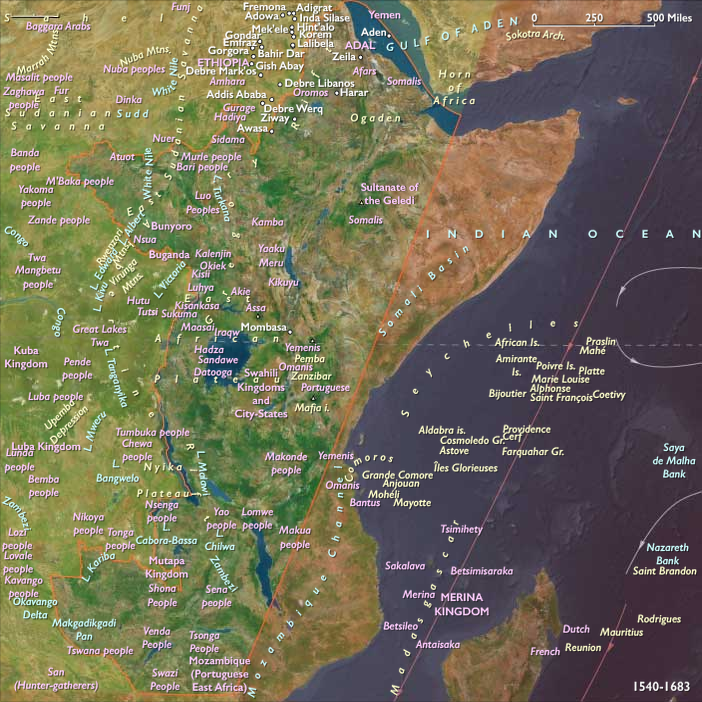
No Spanish or Portuguese soldiers have arrived in Ethiopia, despite several letters from Susenyos to the King of Spain (and Portugal), Philip III, asking for military help.
Even so, Susenyos at last converts to Catholicism in 1622 in a public ceremony, and separates himself from all of his wives and concubines except for his first wife.
The tolerant and sensitive Pedro Paez dies soon afterwards.
Locations
People
Groups
- Christians, Roman Catholic
- Ethiopia, Solomonid Dynasty of
- Jesuits, or Order of the Society of Jesus
- Spain, Habsburg Kingdom of
- Portugal, Habsburg (Philippine) Kingdom of
Topics
Regions
Subregions
Related Events
Filter results
Showing 10 events out of 32975 total
The East India Company in 1622 closes their unprofitable Pattani and Ayutthaya factories.
Songtham sends his brother Uparaja Si Sin to invade Cambodia again in 1622 and fails once more.
Also in 1622, ...
...King Anaukpetlun of Pegu removes Tavoy from Ayuttayan control.
The English East India Company has also begun to take what is to be a long-running interest in Iran: in 1622 four of its ships help Shah Abbas retake Hormuz from the Portuguese.
The Portuguese had held the Castle of Ormuz for more than a century, since 1507 when Afonso de Albuquerque had established it in the Capture of Ormuz (1507), giving them full control of the trade between India and Europe through the Persian Gulf and entirely changed the balance of power and trade.
The English side consists of a force supplied by the English East India Company consisting of five warships and four pinnaces.
The Persians had recently gone to war with the Portuguese, and a Persian army is besieging the Portuguese fort in Kishm, but English help is needed to capture Ormuz.
Abbas wishes to obtain English support against the Portuguese, and the commander Imam Kuli Khan, son of Allahverdi Khan, has negotiated with the English to obtain their support, promising the development of silk trade in their favor.
An agreement is signed, providing for the sharing of spoils and customs dues at Hormuz, the repatriations of prisoners according to their faith, and the payment by the Persians of half of the supply costs for the fleet.
The English fleet had gone to Kishm, some 15 miles away, to bombard the Portuguese position.
The Portuguese quickly surrenders, and the English casualties are few, but include the famous explorer William Baffin.
The Anglo-Persian fleet then sails to Ormuz and the Persians disembark to capture the town.
The English bombard the castle and sink the Portuguese fleet, and on April 22, 1622, Ormuz is finally captured.
The Portuguese have to retreat to another base at Maskat.
The Portuguese Empire had earlier taken the city of Gamrūn, known as Gombroon to English traders and Gamrun to Dutch merchants), a port city on the southern coast of Iran, and transliterated the name to Comorão.
Comorão is taken by the forces of ‘Abbās after a naval battle with the Portuguese in 1622 and renamed Bandar-e ‘Abbās, or "Port of ‘Abbās".
Although the mainland port never became as successful a trading center as Ormus, Bandar 'Abbas, today the capital and also largest city of the province of Hormozgān, occupies a strategic position on the narrow Straits of Hormuz, and is the location of the main base of the Iranian Navy.
Iran has been traditionally allied with Mughal India against the Uzbeks, who covet the province of Khorasan.
The Mughal emperor Humayun had given Abbas’ grandfather, Shah Tahmasp, the province of Kandahar as a reward for helping him back to his throne.
Humayun’s successor Akbar, profiting from the confusion in Iran, had in 1590 seized Kandahar.
Abbas has continued to maintain cordial relations with the Mughals, while always asking for the return of Kandahar.
A diplomatic incident in 1620, in which the Iranian ambassador had refused to bow down in front of the Emperor Jahangir, finally leads to war.
India is embroiled in civil turmoil and Abbas finds he only needs a lightning raid to take back Kandahar in 1622.
After the conquest, he is very conciliatory to Jahangir, claiming he has only taken back what is rightly his and disavowing any further territorial ambitions.
Jahangir is not appeased but he is unable to recapture the province.
Guercino, born at Cento, a village between Bologna and Ferrara, was by the age of seventeen associated with Benedetto Gennari, a painter of the Bolognese School.
He had moved by 1615 to Bologna, where his work had earned the praise of an elder Ludovico Carracci.
For Cardinal Serra, Papal Legate to Ferrara, he had painted two large canvases, Elijah Fed by Ravens and Samson Seized by Philistines, in what appears to be a stark naturalist Caravaggesque style (although it is unlikely he had been able to see any of the Roman Caravaggios firsthand).
The Arcadian Shepherds (Et in Arcadia ego) had been painted in 1618 contemporary with The Flaying of Marsyas by Apollo in the Palazzo Pitti.
His first style, he will often claim, had been influenced by a canvas of Carracci in Cento.
Esteemed very highly in his lifetime, some of Guercino's later pieces approach more closely the manner of his great contemporary Guido Reni, and are painted with more lightness and clearness.
Recommended by Marchese Enzo Bentivoglio to Gregory XV, the Bolognese Ludovisi Pope, Guercino spends two very productive years in Rome from 621 to 1623.
From this stay date his frescoes of Aurora at the casino of the Villa Ludovisi and the ceiling in San Crisogono (1622) of San Chrysogonus in Glory; his portrait of Pope Gregory (now in the Getty Museum, and, what is considered his masterpiece, The Burial of Saint Petronilla or St. Petronilla Altarpiece, for the Vatican (now in the Museo Capitolini).
Guercino, remarkable for the extreme rapidity of his execution, completes no fewer than one hundred and six large altar-pieces for churches, and his other paintings amount to about 144.
He begins his frescoes in the Duomo of Piacenza in 1526.
Caravaggio's influence is manifest in Guercino’s canvas of Semiramis hearing of the insurrection at Babylon.
Dirck van Baburen, also known as Teodoer van Baburen and Theodor Baburen, was probably born in Wijk bij Duurstede, but his family moved to Utrecht when he was still young.
The earliest reference to the artist is in the 1611 records of Utrecht's Guild of St. Luke as a pupil of Paulus Moreelse.
He traveled sometime between 1612 and 1615 to Rome, where he collaborated with fellow countryman David de Haen and befriended the close follower of Caravaggio, Bartolomeo Manfredi.
Baburen had also come to the attention of the art collectors and patrons Vincenzo Giustiniani and cardinal Scipione Borghese, and possibly under their influence received the commission to paint the altarpiece of the Entombment for the chapel of the Pietà in San Pietro in Montorio around 1617.
Baburen was one of the earliest artists to belong to the group of Dutch-speaking artists active in Rome in the seventeenth-century known as the "Bentvueghels" ("Birds of a Feather"); his nickname is "Biervlieg" ("Beer Fly", or one who drinks a lot).
Baburen in late 1620 had returned to Utrecht, where he began painting genre scenes.
The painter, along with Hendrick ter Brugghen and Gerard van Honthorst, has helped establish the stylistic and thematic innovations now known as the Utrecht School of Caravaggisti.
Dirck van Baburen's career is short—he dies in 1624—and only a few of his paintings are known today.
He mostly painted religious subjects in Rome, including the San Pietro in Montorio Entombment that is indebted to Caravaggio's version of the same subject in the Vatican Museums.
Baburen also painted a Capture of Christ (Borghese Gallery) for Scipione Borghese and Christ Washing the Feet of the Apostles (Gemäldegalerie, Berlin) for Vincenzo Giustiniani.
Baburen is among the first artists to popularize genre subjects such as musicians and cardplayers.
One of his best-known works is The Procuress (Museum of Fine Arts, Boston).
It depicts a man offering a coin for the services of a lute-playing prostitute while an old woman, the lady's procuress, inspects his money.
This painting (or a copy) was owned by Johannes Vermeer's mother-in-law and appears in two of that artist's works, The Concert (stolen from the Isabella Stewart Gardner Museum, Boston) and Woman Seated at a Virginal (National Gallery, London).

Years: 1622 - 1622
Locations
People
Groups
- Christians, Roman Catholic
- Ethiopia, Solomonid Dynasty of
- Jesuits, or Order of the Society of Jesus
- Spain, Habsburg Kingdom of
- Portugal, Habsburg (Philippine) Kingdom of