
Nikephoros Phokas, a son of Bardas Phokas, …
Years: 955 - 955
Nikephoros Phokas, a son of Bardas Phokas, an important imperial general in Anatolia, on the borders of the empire, had quickly embraced a military career of arms and as a young patrician had distinguished himself at his father's side in a war against the Hamdanid Arabs in the East.
In 954-955, Constantine names him commander in chief of the armies of the East, replacing his aged father.
Nikephoros proceeds to restructure the army to reinforce discipline and improve recruiting.
At this point, he probably writes the treatises on military tactics that are attributed to him, although proof is lacking.
Locations
People
Groups
- Christianity, Chalcedonian
- Islam
- Roman Empire, Eastern: Macedonian dynasty
- Hamdanid Dynasty
- Aleppo, Hamdanid Emirate of
Topics
Commodoties
Subjects
Regions
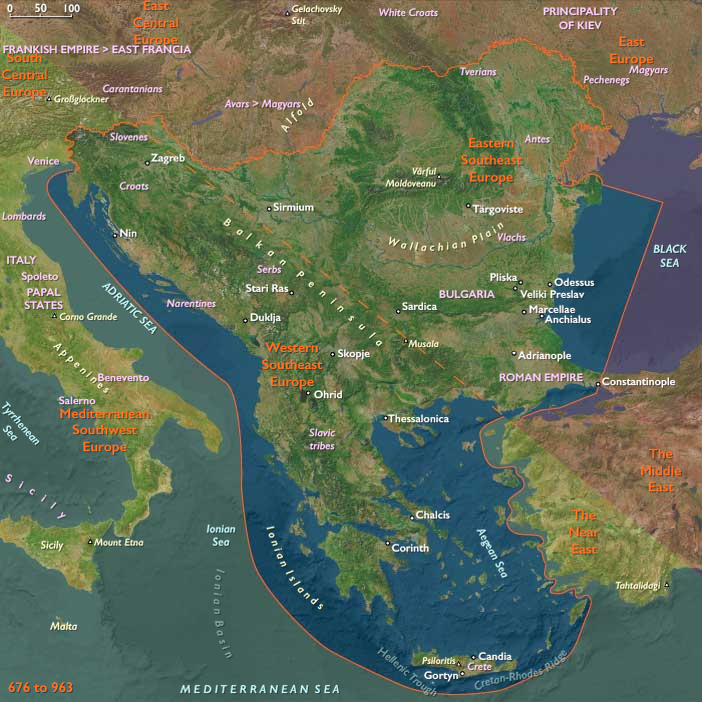
Subregions
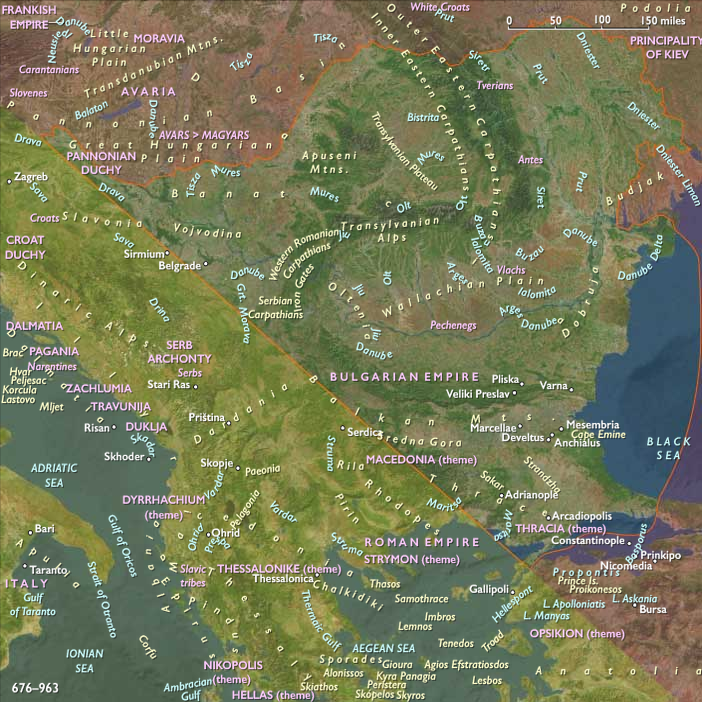
Related Events
Filter results
Showing 10 events out of 52873 total
The Hamdanid Emir of Aleppo, Sayf al-Dawla, is to be Constantinople’s most persistent opponent on their eastern frontier in the period from 945 to 967, by virtue of his control over most of the borderlands between the Christains and the Muslims (the al-thughūr) and his commitment to jihad.
Sayf al-Dawla had already campaigned against the Empire in 938 and 940, but it is after his establishment of a large domain centered on Aleppo in 945, that he had begun confronting them on an annual basis.
Despite the numerical advantages enjoyed by the imperial forces, the Hamdanid's emergence had blunted an imperial offensive that had been unfolding since the mid-920s and had already resulted in the fall of Malatya (934), Arsamosata (940), and Qaliqala (in 949).
His main enemy during the first decade of continuous conflict with the Empire had been the Domestic of the Schools (commander-in-chief) Bardas Phokas.
After a few initial failures, Sayf al-Dawla had quickly established his supremacy, heavily defeating Bardas near Marash in 953.
Expeditions led by Bardas in the next two years had also been defeated, allowing Sayf al-Dawla to refortify his frontier zone and strengthen it against further imperial attacks.
Using his light cavalry to evade the more slow-moving imperial troops, Sayf al-Dawla is also able to launch destructive raids deep into imperial territory; however, his raids avoid fortified positions, and he cannot challenge effective imperial control over their recent conquests.
After 955, however, the situation had begun to change: the ineffective Bardas Phokas had been dismissed and replaced by his more capable son, Nikephoros, under whose supervision the Byzantine army's equipment has been upgraded, its ranks filled with Armenians, and its training intensified.
The new imperial leadership, which includes Nikephoros's brother Leo and his nephew John Tzimiskes, has resolved on a forward strategy and has begun raiding deep into Hamdanid territory.
Al-Mutanabbi had joined the court of Abu al-Misk Kafur after parting ways with Saif al Dawla, but Kafur had dismissed Al-Mutanabbi's intentions, claiming them to be a threat to his position.
Realizing that his hopes of becoming a statesman will not materialize, Al-Mutanabbi keaves Egypt in about 960, afterward heavily criticizes Abu al-Misk Kafur with satirical odes.
Following the death of Pope Agapetus II in November 955, Octavianus, who is the Cardinal deacon of the deaconry of Santa Maria in Domnica, is elected his successor on December 16, 955.
His adoption of the apostolic name of John XII is the third example of a pontiff taking a regnal name upon elevation to the papal chair, the first being John II (533–535) and the second John III (561–574).
Right from the start, in relation to secular issues, the new pope issues his directives under the name of Octavianus, while in all matters relating to the Church, he issues papal bulls and other material under his pontifical name of John.
Lothair and Hugh the Great’s Failed Siege of Poitiers (955) and the Rout of William III of Aquitaine
By 955, King Lothair of West Francia, still a young ruler, seeks to assert his authority over his magnates. One of his greatest concerns is William III of Aquitaine, whose power in the south threatens royal influence. To curb William’s strength, Lothair joins forces with Hugh the Great, Duke of the Franks, and together they lay siege to Poitiers in August 955.
The Siege of Poitiers (955)
- Poitiers, the heart of William III’s power, is a well-defended stronghold.
- Lothair and Hugh launch a siege, but the city’s defenders hold out successfully, refusing to surrender.
- The siege does not achieve the desired outcome, as Poitiers remains firmly in Aquitanian hands.
The Battle and William III’s Defeat
- After the failed siege, William III gathers his forces and offers battle against Lothair and Hugh.
- In open combat, William’s forces are routed, suffering a decisive defeat.
- This setback weakens his position in Aquitaine, but he still retains control over much of his domain, as Poitiers remains unconquered.
Consequences of the 955 Campaign
-
Royal Authority Remains Weak in Aquitaine
- Despite winning the battle, Lothair and Hugh fail to subdue Poitiers, meaning William III continues to rule Aquitaine independently.
-
Hugh the Great’s Continued Dominance
- Hugh, already the most powerful noble in France, further strengthens his influence by helping to lead the campaign against William.
- His role in the battle underscores his power as the true enforcer of royal authority in the kingdom.
-
Lothair’s Struggle for Control
- Though he participates in the victory, Lothair remains reliant on Hugh, highlighting his limited authority as king.
- His inability to secure Aquitaine further proves the monarchy’s weakness in the feudalized realm of West Francia.
Conclusion: A Partial Victory, but No Lasting Gains
While Lothair and Hugh defeat William III in battle, their failure to capture Poitiers means that Aquitaine remains outside direct royal control. This event highlights the continued fragmentation of West Francia, as the great magnates continue to operate with near-total independence, leaving Lothair as a nominal king with little direct authority.
The Rise of Hugh Capet and the Fragmented Kingdom of the Franks (941–956)
Born in 941, Hugh Capet was the son of Hugh the Great, Duke of the Franks, and Hedwige of Saxony, daughter of Henry the Fowler, King of East Francia. His paternal family, the Robertians, were powerful landowners in the Île-de-France, and his lineage was deeply tied to both the Carolingians and the Ottonian rulers of the Holy Roman Empire.
Hugh Capet’s Royal and Noble Connections
- Grandson of King Robert I of West Francia.
- Great-great-great-great-grandson of Charlemagne, descended from Pepin of Italy through his grandmother Beatrice of Vermandois.
- Grandnephew of King Odo of West Francia.
- Related to the Ottonian emperors, being first cousin to Otto II of Germany.
- Son of Hugh the Great, the most powerful noble in West Francia, though he never took the crown.
Hugh the Great’s Role in the Return of Louis IV (936)
- When King Rudolph (Raoul) of Burgundy died in 936, Hugh the Great orchestrated the return of Louis IV ("d’Outremer"), son of the deposed Charles the Simple, from exile in England.
- Motives remain unclear, but possible reasons include:
- Preventing Rudolph’s brother, Hugh the Black, from claiming the throne.
- Blocking Herbert II of Vermandois or Richard the Fearless, Duke of Normandy, from taking power.
- Though he restored the Carolingian dynasty, Hugh the Great ensured his own dominance, keeping Louis IV as a weak, dependent king.
Hugh Capet Inherits Power (956)
- Hugh the Great dies in 956, leaving his vast estates to his young son, Hugh Capet.
- At the time, Hugh Capet is still a minor, so his mother, Hedwige of Saxony, acts as his guardian.
- Despite his father’s immense influence, Hugh immediately faces challenges from ambitious neighbors.
Loss of Land to Former Vassals
- Theobald I of Blois, a former vassal of Hugh the Great, seizes Chartres and Châteaudun, weakening Hugh’s control in the Loire Valley.
- Fulk II of Anjou, another former client of Hugh the Great, carves out a principality at Hugh’s expense, gaining control over key territories along the Breton border.
The Fragmentation of West Francia
Hugh Capet grows up in a much-reduced West Frankish kingdom, which looks nothing like modern France:
- The king is known as Rex Francorum ("King of the Franks"), not "King of France," a title that will only emerge under Philip II Augustus (1180–1223).
- West Francia is a weak and fragmented realm, with the king controlling only a small portion of the former Carolingian Empire.
- The Holy Roman Empire, ruled by Hugh’s first cousin Otto II and later Otto III, dominates the eastern Frankish lands.
- South of the Loire, the king’s influence is nearly nonexistent, as local rulers act independently.
- Normandy and Burgundy are virtually autonomous, with Hugh’s brothers Otto and Henry ruling Burgundy from 956.
- Brittany is entirely independent, resisting West Frankish authority.
Conclusion: The Future King of a Feudal Kingdom
As Hugh Capet comes of age, he inherits a divided and decentralized realm, where noble power surpasses royal authority. His eventual rise to the throne in 987 will mark the end of Carolingian rule and the beginning of the Capetian dynasty, setting the foundation for the Kingdom of France. However, for now, he remains a young duke in a fractured kingdom, struggling to reclaim lost lands and secure his position.
Eadred suffers towards the end of his life from a digestive malady that will prove fatal.
'Author B', the biographer and former apprentice of St Dunstan, describes with vivid memory how the king sucked out the juices of his food, chewed on what was left and spat it out.
Eadred dies on November 123 (St. Clement's Day), 955, at Frome (Somerset), and is buried in the Old Minster at Winchester.
He dies a bachelor, and is succeeded by his late brother Edmund's son Eadwig.
According to one legend, Eadwig’s feud with Dunstan began on the day of Eadwig's consecration, when he failed to attend a meeting of nobles.
When Dunstan eventually found the young monarch, he was cavorting with a noblewoman named Æthelgifu and refused to return with the bishop.
Infuriated by this, Dunstan dragged Eadwig back and forced him to renounce the girl as a "strumpet".
Later realizing that he had provoked the king, Dunstan fled to the apparent sanctuary of his cloister, but Eadwig, incited by Æthelgifu, followed him and plundered the monastery.
Though Dunstan managed to escape, he refused to return to England until after Eadwig's death.
The contemporary record of the Anglo-Saxon Chronicle reports Eadwig's accession and Dunstan fleeing England - but does not explain why Dunstan fled.
Thus this report of a feud between Eadwig and Dunstan could either have been based on a true incident of a political quarrel for power between a young king and powerful church officials who wished to control the king and who later spread this legend to blacken his reputation, or it could be an urban legend; the Chronicle also tells of Odo of Canterbury putting aside the King's marriage on the grounds Eadwig and his wife were "too related".
The account of the quarrel with Dunstan and Cynesige, bishop of Lichfield, at the coronation feast is recorded in the Anglo-Saxon Chronicle and in the later chronicle of John of Worcester and was written by monks supportive of Dunstan's position.
The "cavorting" in question consists of Eadwig (at this time only sixteen) being away from the feast with Ælfgifu and her mother Æthelgifu.
He will later marry Ælfgifu, who seems to have been the sister of Æthelweard the Chronicler.
The Magyars, returning from their devastating sweep through France and northeastern Italy, cross the Carnatic Alps to the valleys of the Drava and Danube Rivers.
They remain in their homeland long enough to assemble a force of some fifty thousand warriors, then invade Bavaria.
Otto, after having put down a rebellion by his son, Liudolf, Duke of Swabia and son-in-law, Conrad, Duke of Lorraine, sets out to Saxony, his duchy.
Upon arriving in Magdeburg, he receives reports of the Hungarian invasion.
The Hungarians had already invaded once before during the course of the rebellion, immediately after he had put down a revolt in Franconia.
Because of unrest among the Polabian Slavs on the lower Elbe, Otto has had to leave most of his Saxons at home.
In addition, Saxony is distant from Augsburg and its environs, and considerable time would have elapsed waiting for their arrival.
(The Battle of Lechfeld takes place six weeks after the first report of an invasion, and historian Hans Delbrück asserts that they could not have possibly made the march in time.)
The king orders his troops to concentrate on the Danube, in the vicinity of Neuburg and Ingolstadt.
He does this in order to march on the Hungarian line of communications and catch them in their rear while they are raiding northeast of Augsburg.
It is also a central point of concentration for all the contingents that are assembling.
Strategically, therefore, this is the best location for Otto to concentrate his forces before making the final descent upon the Hungarians.
There are other troops that are to have an influence on the course of the battle.
On previous occasions, in 932 and 954 for example, there had been Hungarian incursions that had invaded the Germanic lands to the south of the Danube, and then retreated back to their native country via Lotharingia, to the West Frankish Kingdom and finally, through Italy.
That is to say, a wide sweeping U-turn that initially started westward, then progressed to the south, and then finally to the east back to their homeland; and thus escaping retribution in Germany.
The king is aware of the escape of these Hungarians on the above mentioned occasions, and is determined to trap them.
He therefore orders his brother, Archbishop Bruno, to keep the Lotharingian forces in Lorraine.
He has done this with the fear that the Hungarians will follow their plan of retreat on the previous occasions.
However, with a powerful enough force of knights pressing them in the front from the west, and a powerful force of knights chasing them from the East, the Hungarians will be unable to escape.
The Bishop Ulrich defends Augsburg, a border city of Swabia, with a contingent of soldiers.
Motivating them with the 23rd Psalm ("Yea, though I walk through the valley of the shadow of death").
While this defense is going on, the king was raising an army to march south.
There is no reliable source on the size of the armies and the numbers are still disputed.
The most accepted view is that Otto called up about eight thousand men.
The eight one-thousand-strong legiones (divisions) include three from Bavaria, two from Swabia, one from Franconia and one from Bohemia, under Prince Boleslav I.
The eighth division, commanded by Otto and slightly larger than the others, includes Saxons, Thuringians, and the king's personal guard.
The king's contingent probably includes seasoned knights of Frankish origin.
According to chronicles, the Hungarian army amounted to about seventeen thousand light cavalry.
Gerhard writes that the Hungarian forces advanced to the Iller river and placed Augsburg under siege.
At this time, Augsburg is not quite touching the left bank of the river, upon which it is basically situated.
The fort is defended by Bishop Ulrich.
Most probably the fiercest battle took place on August 8 at the eastern gate, when the Hungarians tried to storm the fort in large numbers.
The bishop's men defended bravely and killed the leader of the attack, forcing the Hungarians to withdraw.
The next day the Hungarians launched a wider general attack.
During the battle, Berchtold of Risinesburg arrives, which heralds the approach of the German army.
At the end of the day, the siege is suspended, and the Hungarians prepared for the next day's battle.
Count Dietpald leads soldiers to Otto's camp during the night.
The order of march of the German army against the Magyars is as follows: the three Bavarian contingents, the Frankish contingent under Duke Konrad, the royal unit (the center), the two contingents of Swabians and the Bohemian contingent.
The Bavarians are placed at the head of column, according to Delbrück, because they were marching through Bavarian territory and they therefore knew the territory best.
All of these are mounted.
According to the chronicler Widukind of Corvey, Otto "pitched his camp in the territory of the city of Augsburg and joined there the forces of Henry I, Duke of Bavaria, who was himself lying mortally ill nearby, and by Duke Conrad with a large following of Franconian knights. Conrad's unexpected arrival encouraged the warriors so much that they wished to attack the enemy immediately."
The arrival of Conrad, the exiled duke of Lotharingia (Lorraine) and Otto's son-in-law, is particularly heartening because he had recently thrown in his lot with the Magyars, but now returns to fight under Otto; in the ensuing battle, he will lose his life.
A legion of Swabians is commanded by Burchard III, Duke of Swabia, who had married Hedwig, the daughter of Henry, the brother of Otto.
Also among those fighting under Otto is Boleslav of Bohemia.
The Hungarians cross the river and immediately attack the Bohemians, then later the Swabian legions, but retreat after a short fight.
As Otto receives word of the attack, he orders Conrad to recover the baggage train, which Conrad succeeds in doing before returning to the main forces.
For Otto, it becomes evident that this is the time to attack the Hungarians, and he does not hesitate.
Despite a volley of arrows from the Hungarians, Otto's army smashes into the Hungarian line, and begins to sweep over it.
The Germans are able to fight hand-to-hand with the Hungarians, giving the traditionally nomadic warriors no room to use their favorite shoot-and-run tactics.
Bulcsú feigns a retreat with part of his force, in an attempt to lure Otto's men into breaking their line in pursuit, but to no avail.
The German line maintains formation and routs the Magyars from the field.
Years: 955 - 955
Locations
People
Groups
- Christianity, Chalcedonian
- Islam
- Roman Empire, Eastern: Macedonian dynasty
- Hamdanid Dynasty
- Aleppo, Hamdanid Emirate of
