
Nicolas Rolin and the Hôtel-Dieu of Beaune …
Years: 1443 - 1443
Nicolas Rolin and the Hôtel-Dieu of Beaune (1443)
In 1443, Nicolas Rolin, Chancellor to Philip the Good, Duke of Burgundy, founded the renowned Hôtel-Dieu (Hospices de Beaune), in the Burgundian city of Beaune. Rolin, a powerful statesman and patron of the arts, commissioned this hospital as an act of pious philanthropy, intending it to provide care for the sick and needy.
Architecturally, the Hôtel-Dieu of Beaune (as it later became famously known) stands as one of the most celebrated examples of Burgundian-Flemish Flamboyant Gothic style, reflecting the wealth and artistic innovation characteristic of Burgundian territories during the mid-15th century. The hospital complex is defined by distinctive timber-frame buildings arranged around a spacious central courtyard. Its steeply pitched roofs, covered with vividly colored glazed tiles, feature numerous decorative dormer windows surmounted by elaborately sculpted gables, exemplifying the elegance and flamboyance typical of Burgundian architecture in this period.
Rolin’s hospital not only demonstrated his personal devotion and status but also provided lasting evidence of the artistic fusion between Burgundian and Flemish influences. The complex’s architectural beauty and practical functionality made it a significant cultural landmark, representing both charitable generosity and architectural innovation in mid-15th-century Atlantic West Europe.
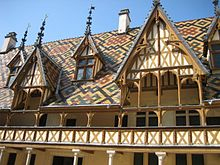
Polychrome roof of the Hospices de Beaune. (Photo 19:46, 3 May 2006 by Nguyenld)
Locations
People
Groups
Topics
Subjects
Regions
Subregions
Related Events
Showing 10 events out of 41764 total
Years: 1443 - 1443
Polychrome roof of the Hospices de Beaune. (Photo 19:46, 3 May 2006 by Nguyenld)
Locations
People
Groups
Topics
Subjects
Regions
Subregions