
Nicias, his health worsening, asks to be …
Years: 413BCE - 413BCE
Nicias, his health worsening, asks to be relieved of his command, but instead reinforcements under the energetic Demosthenes arrive early in 413.
Failing in a night attack on the high ground overlooking the city, Demosthenes favors the immediate withdrawal of the Athenian army, but an eclipse of the Moon occurs on Aug. 27, 413, and the superstitious Nicias accepts his soothsayers' advice to delay setting out.
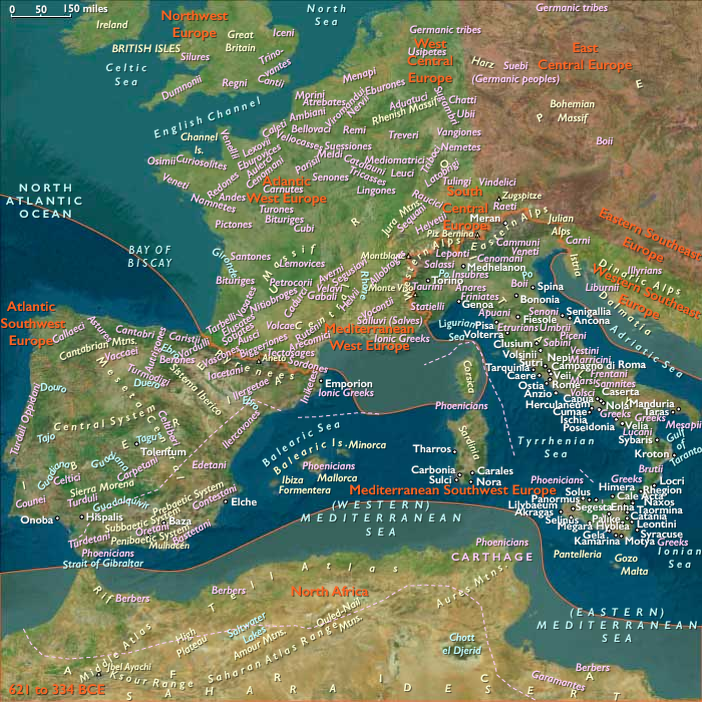
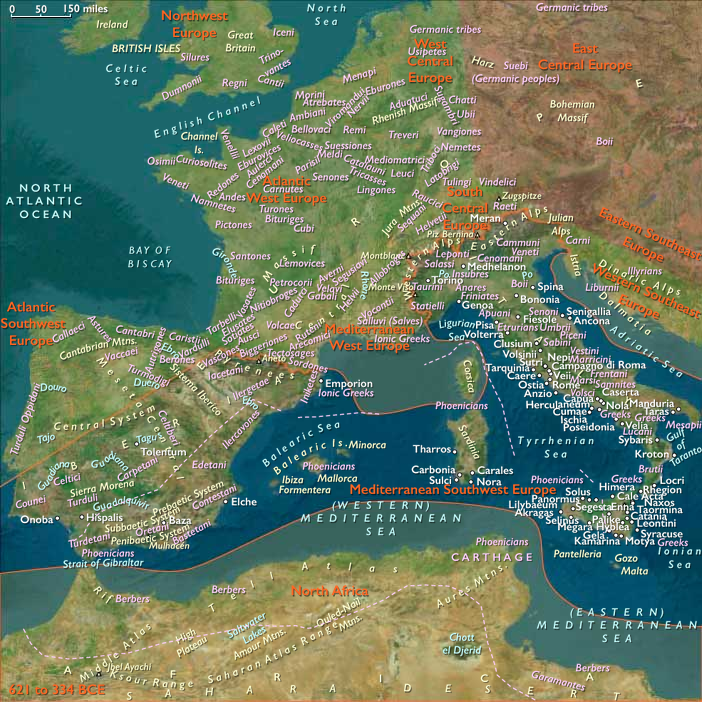
The final catastrophic sea battle in the Great Harbor of Syracuse is fought in cramped circumstances that do not allow the Athenian fleet enough freedom of maneuver: a Spartan-Corinthian-Syracusan navy destroys the Athenian fleet, enabling the Syracusans to crush Nicias' forces.
When the retreat finally begins, the division under Demosthenes falls behind and is forced to surrender.
The expeditionary force is virtually annihilated, including its main commanders.
Gylippus seeks to spare Nicias and Demosthenes, but is overruled.
The Syracusans execute both commanders and enslave the surviving Athenians, who have lost, in addition to their leaders, two hundred and forty ships and over forty thousand men.
Locations
People
Groups
- Ionians
- Dorians
- Greece, classical
- Sicily, classical
- Italy, classical
- Carthage, Kingdom of
- Magna Graecia
- Syracuse, Corinthian city-state of
- Etruria
- Peloponnesian League (Spartan Alliance)
- Athenian Empire (Delian League)
Topics
- Iron Age Europe
- Greek colonization
- Iron Age Cold Epoch
- Classical antiquity
- Peloponnesian War, Second or Great
- Sicilian Expedition
- Decelean War, or Ionian War
Commodoties
Subjects
Regions
Subregions
Years: 413BCE - 413BCE
Locations
People
Groups
- Ionians
- Dorians
- Greece, classical
- Sicily, classical
- Italy, classical
- Carthage, Kingdom of
- Magna Graecia
- Syracuse, Corinthian city-state of
- Etruria
- Peloponnesian League (Spartan Alliance)
- Athenian Empire (Delian League)
Topics
- Iron Age Europe
- Greek colonization
- Iron Age Cold Epoch
- Classical antiquity
- Peloponnesian War, Second or Great
- Sicilian Expedition
- Decelean War, or Ionian War
Commodoties
Subjects
Regions
Subregions