
Nicéphore Niépce reveals the existence of his …
Years: 1825 - 1825
June
Nicéphore Niépce reveals the existence of his invention, "heliography", where an image can be reproduced on to a pewter plate and then reprinted, in a package sent to Louis Daguerre on June 4, 1827.
In 1829, the two will begin a partnership, and Daguerre will perfect Niépce's photographic process to reproduce images more quickly.
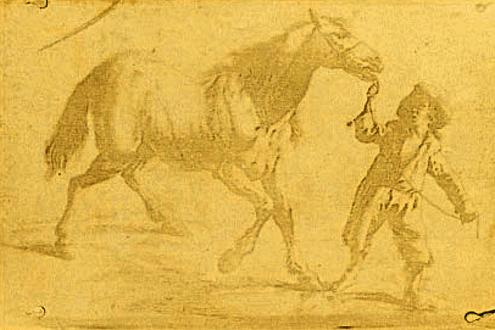
One of the two earliest known pieces of seminal photographic activity, made by Nicéphore Niépce in 1825 by the heliograph process. It was printed from a metal plate covered with a ground that was etched following exposure to sunlight. Niépes's print captures the image of a 17th-century Flemish engraving of a man leading a horse. (Bibliothèque nationale de France)
Locations
People
Groups
Topics
Subjects
Regions
Subregions
Related Events
Filter results
Showing 10 events out of 20063 total
Until the establishment of Fort Vancouver, the Hudson's Bay Company's largest westward fort was Fort William in present day Ontario, which the company had gained through its merger with the North West Company.
From its establishment, Fort Vancouver is the regional headquarters of the Hudson's Bay Company's fur trade operations in the Columbia District.
The territory it oversees stretched from the Rocky Mountains in the East to the Pacific Ocean in the West, and from Sitka, Alaska in the North to San Francisco in the South.
Fur trappers bring pelts collected during the winter to the fort to be traded in exchange for company credit.
The credit, issued by the company clerks, can be used to purchase goods in the fort's trade shops.
Furs from throughout the Columbia District are brought to Fort Vancouver from smaller Hudson's Bay Company outposts either overland, or by water via the Columbia River.
Once they are sorted and inventoried by the Company's clerks, the furs are hung out to dry in the fur storehouse, a large two story post on sill type building located within the walls of the fort.
After the furs are processed, they are mixed, weighed into two hundred and seventy pound- (one hundred and twenty kilogram) bundles, and packed with tobacco leaves as an insecticide.
The bundle of furs is then placed in a large press and wrapped in elk or bear hide to create overseas fur bales.
The large bales are then placed on boats on the Columbia River for shipment to London via the Hudson's Bay Company trade routes.
The furs are ultimately auctioned off to textile manufacturers in London.
A large demand comes from hatters who produce popular beaver felted hats.
Hongi avenges the earlier defeat of Moremonui in the battle of Te Ika-a-Ranganui in 1825, although both sides suffer heavy losses.
Hongi Hika attacks Ngāti Whātua again in 1824–25, losing seventy men, including his eldest son Hare Hongi, in the battle of Te Ika a Ranganui.
According to some accounts, Ngāti Whātua lost one thousand men—although Hongi Hika himself, downplaying the tragedy, put the number at one hundred.
In any event, the defeat is a catastrophe for Ngāti Whātua—the survivors retreat south, leaving behind the fertile region of Tāmaki Makaurau (the Auckland isthmus) with its vast natural harbors at Waitemata and Manukau—land which had belonged to Ngāti Whātua since they won it by conquest over a hundred years before.
Hongi Hika leaves Tāmaki Makaurau almost uninhabited as a southern buffer zone.
Fifteen years later, when Lieutenant Governor William Hobson wishes to remove his fledgling colonial administration from settler and Ngāpuhi influence in the Bay of Islands, he will be able to purchase this land cheaply from Ngāti Whātua, to build Auckland, a settlement that has become New Zealand’s principal city.
Although the Māori population has always been, to some extent, mobile in the face of conquests of land, during the Musket Wars, Hongi Hika alters the balance of power not only in the Waitemata but also the Bay of Plenty, Tauranga, Coromandel, Rotorua and Waikato to an extent which seems unprecedented within the memory of his contemporaries.
Although he does not usually occupy conquered territory, his campaigns and those of other musket warriors trigger a series of migrations, claims and counter claims which in the late twentieth century will add to the disputes over land sales in the Waitangi Tribunal—not least Ngāti Whātua's occupation of Bastion Point.
Norfolk Island has lain abandoned from February 15, 1814 to June 6, 1825.
In 1824, however, the British government had instructed the Governor of New South Wales, Thomas Brisbane, to occupy Norfolk Island as a place to send “the worst description of convicts”.
Its remoteness, previously seen as a disadvantage, is now viewed as an asset for the detention of recalcitrant male prisoners.
The convicts detained have long been assumed be a hardcore of recidivists, or 'doubly-convicted capital respites'—that is, men transported to Australia who have committed fresh colonial crimes for which they have been sentenced to death, and are spared the gallows on condition of life at Norfolk Island.
However, a recent study has demonstrated, utilizing a database of six thousand four hundred and fifty-eight Norfolk Island convicts, that the reality was somewhat different: more than half were detained at Norfolk Island without ever receiving a colonial conviction, and only fifteen percent had been reprieved from a death sentence.
Furthermore, the overwhelming majority of convicts sent to Norfolk Island had committed nonviolent property sentences, the average length of detention was three years, and the scale of punishments inflicted upon the prisoners was significantly less than assumed.
The Redcliffe settlement is abandoned after a year, and the colony is moved to a site on the Brisbane River now known as North Quay, twenty-eight kilometers (seventeen miles) south, which offers a more reliable water supply.
The newly selected region is plagued by mosquitoes.
Sir Thomas Brisbane had visited the settlement and traveled forty-five kilometers (twenty-eight miles) up the Brisbane River in December 1824, bestowing upon Brisbane the distinction of being the only Australian capital city set foot upon by its namesake.
Chief Justice Forbes had given the new settlement the name of Edenglassie before it was named Brisbane.
French vessels entering Vietnamese harbors are ordered to be searched with extra care.
All entries are to be watched.
Minh Mạng had continued and intensified his father's isolationist and conservative Confucian policies.
His father had rebuffed a British delegation in 1804 proposing that Vietnam be opened to trade.
The delegation's gifts are not accepted and turned away.
Vietnam is under no threat of colonization, since most of Europe is engaged in the Napoleonic Wars.
Nevertheless, Napoleon had seen Vietnam as a strategically important objective in the colonial power struggle in Asia, as he felt that it would make an ideal base from which to contest the British East India Company's control of the Indian subcontinent.
With the restoration of the monarchy and the final departure of Napoleon in 1815, the military scene in Europe quieted and French interest in Vietnam was revived.
Jean-Baptiste Chaigneau, one of the volunteers of Pigneau de Behaine who had helped Gia Long in his quest for power, had become a mandarin and continued to serve Minh Mạng, upon whose ascension, Chaigneau and his colleagues were treated more distantly.
He eventually left in November 1824.
In 1825, he is appointed as French consul to Vietnam after returning to his homeland to visit his family after more than a quarter of a century in Asia.
Upon his return, Minh Mạng receives him coldly.
The policy of isolationism will soon see Vietnam fall further behind and become more vulnerable as political stability returns to continental Europe, allowing her colonial powers a free hand to once again direct their attention towards further conquests.
Minh Mạng was willing to sign a contract, but only to purchase artillery, firearms, uniforms and books.
White was of the opinion that the deal was not sufficiently advantageous and nothing was implemented.
In 1821, a trade agreement from Louis XVIII was turned away, with Minh Mạng indicating that no special deal would be offered to any country.
That same year, British East India Company agent John Crawfurd made another English attempt at contact, but was only allowed to disembark in the northern ports of Tonkin; he gained no agreements, but concluded relations with France posed no threat to Company trade.
Her captain was to pay his respects to Minh Mạng, but was greeted with a symbolic dispatch of troops as though an invasion had been expected.
In 1824 Minh Mạng rejected the offer of an alliance from Burma against Siam, a common enemy of both countries.
In 1824 Henri Baron de Bougainville had been sent by Louis XVIII to Vietnam with the stated mission "of peace and protection of commerce.
Upon arriving in Tourane in 1825, the mission is not allowed ashore.
The royal message is turned away on the pretext that there is nobody able to translate it.
It is assumed that the snub is related to an attempt by Bougainville to smuggle ashore a Catholic missionary from the Missions étrangères de Paris.
Years: 1825 - 1825
June
One of the two earliest known pieces of seminal photographic activity, made by Nicéphore Niépce in 1825 by the heliograph process. It was printed from a metal plate covered with a ground that was etched following exposure to sunlight. Niépes's print captures the image of a 17th-century Flemish engraving of a man leading a horse. (Bibliothèque nationale de France)
