
Nicéphore Niépce had begun experimenting to set …
Years: 1825 - 1825
Nicéphore Niépce had begun experimenting to set optical images in 1793, resulting in an impermanent camera image in 1816, marking the birth of photography.
Some of his early experiments had made images, but they faded very fast.
Letters to his sister-in-law around 1816 indicate that he found a way to fix images on paper, but not prevent them from deterioration in light.
In 1818, Niépce had become interested in the ancestor of the bicycle, a Laufmaschine invented by Karl von Drais in 1817.
He had built himself a model and called it the vélocipède (fast foot) and caused quite a sensation on the local country roads.
Niépce improves his machine with an adjustable saddle (it is today exhibited at the Niépce Museum.
In a letter to his brother, Nicéphore contemplates motorizing his machine.
Niépce had taken what is believed to be the world’s first photogravure etching, in 1822, of an engraving of Pope Pius VII, but the original was later destroyed when he attempted to duplicate it.
The earliest surviving photogravure etchings by Niépce are of a 17th century engraving of a man with a horse and of an engraving of a woman with a spinning wheel.
Niépce does not have a steady enough hand to trace the inverted images created by the camera obscura, as is popular in his day, so he has sought a way to capture an image permanently.
He has experimented with lithography, which had led him in his attempt to take a photograph using a camera obscura.
Niépce has also experimented with silver chloride, which darkens when exposed to light, but eventually looked to bitumen, which he uses in his first successful attempt at capturing nature photographically.
He dissolves bitumen in lavender oil, a solvent often used in varnishes, and coats the sheet of pewter with this light-capturing mixture.
He places the sheet inside a camera obscura to capture the picture, and eight hours later removes it and washes it with lavender oil to remove the unexposed bitumen.
Niépce calls his process heliography, which literally means "sun writing".
Nevertheless, semiologist Roland Barthes, in a Spanish edition of his book "La chambre claire", "La cámara lúcida" (Paidós, Barcelona,1989) shows a picture from 1822, "Table ready", a foggy photo of a table set to be used for a meal.
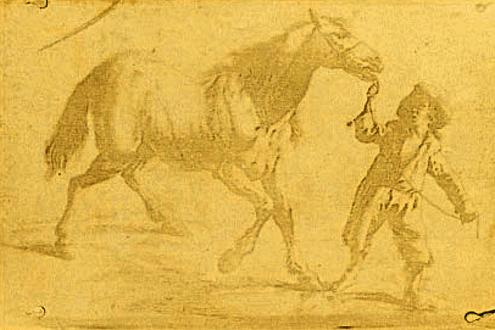
One of the two earliest known pieces of seminal photographic activity, made by Nicéphore Niépce in 1825 by the heliograph process. It was printed from a metal plate covered with a ground that was etched following exposure to sunlight. Niépes's print captures the image of a 17th-century Flemish engraving of a man leading a horse. (Bibliothèque nationale de France)
Locations
People
Groups
Commodoties
Subjects
Regions
Subregions
Related Events
Showing 10 events out of 20063 total
Years: 1825 - 1825
One of the two earliest known pieces of seminal photographic activity, made by Nicéphore Niépce in 1825 by the heliograph process. It was printed from a metal plate covered with a ground that was etched following exposure to sunlight. Niépes's print captures the image of a 17th-century Flemish engraving of a man leading a horse. (Bibliothèque nationale de France)
Locations
People
Groups
Commodoties
Subjects
Regions
Subregions