
News reaches the imperial court of a …
Years: 1087 - 1087
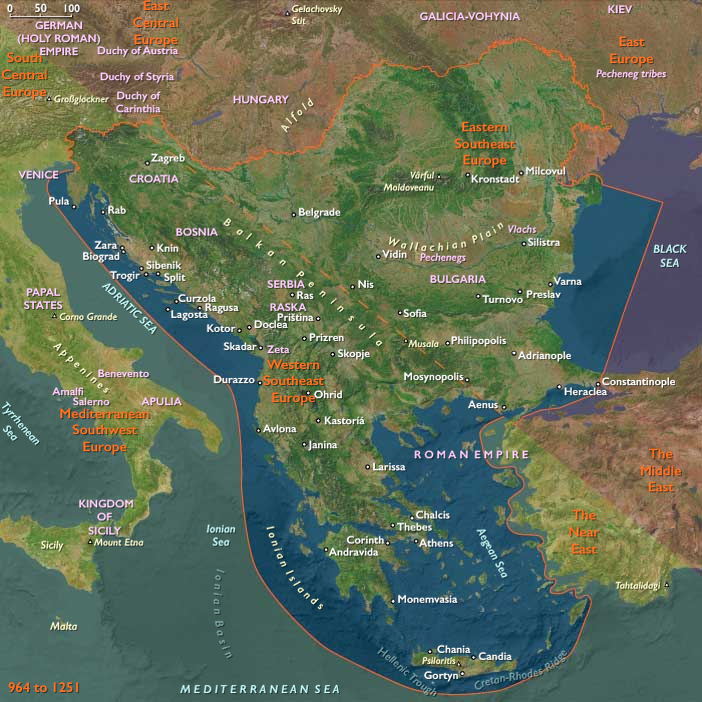
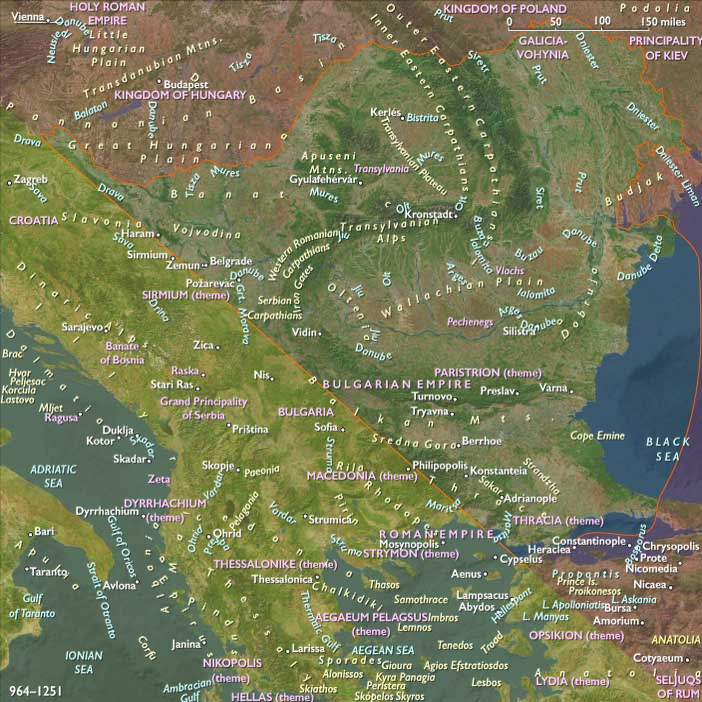
News reaches the imperial court of a huge invasion from the north in the spring of 1087.
The invaders are Pechenegs from the northwest Black Sea region; it is reported that they number eighty thousand men in all.
Displaced by the Cumans, the Pchenegs raid into Thrace, and Alexios crosses into Moesia to retaliate but fail to take Dorostolon (Silistra).
During his retreat, the emperor is surrounded and worn down by the Pechenegs, who force him to sign a truce and to pay protection money.
The former pretender Melissenos, commanding the imperial left wing, is taken captive along with many other soldiers, to be ransomed by the emperor after some time.
Locations
People
Groups
- Oghuz Turks
- Greeks, Medieval (Byzantines)
- Thrace, Theme of
- Pechenegs, or Patzinaks
- Turkmen people
- Paristrion (Paradounabon), Theme of
- Cuman people, or Western Kipchaks, also called Polovtsy, Polovtsians)
- Rum, Sultanate of
- Roman Empire, Eastern: Komnenos dynasty, restored
Topics
Commodoties
Subjects
Regions
Subregions
Related Events
Filter results
Showing 10 events out of 50402 total
Quanzhou during the Northern Song Dynasty is a bustling port of call visited by a plethora of different foreigners, from Muslim Arabs, Persians, Egyptians, Hindu Indians, Middle-Eastern Jews, Nestorian Christians from the Near East, etc.
Muslims from foreign nations dominate the import and export industry.
To regulate this enormous commercial center, the Northern Song government establishes an office in Quanzhou in 1087 for the sole purpose of handling maritime affairs and commercial transactions.
Fujiwara no Kiyohira, the son of Fujiwara no Tsunekiyo and a daughter of Abe no Yoritoki whose name is not known, was born somewhere in the Kitakami Basin in 1056.
His father was of the Hidesato branch of the Fujiwara clan, which is known for their fighting ability.
Even so, Tsunekiyo had been a mid-level bureaucrat at Fort Taga in present day Sendai, Miyagi Prefecture when he married his Emishi wife, left his position and went to live with his wife's family in present day Iwate Prefecture.
Thus, Kiyohira was born in an Emishi household in Emishi territory to a father who was considered a traitor by the Japanese authorities.
Much of Kiyohira’s early life had been spent spent in a community at war with the Japanese central authorities.
The Earlier Nine Years War (Zenkunen War) had been fought on and off from 1050 to 1062 while the Latter Three Years War (Gosannen War) had begun in 1083.
He had lost his grandfather, Abe no Yoritoki, in battle in 1057, his uncle Sadato in 1062 and all of his mother's brothers had been deported to Kyūshū in the same year.
His own father had been personally beheaded by Minamoto no Yoriyoshi with a blunt sword.
These events will shape his life and influence his decisions as long as he lives.
After he lost his father in the Earlier Nine Wars, his mother had become the concubine of his enemy, Kiyohara no Takehira, who had helped Minamoto no Yoriyoshi in the last war.
Kiyohira had been brought up in this enemy clan as Kiyohara no Kiyohira, with his elder stepbrother Sanehira and younger half-brother Iehira.
The Later Three Years War involves a struggle among the three brothers in this complex relationship.
Kiyohira has lost his wife and son during the war, killed by his half-brother Iehira.
Kiyohira wins the final victory in the war in 1087, with the aid of Minamoto no Yoshiie, the son of another of his old enemies, Minamoto no Yoriyoshi.
Yoshiie assembles a new army, reinforcing it with troops brought by his younger brother and the Fujiwara clan, and lays siege to the Kiyowara fortress at Kanazawa.
The defenders surrender after four months; the Kiyowara leaders are killed while attempting to escape from their burning stockade.
The conflict becomes known—misleadingly, as the actual periods of fighting spanned a mater of months—as the Later Three Years’ War.
Much of the war is depicted in an e-maki narrative handscroll, the Gosannen Kassen E-maki, which was created in 1171.
The artwork is owned today by the Watanabe Museum in Tottori city, Japan.
Inge, according to the Hervarar saga, returns from Västergötland after three winters to kill Blot-Sweyn and reclaim the throne in 1087.
A similar story also appears in the Orkneyinga saga, but in this account, Sweyn stays indoors and is burnt to death.
It is possible that Inge was not immediately accepted by the stubbornly pagan Swedes of Uppland.
The thirteenth-century historian Snorri Sturlusson wrote in the Heimskringla that Blót-Sweyn had a pagan successor who continued the sacrifices.
According to the Westrogothic law, Inge rules Sweden with virility and he never beaks the laws that have been accepted in the districts.
Some accounts credit Alexios with having put an end to the Paulician heresy.
During a stay at Philippopolis, Alexios had argued with the sect, bringing most, if not all, back to the Church (so his daughter: "Alexias", XV, 9).
For the converts, the new city of Alexiopolis, is built, opposite Philippopolis.
After this episode, Paulicians disappear from history as a major force, though as a powerless minority they will reappear in many later times and places.
Alexios has been rumored during this time to be the lover of Empress Maria of Alania, the daughter of King Bagrat IV of Georgia, who had been successively married to Michael VII Doukas and his successor Nikephoros III Botaneiates, and who is renowned for her beauty.
Alexios has arranged for Maria to stay on the palace grounds, and it was thought that he was considering marrying her.
However, his mother consolidates the Doukas family connection by arranging the Emperor's marriage to Irene Doukaina, granddaughter of the Caesar John Doukas, the uncle of Michael VII, who would not have supported Alexios otherwise.
As a measure intended to keep the support of the Doukai, Alexios has restored Constantine Doukas, the young son of Michael VII and Maria, as co-emperor and a little later had betrothed him to his own first-born daughter Anna, who moved into the Mangana Palace with her fiancé and his mother.
This situation changes drastically, however, when Alexios' first son John II Komnenos is born in 1087: Anna's engagement to Constantine is dissolved, and she is moved to the main Palace to live with her mother and grandmother.
Alexios becomes estranged from Maria, who is stripped of her imperial title and retired to a monastery, and Constantine Doukas is deprived of his status as co-emperor.
Nevertheless, he remains in good relations with the imperial family and succumbs to his weak constitution soon afterwards.
A struggle for power had commenced between King Solomon and his cousins (sons of the late Béla I) during the 1070s.
The King's forces had been decisively defeated by his cousins and their allies, the Dukes of Poland and Bohemia at the Battle of Mogyoród on March 14, 1074.
Solomon’s wife, Judith of Swabia, had fled to Germany while Solomon continues his fight for the Hungarian throne; in 1077, he had accepted the rule of his cousin King László I, who gave him in exchange extensive landholdings after his formal abdication in 1081.
Despite this, Solomon had never given up his pretensions and began to plot against King László I; however, his plans had been discovered and he was imprisoned by the King in the Tower of Visegrád until August 15, 1083, when on the occasion of the canonization of István I, the first King of Hungary, Solomon had been released.
Judith had meanwhile remained in Germany and settled in her residence in Regensburg (with short breaks) from May or July 1074.
After his release, Solomon had gone to Germany and tried to reunite with his wife, but she had refused to receive him.
After a long wandering, Solomon had made an alliance with Kuteshk, the leader of a Pecheneg tribe settled in the later principality of Moldavia.
Between 1084-1085, he married Kuteshk’s daughter, committing bigamy with this act.
Solomon has promised to hand over parts of the kingdom of Hungary in exchange for his new father-in-law's military assistance.
Solomon had led the Pecheneg troops against Hungary in 1085, but King László I had defeated them.
Two years later, Solomon takes part in the Pechenegs' campaign against Constantinople and is killed in a battle near Hadrianopolis in 1087.
Edessa falls in 1087 to Malik Shah and Philaretos escapes back to the fortress of Germanikeia; however, some sources indicate that he died in 1086.
He is the last well-known Domestic of the Schools of the East.
His sons will hand Germanikeia to the First Crusade in 1098.
The ancient Sicilian city of Agrigentum had passed after the fall of the Western Roman Empire into the hands of the Ostrogothic Kingdom of Italy and then the Eastern Roman Empire.
During this period, the inhabitants of Agrigentum largely abandoned the lower parts of the city and moved to the former acropolis, at the top of the hill.
The reasons for this move are unclear but were probably related to the destructive coastal raids of the Saracens and other peoples around this time.
In 828, the Saracens had captured the diminished remnant of the city.
They pronounced its name as Kerkent in Arabic; it was thus Sicilianized as "Girgenti".
(It will retain this name until 1927, when Benito Mussolini's government will reintroduce an Italianized version of the Latin name.)
Agrigento is captured in 1087 by the Normans under Count Roger, who establishes a Latin bishopric here.
The actions of Zirid ruler Tamim ibn Muizz (rule 1062–1108) as a pirate in waters off the Italian peninsula, along with his involvement in Sicily fighting the Norman invasion, prompt an attack on the North African town of Mahdia by armed ships from Genoa and Pisa in northern Italy.
The attack is led by the Pisans, with military aid from Rome; one Pantaleone, a nobleman from Amalfi, is also involved, and the whole endeavor is backed by Matilda of Tuscany.
It succeeds in capturing the city, but the attackers cannot hold it.
The Zirds are forced to pay a high ransom—a sign of the growing dominance of Christian powers in the Mediterranean.
The money from the plunder will be spent on the cathedral at Pisa and to build a new church.
Godfrey of Bouillon Reclaims Lower Lorraine (1087) and His Rise in the Holy Roman Empire
After a long struggle, Godfrey of Bouillon finally secured the Duchy of Lower Lorraine in 1087, proving his loyalty and military ability to Holy Roman Emperor Henry IV. His path to power was not straightforward, as he had to fight for his rightful inheritance, navigate the investiture controversy, and resist rival claims from within and outside his family.
Early Life and Family Background
- Born around 1060, Godfrey was the second son of Eustace II, Count of Boulogne, and Ida of Lorraine, the daughter of Godfrey the Bearded, Duke of Lower Lorraine.
- His birthplace was likely Boulogne-sur-Mer, though some sources claim Baisy in Lower Lorraine.
- As a second son, Godfrey initially had fewer prospects and seemed destined to be a minor noble in the service of a more powerful lord.
The Struggle for Lower Lorraine (1076–1087)
-
Godfrey's Uncle Names Him Heir (1076)
- Godfrey’s maternal uncle, Godfrey IV ("the Hunchback"), Duke of Lower Lorraine, died childless in 1076 and named his nephew as heir.
- However, Emperor Henry IV refused to grant him the duchy outright, instead appointing his own son as duke and leaving Godfrey only with Bouillon and the Margraviate of Antwerp.
- This was a test of Godfrey’s loyalty and abilities, as Lower Lorraine was a crucial imperial buffer statebetween France and the Holy Roman Empire.
-
Service to Emperor Henry IV (1076–1082)
- Despite being denied his full inheritance, Godfrey remained loyal to Henry IV, supporting him during the investiture controversy against Pope Gregory VII.
- He fought alongside Henry IV in Germany against the anti-king Rudolf of Swabia and later participated in Henry’s campaign in Italy, where Rome was captured from the pope in 1084.
-
Excluded from His Inheritance and Facing Rival Claims (1082–1087)
- Godfrey was excluded from his ducal inheritance until 1082, struggling to hold onto Bouillon and Antwerp.
- Matilda of Tuscany, widow of his uncle Godfrey the Hunchback, laid claim to parts of his lands, creating further disputes.
- Meanwhile, external enemies attempted to seize parts of his domain.
- His brothers, Eustace III of Boulogne and Baldwin II of Boulogne, came to his aid, helping him resist these challenges.
Godfrey Secures Lower Lorraine (1087)
- By 1087, Godfrey had proven his loyalty and military capabilities to Emperor Henry IV, who finally granted him the full Duchy of Lower Lorraine.
- His rule solidified the imperial influence over this critical frontier duchy, which buffered France from the Holy Roman Empire.
Legacy and Future Role
- Now firmly established as Duke of Lower Lorraine, Godfrey became one of the most important lords of the Holy Roman Empire.
- He would later achieve lasting fame as one of the leaders of the First Crusade (1096–1099), where he played a decisive role in the conquest of Jerusalem.
- His tenacity in securing his inheritance foreshadowed the determination he would later display in the Crusades.
The reclamation of Lower Lorraine in 1087 was a major turning point in Godfrey of Bouillon’s life, marking his ascendancy in imperial politics and setting the stage for his legendary role in the Crusades.
Years: 1087 - 1087
Locations
People
Groups
- Oghuz Turks
- Greeks, Medieval (Byzantines)
- Thrace, Theme of
- Pechenegs, or Patzinaks
- Turkmen people
- Paristrion (Paradounabon), Theme of
- Cuman people, or Western Kipchaks, also called Polovtsy, Polovtsians)
- Rum, Sultanate of
- Roman Empire, Eastern: Komnenos dynasty, restored
