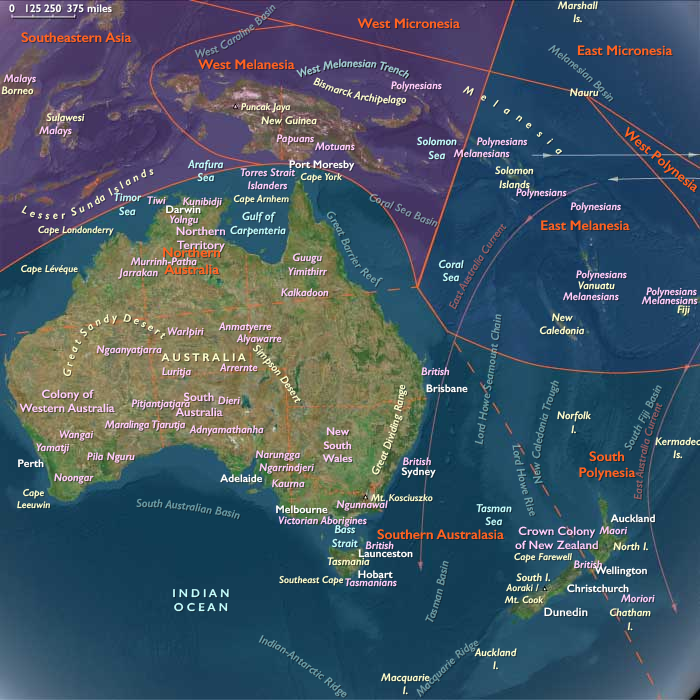
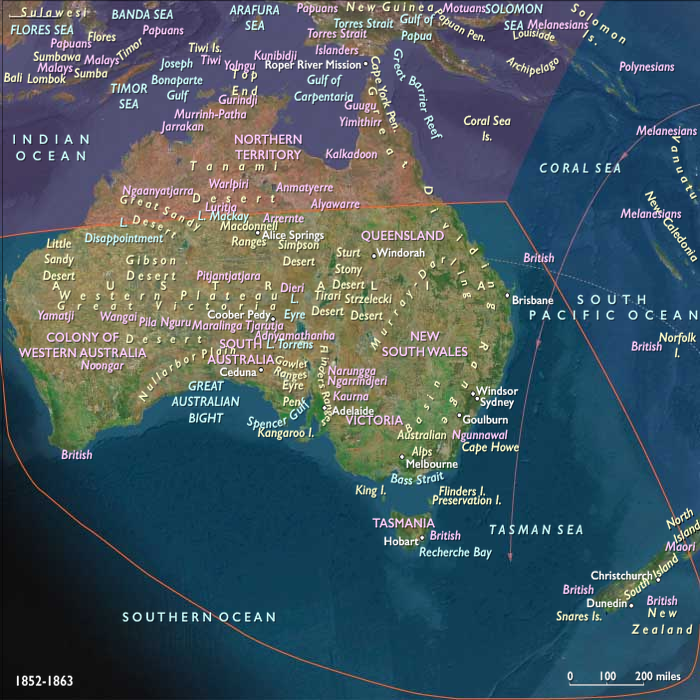
The New Zealand colony gains a representative …
Years: 1852 - 1863
In 1856 the colony effectively becomes self-governing, gaining responsibility over all domestic matters other than native policy. (Control over native policy will be granted in the mid-1860s.)
Locations
Groups
- Maori people
- British people
- Britain (United Kingdom of Great Britain and Ireland)
- New Zealand, (British) Crown Colony of
Topics
Subjects
Regions
Subregions
Related Events
Filter results
Showing 10 events out of 16184 total
The telegraph frees communication from the time constraints of postal mail and revolutionizes the global economy and society.
Instant communication on a global scale had been made possible for the first time by the invention of the electric telegraph network, which, within twenty-nine years of its invention, crosses the oceans to every continent.
Its development enables newspapers to cover significant world events in near real-time, revolutionizes business, particularly trading businesses, and allows huge fortunes to be won and lost in a flurry of investment in research and infrastructure building that will not be be duplicated until the dot-com boom in the Internet Era, which will begin in 1996.
The Spectacled cormorant becomes extinct around this date.
The species was first identified by Georg Steller in 1741 on Vitus Bering's disastrous second Kamchatka expedition.
He described the bird as large, clumsy and almost flightless—though it was probably reluctant to fly rather than physically unable—and wrote "they weighed 12–14 pounds, so that one single bird was sufficient for three starving men."
Though cormorants are normally notoriously bad-tasting, Steller says that this bird tasted delicious, particularly when it was cooked in the way of the native Kamtchadals, who encased the whole bird in clay and buried it and baked it in a heated pit.
Apart from the fact that it fed on fish, almost nothing else is known about this bird.
The population declined quickly after further visitors to the area started collecting the birds for food and feathers, and their reports of profitable whaling grounds and large populations of Arctic foxes and other animals with valuable pelts led to a massive influx of whalers and fur traders into the region; the last birds were reported to have lived around 1850 on Ariy Rock islet, off the northwestern tip of Bering Island.
In 1743 Emilian Basov had landed on Bering Island to hunt sea otter, beginning the island's documented human habitation as well as ecological destruction.
Promyshlenniki began to island-hop across the Bering Sea to the Aleutian islands and ultimately Alaska.
In 1825 the Russian-American Company transferred Aleut families from Attu Island to Bering Island to hunt, and another group of Aleut and mixed-race settlers followed the following year, thus establishing the first known permanent human habitation on Bering Island.
Settlers pour into Oregon territory in the 1850s, sparking a series of small but brutal wars that pit the settlers against the Walla-walla and Yakima tribes, among several others.
The quarrels between the United States government and various indigenous peoples continue in Oregon and Washington Territories with the ongoing Cayuse War (1848-55), the Rogue River Wars (1855-56), and the Yakima Wars (1855-58); in Florida with the third Seminole War (1855-58); in the northern Plains with the Sioux; and in the Southwest with the Navaho and Apache War of 1860-65.
North Polynesia (1852–1863 CE)
Economic Expansion and Social Change under Kamehameha III and IV
Following the constitutional reforms under Kamehameha III (Kauikeaouli), the Hawaiian Kingdom experienced significant economic and demographic transformations. The sugar industry, rapidly expanding due to increased global demand, prompted substantial agricultural development and demographic shifts.
In 1852, Hawaiian sugar planters brought over the first Chinese laborers on three- to five-year contracts. These laborers earned approximately three dollars per month plus room and board, working twelve-hour days, six days a week. This initial wave of immigration marked the beginning of a trend that dramatically diversified the population and shaped Hawaii’s labor landscape for decades to come.
Diplomatic Recognition and Legacy of Kamehameha III
Earlier diplomatic missions, such as that undertaken by Timoteo Haʻalilio in the 1840s—who tragically passed away at sea off New York in 1844—had already established significant diplomatic precedents. Building upon these earlier foundations, the Hawaiian Kingdom continued to seek and maintain international recognition of its sovereignty during the mid-19th century.
King Kamehameha III died on December 15, 1854, after a reign that had profoundly reshaped the Hawaiian Kingdom’s political and social structures. His successor, Kamehameha IV (Alexander Liholiho), continued policies promoting economic modernization and international diplomacy.
Reign of Kamehameha IV
Kamehameha IV, who ascended the throne in 1855, actively supported public health and education initiatives. Recognizing the devastating effects of foreign-introduced diseases, he and his wife, Queen Emma, established the Queen's Hospital (later Queen’s Medical Center) in Honolulu in 1859, significantly improving healthcare access for native Hawaiians.
Additionally, Kamehameha IV sought closer diplomatic and commercial ties with Britain, reflecting his admiration for British constitutional monarchy. This preference was partially influenced by concerns about the United States’ increasing economic and political interests in Hawaii.
Cultural and Religious Developments
Missionary efforts continued to expand, with Protestant and Catholic communities growing significantly. The competition between denominations further established educational institutions and fostered the spread of Christianity throughout the islands. Schools teaching English and Western-style curricula became more widespread, reinforcing English as the language of government and commerce.
During this period, the Kingdom of Hawaii maintained a delicate balance between traditional Hawaiian culture and growing Western influences, a duality increasingly reflected in the islands’ political and social life.
These developments between 1852 and 1863 marked a critical phase in Hawaii’s evolution, characterized by rapid economic growth, significant demographic changes, improved healthcare, and continued efforts to assert international recognition and domestic stability under the reigns of Kamehameha III and Kamehameha IV.

The new Maori kingdom begins to clash with land-hungry colonists.
Traces of gold had nevertheless been found in Australia as early as 1823 by surveyor James McBrien.
As by English law all minerals belong to the Crown, there was at first, "little to stimulate a search for really rich goldfields in a colony prospering under a pastoral economy". (Frances Hale (1983) Wealth beneath the Soil. pp. 3–5. Thomas Nelson. Melbourne.)
Richard Broome (1984) Arriving. p. 69) also argues that the California Gold Rush at first overawed the Australian finds, until "the news of Mount Alexander reached England in May 1852, followed shortly by six ships carrying eight tons of gold".
The gold rushes brings many immigrants to Australia from the British Isles, continental Europe, North America and China.
The Colony of Victoria's population grows rapidly, from seventy-six thousand in 1850 to five hundred and thirty thousand by 1859.
Discontent arises among diggers almost immediately, particularly on the crowded Victorian fields.
The causes of this are the colonial government's administration of the diggings and the gold license system.
Following a number of protests and petitions for reform, violence erupts at Ballarat in late 1854.
European explorers make their last great, often arduous and sometimes tragic expeditions into the interior of Australia during the second half of the nineteenth century—some with the official sponsorship of the colonial authorities and others commissioned by private investors.
Large areas of the inland are still unknown to Europeans in mid-century.
Trailblazers like Edmund Kennedy and the Prussian naturalist Ludwig Leichhardt had met tragic ends attempting to fill in the gaps during the 1840s, but explorers remain ambitious to discover new lands for agriculture or answer scientific inquiries.
Surveyors also act as explorers and the colonies send out expeditions to discover the best routes for lines of communication.
The size of expeditions vary considerably from small parties of just two or three to large, well-equipped teams led by gentlemen explorers assisted by smiths, carpenters, laborers and Aboriginal guides accompanied by horses, camels or bullocks.
In 1860, the ill-fated Burke and Wills leads the first north-south crossing of the continent from Melbourne to the Gulf of Carpentaria.
Lacking bushcraft and unwilling to learn from the local Aboriginal people, Burke and Wills die in 1861, having returned from the Gulf to their rendezvous point at Coopers Creek only to discover the rest of their party had departed the location only a matter of hours previously.
Though an impressive feat of navigation, the expedition was an organizational disaster that continues to fascinate the Australian public.
In 1862, John McDouall Stuart succeeds in traversing Central Australia from south to north.
His expedition maps out the route that is later followed by the Australian Overland Telegraph Line.
Years: 1852 - 1863
Locations
Groups
- Maori people
- British people
- Britain (United Kingdom of Great Britain and Ireland)
- New Zealand, (British) Crown Colony of