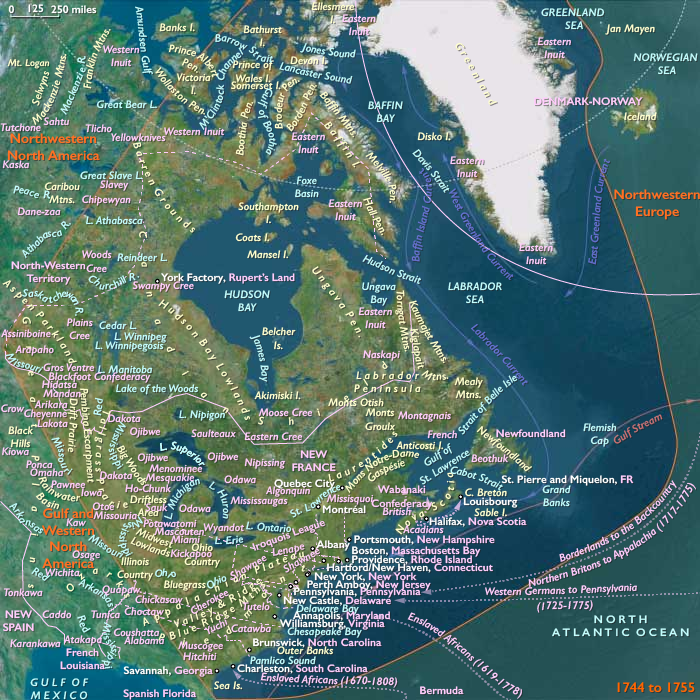
New Bern, settled in 1710 by Swiss …
Years: 1747 - 1747
Locations
Groups
Topics
Commodoties
Subjects
Regions
Subregions
Related Events
Filter results
Showing 10 events out of 27058 total
Following the slow disintegration of the Safavid state at the beginning of the eighteenth century, there were uprisings in the Northeast Caucasus against the Persian rule.
The Russian and Ottoman Empire, both imperial rivals of the Persians, had exploited these.
Peter the Great declared war on Persia in 1722 and started the Russo-Persian War, in which the Russians for the first time make an expedition for the capture of Derbent and beyond down to the Caucasus.
During and before the occupation of Derbent by Peter I, the naib of city had been Imam Quli Khan and was naturally a Shiite like the rest of the Safavid Empire.
He offered the Russian emperor the keys to the city gates.
Peter I had reappointed Imam Quli Khan as the head of Derbent and its "native" troops by assigning him the rank of Major-General.
Following the Treaty of Saint Petersburg, the Safavid Shah Sultan Husayn, whose empire was for years already in disarray and crumbling, had in September 1723 been forced to cede Derbent alongside the many other Iranian territories in the Caucasus.
However, some years later in connection with the aggravation of Russian-Turkish relations, and the new rise of Persia now led by the brilliant military general Nader Shah, Russia had found itself forced to cede all territories back by March 1735 in the Treaty of Ganja in order to deter itself from a costly war against Persia, and to construct an alliance against the common neighboring foe; the Ottoman Empire.
Most of the other territories had already been given back in the Treaty of Resht in 1732 for similar reasons.
After the death of Nadir Shah in 1747 his huge empire disintegrates and the former Persian provinces in the Caucasus (Beylerbeyis) form two dozen semi-independent and dependent khanates, one of which is the Derbent Khanate.
Starting from 1747 with the title of Khan, the first ruler of the Derbent Khanate is the son of Imam Kuli Khan, Muhammad Hassan (also mentioned as Magomed-Hussein or Mohammed Hussein).
Sultan Mahmud I, advised by Humbaraci Ahmed Pasa (Claude Alexandre, Comte de Bonneval, a French convert to Islam), participates in political and military affairs and attempts a partial reform of the army.
A patron of music and literature, he writes poetry in Arabic.
The Comte de Bonneval is the descendant of an old family of Limousin; at the age of thirteen he had joined the Royal Marine Corps.
After three years, he had entered the army, in which he had risen to the command of a regiment, serving in the Italian campaigns under Catinat, Villeroi and Vendôme, and in the Netherlands under Luxembourg, giving proofs of indomitable courage and great military ability.
After his insolent bearing towards the minister of war was made matter for a court martial, in 1704, he had been condemned to death, but saved himself by fleeing to Germany.
Through the influence of Prince Eugene of Savoy, he had obtained a general's command in the Austrian army, and fought with great bravery and distinction against France, and afterwards against Turkey.
Present at the Battle of Malplaquet, he had been severely wounded at Peterwardein.
The proceedings against him in France were then allowed to drop, and he visited Paris, and married a daughter of Marshal de Biron.
He had after a short time returned to the Austrian army, and fought with distinction at Belgrade.
He might now have risen to the highest rank, had he not made himself disagreeable to Prince Eugene, who then sent him as master of the ordnance to the Low Countries.
There his ungovernable temper had led him into a quarrel with the Marquis de Prié, Eugene's deputy governor in the Netherlands, who had answered his challenge by placing him in confinement.
A court martial was again held upon him, and he was condemned to death; but the emperor commuted the sentence to one year's imprisonment and banishment.
Bonneval was returned to Vienna, stripped of his rank, titles and honors, and exiled to Venice.
Soon after his release, Bonneval had offered his services to the Turkish government, professed Islam, and had taken the name of Ahmed.
Made a pasha, he had been appointed to organize and command the Turkish artillery, eventually contributing to the Austrian defeat at Niš and the subsequent end of the Austrian-Ottoman war marked by the Treaty of Belgrade, where Austria lost Northern Serbia with Belgrade, Lesser Wallachia, and territories in northern Bosnia.
In Constantinople, he met the young Giacomo Casanova, who was then a Venetian naval officer stationed there.
He is also close friends with a well-respected local mullah, Ismail Pasha.
He has rendered valuable services to the sultan in his war with Russia, and with the famous Nader Shah.
As a reward he has received the governorship of Chios, but had soon fallen under the suspicion of the Porte, and was banished for a time to the shores of the Black Sea.
He dies in March 1747 at Constantinople.

Dupleix now sends an expedition against Fort St. David (1747), which is defeated on its march by the Nawab of Arcot, an ally of the British.
Dupleix succeeds in winning over the Nawab, and again attempts the capture of Fort St. David, but does not succeed.
A midnight attack on Cuddalore is repulsed at a great loss to Dupleix.
It ranks as one of the first clinical experiments in the history of medicine.
Shortly after this experiment Lind retires from the Navy and at first practices privately as a physician.
In 1753, he will publish A treatise of the scurvy, which will be virtually ignored.
Lind was born in Edinburgh, Scotland in 1716 into a family of merchants; he has an elder sister.
In 1731 he began his medical studies as an apprentice of George Langlands, a fellow of the Incorporation of Surgeons which preceded the Royal College of Surgeons of Edinburgh.
In 1739, he entered the Navy as a surgeon's mate, serving in the Mediterranean, off the coast of West Africa and in the West Indies.
By 1747 he has become surgeon of HMS Salisbury in the Channel Fleet, and conducts his experiment on scurvy while that ship is patrolling the Bay of Biscay.
Scurvy is a disease now known to be caused by a Vitamin C deficiency, but the concept of vitamins is unknown in Lind's day.
Vitamin C is necessary for the maintenance of healthy connective tissue.
In 1740 the catastrophic result of Anson's circumnavigation attracted much attention in Europe; out of nineteen hundred men, fourteen hundred had died, most of them allegedly from having contracted scurvy.
According to Lind, scurvy caused more deaths in the British fleets than French and Spanish arms.
Since antiquity in various parts of the world, and since the seventeen century in England, it had been known that citrus fruit had an antiscorbutic effect, when John Woodall (1570–1643), an English military surgeon of the British East India Company recommended them, but their use did not become widespread.
A charitable society in London had been working to establish a venereal disease clinic since July 1746.
In November of that year a house had been bought for this purpose in Grosvenor Place, London, near Hyde Park Corner.
The founder of the hospital is William Bromfeild.
After opening on January 31, 1747, as the London Lock Hospital, it treats almost three hundred patients during its first year; the demand for its services stems from the unfounded belief that the treatments available at this time can be effective.
The name dates back to the earlier leprosy hospitals, which came to be known as lock hospitals after the "locks", or rags, which covered the lepers' lesions.
This name was used as far back as medieval times, and was used by lock hospitals including those in Kingsland (established during the reign of Henry VIII) and Kent Street, Southwark as well as the one in Hyde Park Corner.
Spanish troops invade and occupy the coastal towns of Beaufort and ...
...Brunswick in the Royal Colony of North Carolina during what becomes known as the Spanish Alarm. They are later driven out by the local militia.
Another yellow fever epidemic strikes Philadelphia in 1747.
Massachusetts Governor William Shirley, in response to the assaults on Annapolis Royal that were being staged at Grand Pré (and Chignecto), had sent Colonel Arthur Noble and hundreds of New England soldiers to secure control over Grand Pré.
A force of one hundred men under the command of Captain Charles Morris had been sent to Grand Pré in early December 1746.
These troops had been joined eventually by troops under the command of Captains Jedidiah Preble and Benjamin Goldthwait, and Colonel Gorham's Rangers.
Colonel Noble arrives by sea with an additional one hundred men in early January 1747.
In all there are approximately five hundred New England troops stationed at Grand Pré.
Initially the troops are billeted at Grand Pré and several communities nearby.
Upon Noble's arrival, he orders the troops brought into Grand Pré, where they are billeted in twenty-four houses that extend across the village for nearly two and a half miles.
Some of the Inhabitants at Grand Pré warn the New Englanders that Ramezay has a plan to attack them.
The warning is ignored as the New Englanders feel that such an attack that would mean an impractical long march through deep snow and across frozen rivers.
Born in Contrecœur, Quebec, as a son of Nicolas-Antoine Coulon de Villiers and Angelique Jarret de Verchères, his three brothers are Louis Coulon de Villiers, François Coulon de Villiers and Joseph Coulon de Jumonville.
Coulon de Villiers had fought against the Sauks in his youth and had become commander of Fort St. Joseph (Niles, Michigan) after the death of his father in battle.
Returning to Quebec in 1742, he had on October 9, 1743, married Madeleine-Marie-Anne Tarieu de La Pérade, the widow of Richard Testu de La Richardière.
The French embark on January 21, 1747, on a twenty-one day winter march to the Minas.
The troops, on snowshoes and utilizing sleds, cross to Bay Verte, follow the Northumberland shore to Tatamagouche, cross the Cobequid Mountains to Cobequid Bay near present-day Truro, and by February 2 have reached the Shubenacadie River, which they find blocked by ice and too dangerous for the main force to cross.
De Villiers orders Boishébert to cross the river with ten men and to block the roads so that word of the impending attack is not spread by the locals.
The Canadian force has been joined throughout the trek by both Acadian militia and Mi'kmaq warriors.
Further assistance comes when they are sheltered and fed by local Acadian families who also provide information on the New England positions.
There are Acadians, however, who are not allies.