
Nero has retained some control of the …
Years: 68 - 68
Nero has retained some control of the situation, but support for Galba increases despite his being officially declared a public enemy.
The prefect of the Praetorian Guard, Gaius Nymphidius Sabinus, also abandons his allegiance to the Emperor and comes out in support of Galba.
In response, Nero flees Rome with the intention of going to the port of Ostia and from there to take a fleet to one of the still-loyal eastern provinces.
However, he abandons the idea when some army officers openly refuse to obey his commands, responding with a line from Vergil's Aeneid: "Is it so dreadful a thing then to die?"
Nero then toys with the idea of fleeing to Parthia, throwing himself upon the mercy of Galba, or to appeal to the people and beg them to pardon him for his past offenses "and if he could not soften their hearts, to entreat them at least to allow him the prefecture of Egypt".
Suetonius reports that the text of this speech was later found in Nero's writing desk, but that he dared not give it from fear of being torn to pieces before he could reach the Forum.
Nero returns to Rome and spends the evening in the palace.
After sleeping, he awakens at about midnight to find the palace guard had left.
Dispatching messages to his friends' palace chambers for them to come, he receives no answers.
Upon going to their chambers personally, he finds them all abandoned.
When he calls for a gladiator or anyone else adept with a sword to kill him, no one appears.
He cries, "Have I neither friend nor foe?" and runs out as if to throw himself into the Tiber.(Suetonius, The Lives of Twelve Caesars, Life of Nero, 47)
Returning, Nero seeks for some place where he can hide and collect his thoughts.
An imperial freedman offers his villa, located four miles outside the city.
Traveling in disguise, Nero and four loyal servants reach the villa, where Nero orders them to dig a grave for him.
At this time, a courier arrives with a report that the Senate has declared Nero a public enemy and that it is their intention to execute him by beating him to death.
At this news, Nero prepares himself for suicide.
Losing his nerve, he first begs for one of his companions to set an example by first killing himself.
At last, the sound of approaching horsemen drives Nero to face the end.
However, he still cannot bring himself to take his own life but instead he forces his private secretary, Epaphroditos, to perform the task.
Nero's famous last words from this moment are "Qualis artifex pereo" or in English "What an artist dies in me!"
When one of the horsemen enters, upon his seeing Nero all but dead he attempts to stop the bleeding in vain.
Nero dies on June 9, 68, the anniversary of the death of Octavia.
He is buried in the Mausoleum of the Domitii Ahenobarbi, in what is now the Villa Borghese (Pincian Hill) area of Rome.
With his death, the Julio-Claudian dynasty ends.
Chaos ensues in the Year of the Four Emperors.
Galba, praetor in CE 20, consul in 33, and governor of Aquitania respected by Augustus and Tiberius, had earned a reputation in the provinces of Gaul, Germania, Africa and Hispania (Iberia, comprising modern Spain and Portugal) for his military capability, strictness and impartiality.
On the death of Caligula, he had refused the invitation of his friends to make a bid for the empire, and loyally served Claudius.
For the first half of Nero's reign he had lived in retirement, until 61, when the emperor bestowed on him the province of Hispania Tarraconensis.
Following Nero's death, Nymphidius Sabinus seeks to seize power before the arrival of Galba, but he cannot win the loyalty of the Praetorian guard and is killed.
Upon Galba's approach to the city in October at the head of a single legion, VII Galbiana, later known as VII Gemina, he is met by unarmed soldiers presenting demands; Galba replies by having his troops kill a great many many of the petitioners.
Locations
People
Groups
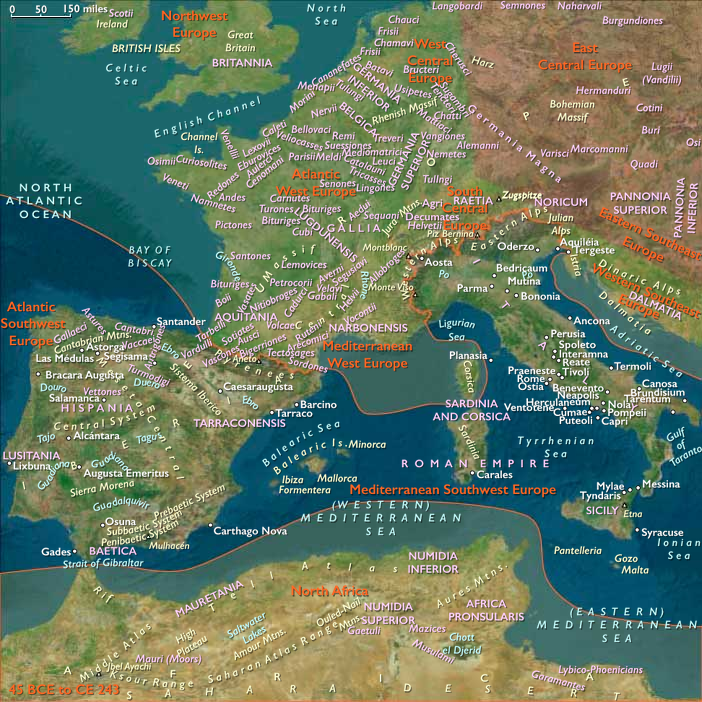
- Germania Superior (Roman province)
- Hispania Tarraconensis (Roman province)
- Gallia Lugdunensis (Roman province)
- Roman Empire (Rome): Julio-Claudian dynasty
Topics
- Classical antiquity
- Portraits, Classical
- Roman art
- Roman Age Optimum
- Pax Romana
- Year of the Four Emperors, or Roman Civil War of 68-69
Commodoties
Subjects
- Commerce
- Watercraft
- Sculpture
- Environment
- Labor and Service
- Conflict
- Mayhem
- Faith
- Government
- Technology
Regions
Subregions
Related Events
Showing 10 events out of 61633 total
Years: 68 - 68
Locations
People
Groups
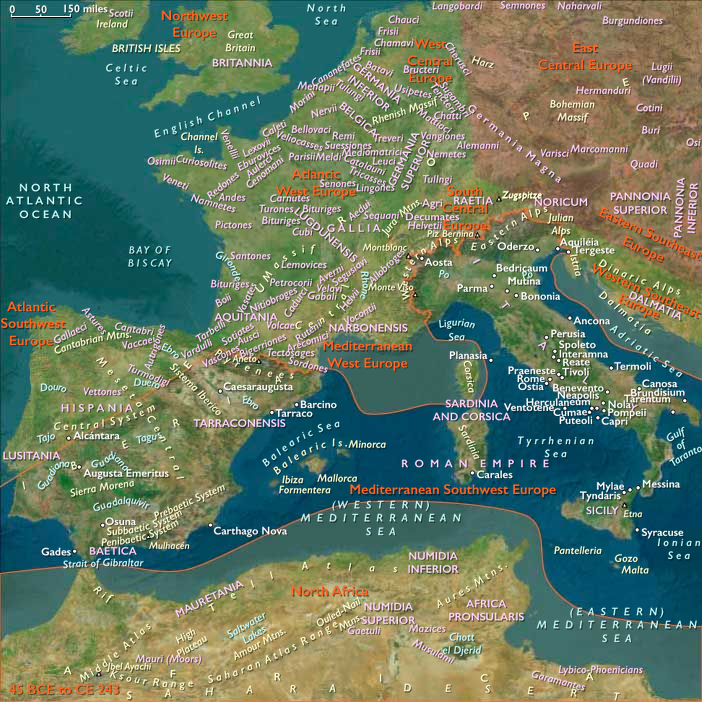
- Germania Superior (Roman province)
- Hispania Tarraconensis (Roman province)
- Gallia Lugdunensis (Roman province)
- Roman Empire (Rome): Julio-Claudian dynasty
Topics
- Classical antiquity
- Portraits, Classical
- Roman art
- Roman Age Optimum
- Pax Romana
- Year of the Four Emperors, or Roman Civil War of 68-69
Commodoties
Subjects
- Commerce
- Watercraft
- Sculpture
- Environment
- Labor and Service
- Conflict
- Mayhem
- Faith
- Government
- Technology
Regions
Subregions