
Near East (45 BCE–99 CE): Transition and …
Years: 45BCE - 99
Near East (45 BCE–99 CE): Transition and Turmoil under Roman Dominance
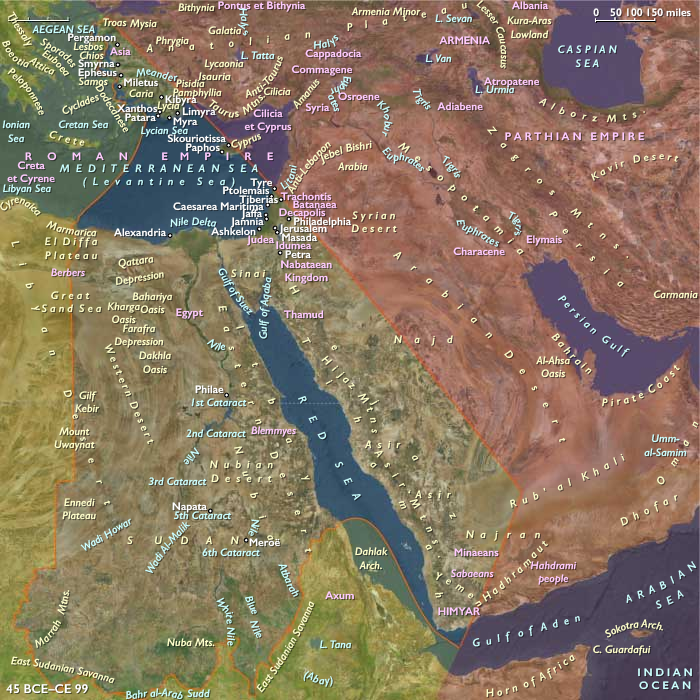
This era in the Near East witnesses dramatic shifts in political control, religious movements, and cultural integration under increasing Roman influence. Following Julius Caesar’s assassination in 44 BCE, Mark Antony and Octavian (later Augustus) emerge victorious in the subsequent Liberators' civil war against Caesar’s assassins, reasserting Roman dominance over eastern territories. Antony’s campaigns, notably his ill-fated Parthian expedition, significantly shape local power dynamics.
Antony allies with Egypt’s Cleopatra VII, ultimately challenging Roman authority. Their defeat by Octavian at the Battle of Actium (31 BCE) leads to Egypt’s annexation into the Roman Empire, concluding Cleopatra’s independent reign. Cleopatra’s suicide symbolizes the definitive end of Egypt’s Hellenistic era and initiates over six centuries of direct Roman control. Egypt, a vital grain supplier to Rome, becomes a strategically crucial province governed directly by the emperor.
Herod the Great, appointed by Rome as king of Judah in 37 BCE, stabilizes Roman rule in Palestine. Upon Herod’s death in 4 BCE, his kingdom fragments among heirs, eventually absorbed by Rome as Syria Palestina. Though under Roman sovereignty, the Jews retain religious autonomy via the Sanhedrin, the authoritative Jewish council overseeing religious, legal, and political matters.
Tensions culminate in the First Jewish-Roman War (66–73 CE), ignited by religious disputes, oppressive taxation, and Roman insensitivity to Jewish traditions. Roman generals Vespasian and Titus decisively destroy Jerusalem and the Second Temple in 70 CE, ending independent Jewish statehood and intensifying the Jewish Diaspora. The final tragic stand occurs at Masada in 73 CE.
Rabbinic leadership significantly shifts post-Jerusalem's fall. Rabbi Johanan ben Zakkai establishes an academic and religious center at Yavneh (Jabneh), creating a new focal point for Judaism recognized throughout the Diaspora. His successors, notably Gamaliel of Jabneh, formalize Jewish religious practices, standardize the calendar, and mediate with Roman authorities, exemplified by Gamaliel’s appeal to Emperor Domitian in 95 CE to rescind Jewish expulsions.
Meanwhile, Christianity prominently emerges, marked by doctrinal debates, notably the rise of Docetism, a Gnostic-influenced teaching claiming Christ only appeared physically, challenging foundational Christian doctrines. Early Christian texts, especially the Johannine Epistles (95–110 CE) from western Anatolia, counter these beliefs by emphasizing the incarnation and communal orthodoxy.
Relations between Meroë and Egypt fluctuate, notably with a Roman punitive expedition in 23 BCE responding to incursions into Upper Egypt. Despite this conflict, continued interactions with Mediterranean, Arab, and Indian traders enrich Meroë’s society, leaving significant architectural and linguistic legacies. Meroë maintains cultural vibrancy, even as northern Kush faces pressure from nomadic Blemmyes, but continues its prominence through trade and cultural integration.
In Cyprus, the missionary activities of Paul and Barnabas lead to the conversion of the Roman proconsul Sergius Paulus, marking Cyprus as the first Roman territory governed by a Christian. Elsewhere, the Lydian language persists among descendants of Lydian colonists at Kibyra in southwest Anatolia, despite becoming extinct in Lydia proper around this period.
Legacy of the Era
From 45 BCE to 99 CE, the Near East experiences profound transformations under Roman hegemony. The definitive incorporation of Egypt into Rome, the violent suppression and subsequent restructuring of Jewish society, and the theological crystallization within early Christianity define this critical juncture. These events lay lasting foundations for regional identities, religious developments, and socio-political dynamics in subsequent centuries.
People
- Augustus
- Barnabas
- Cleopatra VII
- Domitian
- Gamaliel II
- Herod the Great
- Johanan ben Zakai
- Julius Caesar
- Lucius Sergius Paulus
- Mark Antony
- Paul the Apostle
- Titus
- Vespasian
Groups
- Kush, Kingdom of
- Blemmyes
- Meroë, Kingdom of
- Jews
- Parthian Empire
- Cyprus, Roman
- Cilicia et Cyprus (Roman province)
- Syria (Roman Province)
- Roman Empire (Rome): Julio-Claudian dynasty
- Christians, Jewish
- Christians, Early
- Docetism
- Roman Empire (Rome): Flavian dynasty
Topics
- Liberators' civil war
- Antony's Parthian War
- Actium, Battle of
- Pax Romana
- First Jewish-Roman War, or Jewish Revolt of 66-73
- Jewish–Roman wars
- Jerusalem, Siege of
- Masada, Siege of
Subjects
Regions
Subregions
Related Events
Showing 10 events out of 62463 total
Years: 45BCE - 99
People
- Augustus
- Barnabas
- Cleopatra VII
- Domitian
- Gamaliel II
- Herod the Great
- Johanan ben Zakai
- Julius Caesar
- Lucius Sergius Paulus
- Mark Antony
- Paul the Apostle
- Titus
- Vespasian
Groups
- Kush, Kingdom of
- Blemmyes
- Meroë, Kingdom of
- Jews
- Parthian Empire
- Cyprus, Roman
- Cilicia et Cyprus (Roman province)
- Syria (Roman Province)
- Roman Empire (Rome): Julio-Claudian dynasty
- Christians, Jewish
- Christians, Early
- Docetism
- Roman Empire (Rome): Flavian dynasty
Topics
- Liberators' civil war
- Antony's Parthian War
- Actium, Battle of
- Pax Romana
- First Jewish-Roman War, or Jewish Revolt of 66-73
- Jewish–Roman wars
- Jerusalem, Siege of
- Masada, Siege of
Subjects
Regions
Subregions