
Near East (88–99 CE): Challenges to Orthodoxy …
Years: 88 - 99
Near East (88–99 CE): Challenges to Orthodoxy and Consolidation of Rabbinic Authority
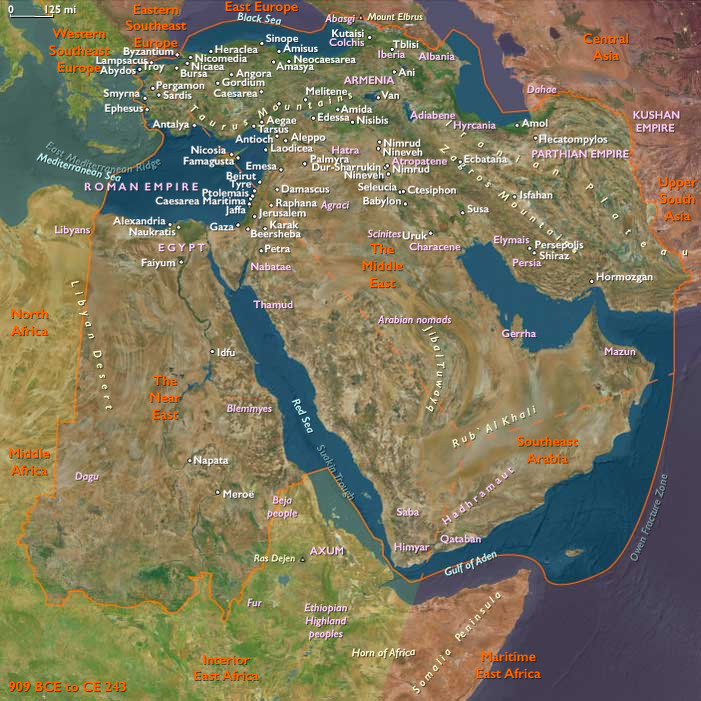
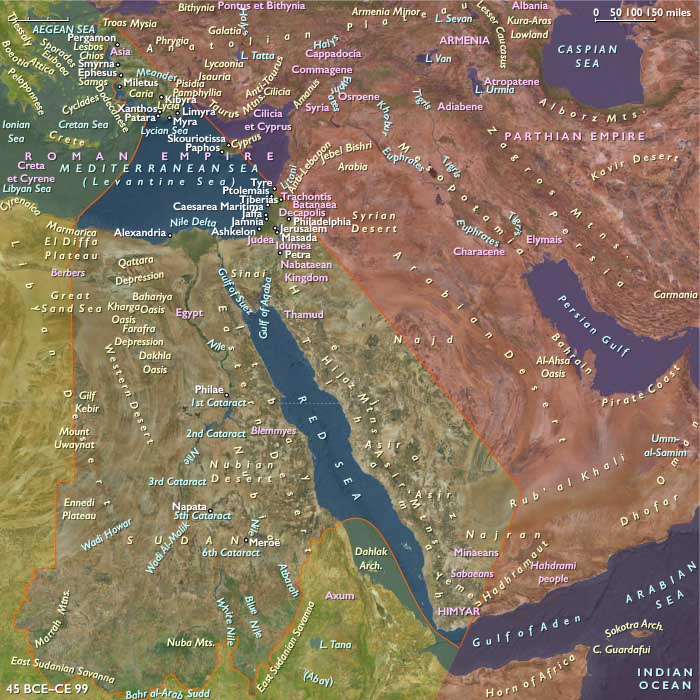
In the late first century CE, significant theological and organizational shifts shape religious communities across the Near East. Within emerging Christian circles, particularly those influenced by Hellenistic thought, a theological movement known as Docetism gains prominence. Docetists, influenced by Gnostic teachings, argue that Jesus Christ only appeared to have a physical body and did not truly suffer on the cross. Rooted in a dualistic worldview that regards matter as inherently evil, this belief system asserts that a divine being would never assume a genuine human form. These teachings provoke sharp opposition from mainstream Christian communities and are specifically addressed in texts such as the Johannine Epistles, composed in the Roman province of Asia (western Anatolia) around 95–110 CE. These epistles, traditionally attributed to the Apostle John, emphasize the incarnation of Christ as an essential doctrine and urge adherence to communal love and orthodoxy.
Simultaneously, in Jewish communities, the authority of Rabbinic Judaism continues to consolidate. Gamaliel of Jabneh, great-grandson of the earlier revered figure Gamaliel I, becomes head of the reconstituted Sanhedrin in Jabneh (Yavneh). Gamaliel significantly shapes religious practices by standardizing synagogue services and fixing the Jewish festival calendar. Notably, he petitions Roman Emperor Domitian in 95 CE to rescind an edict expelling Jews from the Roman Empire, reflecting ongoing Jewish negotiations with imperial authorities.
Legacy of the Era
The era from 88 to 99 CE marks critical theological and institutional consolidations within both Christian and Jewish communities. Docetist controversies compel early Christian leaders to clearly define orthodox doctrines of incarnation and redemption, significantly influencing later creeds and church teachings. Concurrently, Rabbinic Judaism, under influential leaders such as Gamaliel, strengthens its organizational and doctrinal foundations, ensuring the survival and continuity of Jewish religious life following the upheavals of the previous decades.
People
Groups
Topics
Subjects
Regions
Subregions
Related Events
Showing 10 events out of 61483 total
Years: 88 - 99
People
Groups
Topics
Subjects
Regions
Subregions