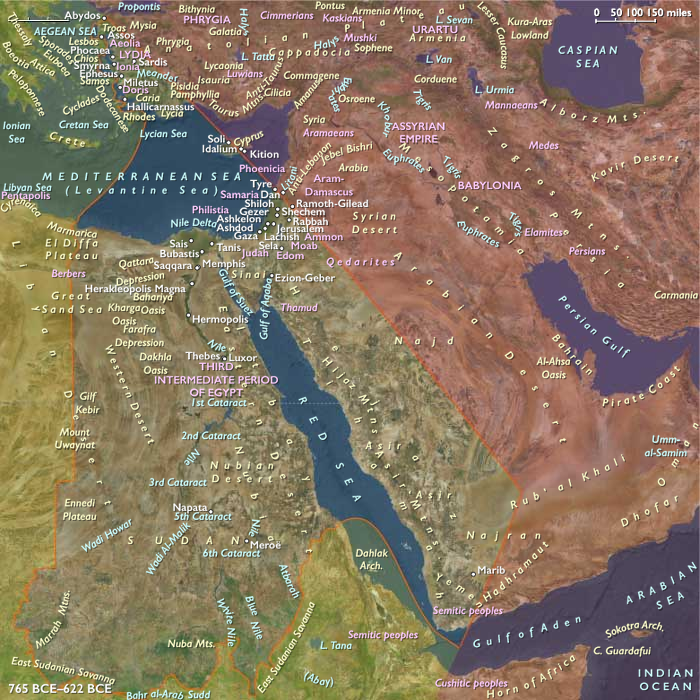
Near East (753–742 BCE): Kushite Expansion and …
Years: 753BCE - 742BCE
Near East (753–742 BCE): Kushite Expansion and Prophetic Voices
Kushite Ascendancy in Upper Egypt
From his power base at Napata, approximately four hundred kilometers north of modern-day Khartoum in Sudan, Kashta, King of Kush, significantly expands his influence into Upper Egypt. Around this time, he successfully installs his daughter, Amenirdis I, as the presumptive successor to Shepenupet I, the serving Divine Adoratrice of Amun in Thebes and daughter of Egypt's Osorkon III. This strategic move legitimizes Kushite control over the Thebaid region and marks the initial phase of what some historians recognize as the Twenty-Fifth Dynasty of Egypt. Under Kashta's reign, the native Kushite population situated between the third and fourth Cataracts of the Nile undergoes rapid "Egyptianization," adopting Egyptian cultural practices, religion, and administrative structures. Kashta’s reign concludes around 752 BCE (or 747 BCE), when he is succeeded by his son, Piye.
Literature and Cultural Reflection: The Book of Ruth
During this period, the narrative known as the Book of Ruth emerges, traditionally attributed to the prophet Samuel but likely authored or redacted later. It details the life of Ruth, a Moabite widow who marries Boaz, an older kinsman from Bethlehem, through the assistance of her mother-in-law Naomi. This poignant story emphasizes themes of family loyalty, legal customs such as levirate marriage, and the subtle workings of divine providence in everyday life. Its enduring significance lies in Ruth’s role as an ancestor of King David, thereby anchoring the narrative in the larger historical and theological fabric of the Hebrew scriptures.
The Prophetic Voice of Amos
Around this same era, the prophet Amos, originating from Tekoa in Judah, rises to prominence. Writing in a time of relative prosperity, Amos directs his sharp critique toward the northern kingdom of Israel. He vehemently condemns the stark disparity between the lavish lifestyles of Israel’s elite and their oppression of the poor. His prophetic oracles, characterized by warnings of impending darkness, famine, and destruction, urge urgent social justice reforms and forecast severe divine judgment if his warnings are ignored.
Isaiah's Emergence and Influence
Beginning approximately in 747 BCE, the prophet Isaiah, possibly of noble lineage, begins his influential ministry in Jerusalem. His early messages (later compiled as chapters 1–35 in the Book of Isaiah, known collectively as First Isaiah) address critical internal political and economic policies. Isaiah's tenure will span multiple decades, profoundly shaping Judah's theological and political landscape. Modern scholarship generally agrees that the entirety of the Book of Isaiah comprises contributions from multiple authors and disciples over a prolonged period, though the initial chapters remain closely tied to Isaiah himself or his immediate circle.
Legacy of the Era
The era from 753 to 742 BCE marks a significant cultural, political, and religious transition in the Near East. Kushite influence in Egypt reshapes the political landscape of the region, while the prophetic voices of Amos and Isaiah redefine the spiritual and moral parameters within the Hebrew kingdoms. Meanwhile, the Book of Ruth provides enduring literary and cultural narratives that continue to influence ethical and religious thought. Collectively, these developments illustrate the vibrant intersections between political authority, religious expression, and social justice during a formative period in Near Eastern history.
Related Events
Showing 10 events out of 66399 total
Years: 753BCE - 742BCE
Groups
- Ammonites, Kingdom of the
- Philistines
- Egypt (Ancient), Third Intermediate Period of
- Judah, Kingdom of
- Israel (Northern Kingdom of)
- Assyria, (New) Kingdom of (Neo-Assyrian Empire)
Subjects
Regions
Subregions