
Near East (729–718 BCE): The Fall of …
Years: 729BCE - 718BCE
Near East (729–718 BCE): The Fall of Samaria and Nubian Expansion
The Fall of the Kingdom of Israel
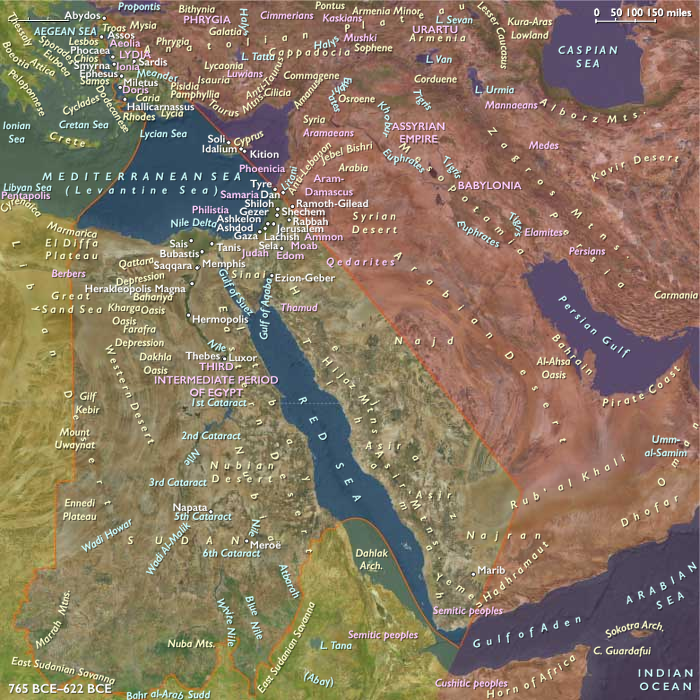
King Hoshea of Israel, encouraged by Egypt, attempts to break free from Assyrian domination. In retaliation, the Assyrian king Shalmaneser V personally leads his forces into Israel in 724 BCE, besieging the Israelite capital, Samaria, and attacking the city of Tyre. After a three-year siege, Samaria falls in 722 BCE. Shalmaneser, however, dies shortly before the capture, and his successor, Sargon II, claims credit for the city's conquest, deporting over twenty-seven thousand inhabitants to Syria—marking the historical disappearance of the "ten lost tribes" of Israel.
Sargon II’s Consolidation
After the capture of Samaria, Sargon II refounds the city as the Assyrian province of Samerina, repopulating it with settlers from Babylon, Cuthah, Avva, Hamath, and Sepharvaim. He also conquers the Philistine city of Gaza, destroys Rafah, and secures a decisive victory against Egyptian forces. However, the Assyrian siege of Tyre, aided by Phoenician mainland cities, ends unsuccessfully after five years, with Assyrian forces withdrawing in 720 BCE.
Nubian Dominance in Egypt
In Egypt, Piye, the ruler of the Nubian kingdom of Kush, exploits internal divisions to extend his influence northward. In response to the alliance formed by Tefnakht of Sais among Delta rulers, Piye launches a successful military campaign in his twentieth regnal year, which he views as a holy war dedicated to Amun. Piye swiftly captures Herakleopolis, Hermopolis, and the ancient capital of Memphis, securing the submission of Delta rulers, including Iuput II of Leontopolis and Osorkon IV of Tanis. Tefnakht ultimately submits indirectly, maintaining nominal independence in Lower Egypt after Piye's withdrawal to Nubia.
Egyptian Fragmentation and Twenty-fourth Dynasty
Following the collapse of Egypt’s Twenty-second Dynasty with the death of Shoshenq V around 720 BCE, Lower Egypt splinters into city-states controlled by local kings. Prominent among these is Tefnakht I, who establishes himself as the "Great Chief of the West" and the founding ruler of Egypt’s short-lived Twenty-fourth Dynasty based in Sais. Although nominally submitting to Piye, Tefnakht soon declares independence and asserts himself as a king.
Legacy of the Era
The era 729–718 BCE witnesses significant shifts in power dynamics in the Near East, marked by the dramatic collapse of the northern Kingdom of Israel under Assyrian conquest and the rise of Nubian authority over a fragmented Egypt. These events reshape regional politics profoundly, setting the stage for ongoing interactions and confrontations among emerging powers, particularly Assyria and the Kushite dynasty in Egypt.
People
Groups
- Tyre, Kingdom of (Phoenicia)
- Philistines
- Kush, Kingdom of
- Egypt (Ancient), Third Intermediate Period of
- Israel (Northern Kingdom of)
- Assyria, (New) Kingdom of (Neo-Assyrian Empire)
Topics
Subjects
Regions
Subregions
Years: 729BCE - 718BCE
People
Groups
- Tyre, Kingdom of (Phoenicia)
- Philistines
- Kush, Kingdom of
- Egypt (Ancient), Third Intermediate Period of
- Israel (Northern Kingdom of)
- Assyria, (New) Kingdom of (Neo-Assyrian Empire)
Topics
Subjects
Regions
Subregions