
Near East (669–658 BCE): Assyrian Dominance, Judah’s …
Years: 669BCE - 658BCE
Near East (669–658 BCE): Assyrian Dominance, Judah’s Controversial Stability, and the Rise of Lydia
Assyrian Authority and Egyptian Turmoil
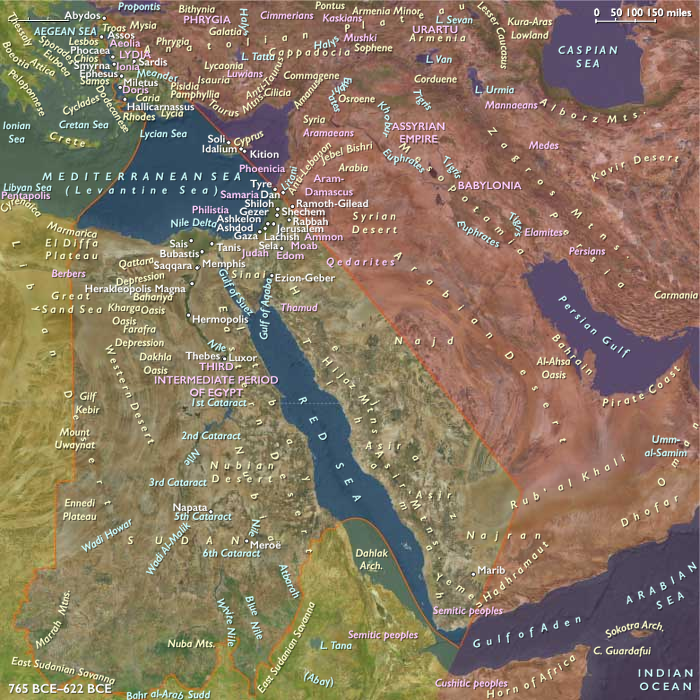
After Esarhaddon’s unexpected death in 669 BCE, his successor, Ashurbanipal, vigorously renews Assyrian ambitions in Egypt. Pharaoh Taharqa, the Nubian ruler previously expelled by Esarhaddon, had regained control of Egypt as far north as Memphis. Ashurbanipal swiftly counters this resurgence, sending his armies to defeat Taharqa decisively, forcing him to retreat permanently to Thebes and eventually to Nubia, where he dies at Nuri in 664 BCE. Taharqa is succeeded by Tantamani, who briefly reasserts Kushite control by retaking Memphis and killing the Assyrian-appointed ruler Necho I of Sais in 664 BCE. Ashurbanipal responds severely, reconquering Egypt, sacking Thebes—an event from which the city never truly recovers—and decisively ending Nubian rule over Egypt. Ashurbanipal places Necho’s son, Psamtik I, as the Assyrian vassal king, reestablishing Assyrian dominance over Egypt.
Stability and Economic Revival under Manasseh in Judah
Manasseh of Judah remains a loyal vassal throughout Esarhaddon’s and Ashurbanipal’s reigns, appearing consistently in Assyrian records among those required to supply resources for Assyrian projects, including military campaigns against Egypt. Archaeological findings and demographic patterns support evidence of relative prosperity and stability in Judah during this era. Modern scholars, notably Israel Finkelstein and Neil Asher Silberman, suggest Manasseh strategically leveraged Assyrian favor to revive Judah’s rural economy, possibly securing a privileged trading status. They argue that Manasseh’s reversal of his father Hezekiah’s strict religious reforms—restoring Canaanite high places and polytheistic worship—may have been part of an economic quid pro quo with the local aristocracy to facilitate trade and commerce.
The re-establishment of fortified settlements at sites like Arad and Horvat Uza, as well as economic vitality in southern Judah (particularly the Beersheba Valley) and the robust olive oil industry at Ekron, provide evidence supporting this theory. Yet, such economic success likely exacerbated wealth disparities, fueling internal tensions. Thus, the Deuteronomic historians portray Manasseh as a deeply wicked monarch who fostered apostasy and violence, even accusing him of sacrificing his son and persecuting followers of Yahweh (2 Kings 21, 2 Chronicles 33).
The Chronicles narrative uniquely includes a disputed tradition that Manasseh was temporarily taken captive to Assyria, repented, and was subsequently restored. However, neither the Assyrian records nor the parallel account in Kings confirms this captivity and repentance.
Philistia under Assyrian Influence
Throughout this period, Philistia remains largely under Assyrian hegemony, notably Ekron and Ashkelon, which consistently pay tribute and support Assyrian military campaigns.
Rise of the Lydian Kingdom under Gyges
Meanwhile, in Asia Minor, Gyges, legendary founder of the Mermnad dynasty, firmly establishes Lydia as a significant military and economic power around 680 BCE. Exploiting the power vacuum created by the devastating Cimmerian invasions that destroyed Phrygia, Gyges expands Lydian control across western Anatolia, capturing the flourishing Greek city of Colophon in 665 BCE, followed by attacks on Miletus and Smyrna. Demonstrating his burgeoning power and prestige, Gyges makes lavish offerings at the Greek sanctuary of Delphi, following the pattern of Phrygia’s earlier King Midas.
Nubia’s Retreat and Consolidation at Meroë
Driven out of Egypt, the Nubian dynasty retreats southward to Meroë, situated strategically in the Sudan, where they fortify their position along vital trade routes linking the Nile to the Red Sea. This relocation begins a new chapter for Nubian civilization, eventually leading to the flourishing of the distinctive Meroitic culture.
Legacy of the Era
This era (669–658 BCE) underscores Assyria’s peak dominance and geopolitical complexity, marked by aggressive imperial expansion into Egypt, strategic alliances in Judah, and vassal arrangements throughout the Near East. Concurrently, the controversial reign of Manasseh demonstrates how Judah navigates the delicate balance between Assyrian subservience, internal religious traditions, and economic prosperity. The rise of Lydia and the repositioning of Nubia at Meroë represent significant realignments that reshape political, cultural, and economic landscapes, laying foundations for future historical developments across the region.
People
Groups
- Philistines
- Kush, Kingdom of
- Egypt (Ancient), Third Intermediate Period of
- Judah, Kingdom of
- Greeks, Classical
- Assyria, (New) Kingdom of (Neo-Assyrian Empire)
- Egypt (Ancient), Late Period of
Topics
Commodoties
Subjects
Regions
Subregions
Years: 669BCE - 658BCE
People
Groups
- Philistines
- Kush, Kingdom of
- Egypt (Ancient), Third Intermediate Period of
- Judah, Kingdom of
- Greeks, Classical
- Assyria, (New) Kingdom of (Neo-Assyrian Empire)
- Egypt (Ancient), Late Period of
Topics
Commodoties
Subjects
Regions
Subregions