
Near East (657–646 BCE): Realignments, Religious Syncretism, …
Years: 657BCE - 646BCE
Near East (657–646 BCE): Realignments, Religious Syncretism, and Egypt’s Resurgence
Judah under Manasseh: Submission and Religious Pluralism
Throughout this era, Judah continues as a compliant ally of Assyria during the stable and prosperous reign of King Manasseh. His loyalty to Assyrian kings Esarhaddon and Ashurbanipal ensures Judah’s participation in imperial building projects and military operations, contributing to increased economic prosperity.
Manasseh’s reign is marked by notable religious pluralism and syncretism, likely reflecting the cosmopolitan influence resulting from extensive Near Eastern commerce and interactions. The Temple in Jerusalem houses not only the worship of Yahweh (YHWH) but also foreign cults—including solar deities, astral gods, and Asherah, a prominent Canaanite fertility goddess. Similarly, the rural regions of Judah see a resurgence of local altars to Yahweh alongside numerous pagan shrines and foreign rituals. The Hebrew scriptures later condemn this religious diversity, highlighting Manasseh’s violent persecution of Yahwist devotees as part of his effort to consolidate religious practice under his rule.
Psamtik I and Egypt’s Reunification and Revival
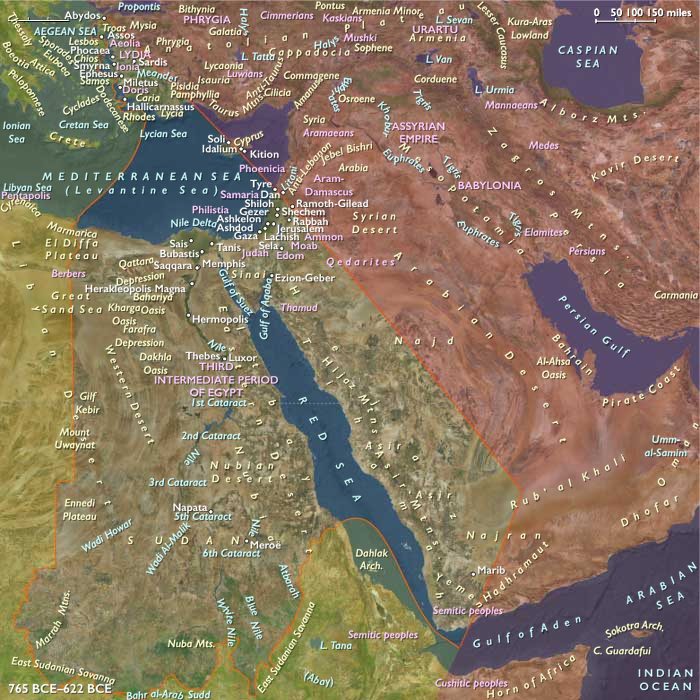
With Assyrian attention occupied by unrest elsewhere, the Egyptian ruler Psamtik I seizes the opportunity to assert greater independence and consolidate power over Egypt. Psamtik strategically employs Greek mercenaries, successfully taking control of northern Egypt around 656 BCE. He quickly moves to reunify the divided nation by dispatching a powerful naval force to Thebes in March 656 BCE, compelling the Nubian-appointed God’s Wife of Amun, Shepenupet II, to adopt his daughter Nitocris I as her successor. Recorded on the so-called Adoption Stela, this diplomatic maneuver effectively ends the remaining influence of the Nubian Twenty-fifth Dynasty in Upper Egypt.
Psamtik actively encourages the growth of Greek settlements, deepening Hellenic influence in Egyptian military and commercial activities. His vigorous military campaigns—especially against Libyan raiders in Egypt’s Dakhla Oasis—demonstrate his resolve in reestablishing centralized Egyptian authority.
Kushite Consolidation at Meroë
Expelled definitively from Egypt, the Kushite dynasty relocates its political center further southward to Meroë around 656 BCE, strategically positioned along vital caravan trade routes connecting the Nile to the Red Sea. After King Tantamani’s death in 653 BCE, he is succeeded by Atlanersa, son of Taharqa, who continues to rule from this newly established Kushite heartland, marking the start of Meroë’s long ascendancy as the primary cultural and political hub of Nubia. Atlanersa is interred in the royal cemetery at El-Kurru, preserving dynastic continuity and heritage.
Gyges and the Fall of Lydian Ambitions
In Asia Minor, the once formidable Lydian king Gyges encounters severe setbacks due to shifting regional alliances. His decision to support Psamtik’s Egyptian revolt against Assyria in 654 or 652 BCE causes the Assyrians to withdraw their previously crucial military backing. Exposed and vulnerable, Lydia faces another invasion by the Cimmerians, who decisively defeat Gyges. The exact date remains unclear, but Gyges’ death during this invasion significantly weakens Lydia’s standing as a regional power.
Legacy of the Era
This period (657–646 BCE) is characterized by shifting political and military realignments across the Near East. Judah under Manasseh balances between religious syncretism, political submission, and economic growth. Meanwhile, Egypt’s reunification under Psamtik I ends decades of foreign domination, reasserting native Egyptian power augmented by Greek military and commercial partnerships. Simultaneously, Kush repositions itself at Meroë, initiating a new chapter in its dynastic history, while Lydia experiences a sharp reversal, illustrating the volatility of power dynamics in the region.
People
Groups
- Lydia, Kingdom of
- Kush, Kingdom of
- Cimmerians
- Judah, Kingdom of
- Greeks, Classical
- Assyria, (New) Kingdom of (Neo-Assyrian Empire)
- Egypt (Ancient), Late Period of
Topics
Commodoties
Subjects
Regions
Subregions
Years: 657BCE - 646BCE
People
Groups
- Lydia, Kingdom of
- Kush, Kingdom of
- Cimmerians
- Judah, Kingdom of
- Greeks, Classical
- Assyria, (New) Kingdom of (Neo-Assyrian Empire)
- Egypt (Ancient), Late Period of
Topics
Commodoties
Subjects
Regions
Subregions