
Near East (645–634 BCE): Regional Upheavals and …
Years: 645BCE - 634BCE
Near East (645–634 BCE): Regional Upheavals and Judah’s Opportunity for Renewal
Cimmerian Conquests and the Crisis at Sardis
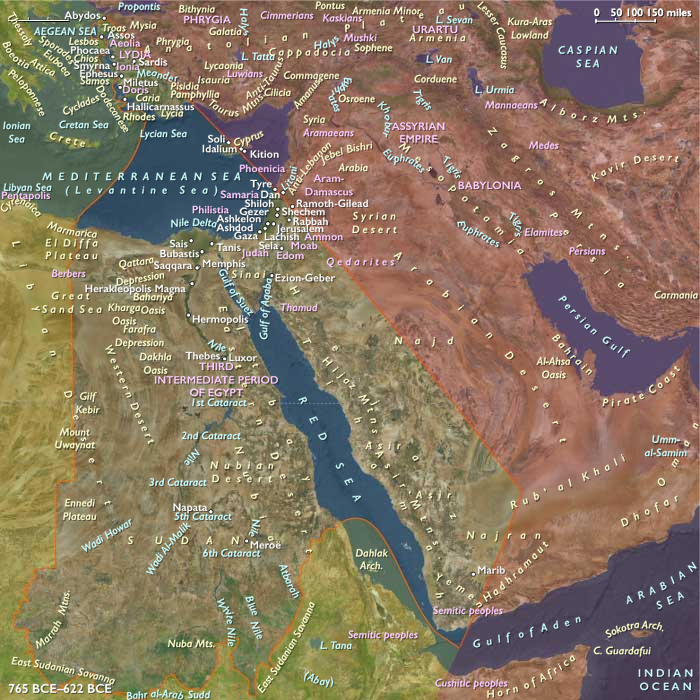
In Lydia, the aftermath of Gyges’ defeat continues to reverberate. Approximately ten years after Gyges' death, his son Ardys II faces a renewed and devastating Cimmerian assault. This time, in a decisive campaign around 644 BCE, the Cimmerians succeed in capturing Sardis, Lydia’s capital, although its fortified citadel narrowly withstands the siege. This dramatic defeat sends shockwaves through Asia Minor and profoundly unsettles the Greek colonies along the Ionian coast, as vividly reflected in the fearful verses composed by contemporary Greek poets Callinus and Archilochus.
Judah’s Transition and Self-Rule Under Josiah
Meanwhile, Judah, having been a vassal to the Assyrian Empire for a century since the reign of Ahaz, witnesses dramatic internal changes. Assyrian domination has brought foreign religious influences and suppressed traditional Yahwist practices, contributing to ongoing social and religious tensions.
In 641/640 BCE, Amon, son and successor of Manasseh, is assassinated after ruling Judah for only two years. Following his assassination, the politically influential faction known as the "People of the Land" places Amon’s eight-year-old son Josiah on the throne. Josiah’s ascension coincides with a critical geopolitical shift: Assyria’s grip on power is weakening, the Neo-Babylonian Empire has yet to emerge fully, and Egypt under Psamtik I remains occupied with internal consolidation. Consequently, Judah finds itself uniquely positioned to assert a degree of autonomy unprecedented in recent memory, providing Josiah and his advisors a rare window of opportunity for internal political and religious reforms.
Psamtik I: Diplomatic Consolidation in Egypt
In Egypt, Psamtik I continues to solidify his hold on power through astute diplomatic measures. Having previously reunified the country, he now successfully secures the allegiance of local rulers in southern Egypt through careful negotiations and alliances, minimizing internal resistance and establishing a stable and centralized rule throughout the entire Nile Valley.
Aeolian Expansion on the Anatolian Coast
Concurrent with these developments, the western Anatolian coast experiences a second wave of Aeolian Greek colonization. Among the new settlements is the strategically placed city of Assus, founded by colonists from Methymna on Lesbos. Constructed upon steep, terraced slopes overlooking the Gulf of Adramyti (modern Edremit), Assus rapidly develops into a crucial maritime hub, controlling the only viable harbor on the gulf’s northern shore and dominating regional trade routes along the Anatolian coastline.
Legacy of the Era
The era of 645–634 BCE is marked by significant regional upheaval and realignment. The Cimmerian invasion profoundly reshapes power dynamics in Asia Minor, instilling widespread insecurity that resonates deeply within the Greek colonies. Judah’s newfound political breathing room under young Josiah sets the stage for a profound religious and social revival. In Egypt, Psamtik’s patient and effective diplomacy continues to consolidate the country’s recovery from foreign domination. Collectively, these events underscore the volatility and fluidity of political and cultural boundaries across the Near East in this transformative period.
People
Groups
- Aeolians
- Lydia, Kingdom of
- Kush, Kingdom of
- Cimmerians
- Judah, Kingdom of
- Greeks, Classical
- Egypt (Ancient), Late Period of
Topics
Subjects
Regions
Subregions
Related Events
Showing 7 events out of 7 total
Years: 645BCE - 634BCE
People
Groups
- Aeolians
- Lydia, Kingdom of
- Kush, Kingdom of
- Cimmerians
- Judah, Kingdom of
- Greeks, Classical
- Egypt (Ancient), Late Period of
Topics
Subjects
Regions
Subregions