
Near East (76–87 CE): Emergence of Rabbinic …
Years: 76 - 87
Near East (76–87 CE): Emergence of Rabbinic Judaism and Cultural Transition
In the aftermath of the devastating Great Jewish Revolt (66–73 CE), significant changes reshape Jewish society and culture. The militant Zealots, once influential revolutionaries, have been crushed by Roman forces, their resistance culminating in a dramatic final stand at Masada in 73 CE. Similarly, the influential sects of the Sadducees, intimately connected to the now-destroyed Second Temple, and the ascetic Essenes, known for their remote community at Qumran, also fade into obscurity.
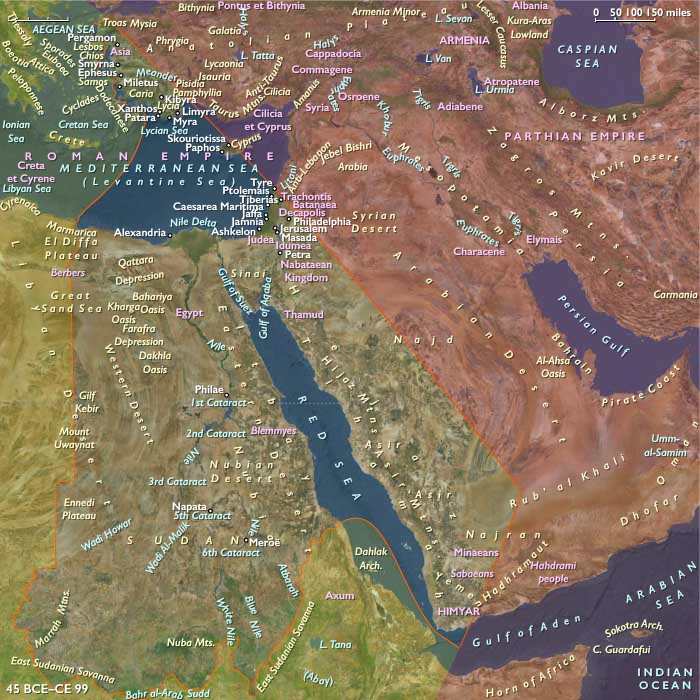
The only major sect to survive the turmoil is the Pharisees, who quickly adapt to new realities, focusing their teachings away from Temple-centric worship toward broader community practices. Prominent Pharisee Yohanan ben Zakkai establishes himself as the first Patriarch (Nasi) and reconstitutes the Sanhedrin at Yavneh, marking the rise of rabbinic Judaism. In place of traditional sacrificial rituals, the rabbis now instruct Jews to engage in acts of charity and emphasize the study of Torah in local synagogues, transforming religious practice into a communal and scholarly endeavor. Galilee, particularly the city of Tiberias, emerges as the new center of rabbinic learning.
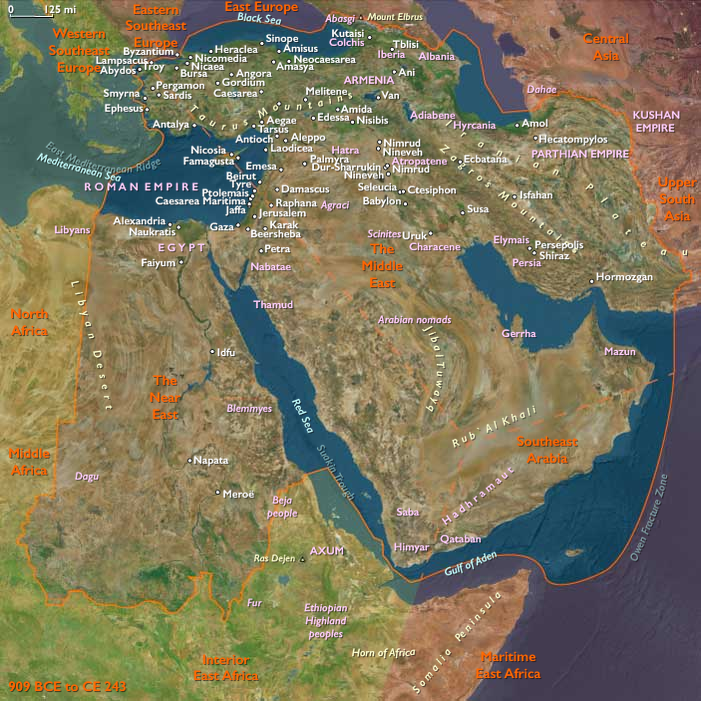
Elsewhere, urban centers such as Alexandria, Miletus, and Smyrna flourish as prominent hubs of commerce and production, bolstering the development of an affluent urban Greek elite.
This period also sees significant developments in early Christian literature. The Gospel According to Matthew, traditionally ascribed to the Apostle Matthew and written primarily for Jewish-Christian communities, emphasizes fulfillment of Old Testament prophecies and presents Jesus as a new lawgiver. Written between approximately 70–90 CE, its narrative structure and thematic elements heavily draw upon earlier sources, notably the Gospel of Mark.
Likewise, the Gospel According to Luke, composed around 80–90 CE, offers a detailed account emphasizing universal salvation, the dignity of women, and social compassion, uniquely presenting parables such as the Good Samaritan and the Prodigal Son. Often linked stylistically and thematically with the Acts of the Apostles, Luke’s Gospel significantly shapes the early Christian narrative and community identity.
Legacy of the Era
The era from 76 to 87 CE is transformative, solidifying rabbinic Judaism as the central framework for Jewish religious and community life following the destruction of the Temple. Concurrently, flourishing urban centers and the development of key Christian texts reflect broader cultural and religious transitions within the Near East, setting foundational patterns that profoundly influence subsequent historical and spiritual landscapes.
People
Groups
Topics
Subjects
Regions
Subregions
Related Events
Showing 10 events out of 61554 total
Years: 76 - 87
People
Groups
Topics
Subjects
Regions
Subregions