
Near East (597–586 BCE): Siege, Subjugation, and …
Years: 597BCE - 586BCE
Near East (597–586 BCE): Siege, Subjugation, and Cultural Realignment
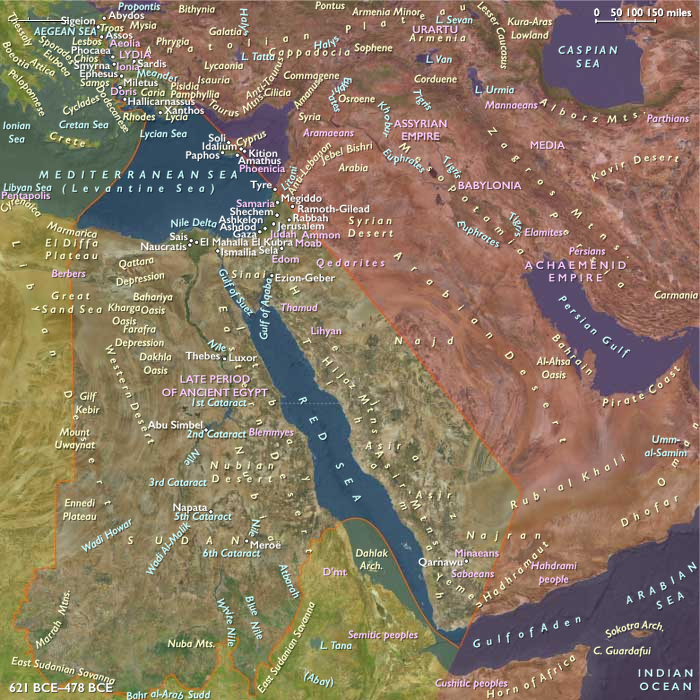
Miletus, Smyrna, and Ionian Decline
The Ionian city of Smyrna, having flourished in the previous century, suffers a devastating setback when Lydian King Alyattes captures and sacks the city around 600 BCE. Smyrna's inhabitants are forced into the countryside, dismantling their political unity and relegating the city to a mere collection of villages. This event highlights the peak of Lydian dominance under Alyattes, who also subjugates cities like Clazomenae, marking the decline of Ionian political autonomy despite continued cultural and commercial significance.
Egyptian Endeavors and Necho II’s Legacy
Pharaoh Necho II, having abandoned attempts at Asian conquest after the defeats against Babylon, redirects Egyptian efforts toward internal stabilization and maritime expansion. According to Herodotus, Necho commissions a pioneering circumnavigation of Africa by Phoenician sailors, a voyage reportedly lasting three years. Though debated by modern historians, this expedition underscores Egypt’s intensified interest in maritime exploration and trade. Necho’s reign concludes in 595 BCE, succeeded by his son Psamtik II, who notably removes Necho's inscriptions from monuments for unclear reasons.
Psamtik II and Egyptian Military Revival
Psamtik II undertakes a significant military campaign against Nubia around 592 BCE, decisively crushing the Kingdom of Kush. His forces sack Napata, destroy royal statues, and loot temples, compelling the Nubians to move their capital further south to the safer and iron-rich region of Meroë. Psamtik II’s aggressive strategy effectively eliminates Nubian aspirations to reconquer Egypt, solidifying Egypt’s southern frontier. The Pharaoh's reign also witnesses extensive temple construction, notably at Hibis in El-Kharga Oasis, marking his short but impactful rule.
Babylonian Siege and Fall of Jerusalem
Nebuchadrezzar II, King of Babylon, asserts dominion over Judah, responding decisively to Zedekiah’s rebellion incited partly by Egyptian intervention under Psamtik II in 589 BCE. Jerusalem endures an intense siege beginning in 588 BCE. The prophet Jeremiah advocates surrender, interpreting Babylonian dominance as divinely ordained, yet Jerusalem resists. In 586 BCE, Nebuchadrezzar breaches the city, destroys the Temple, and razes Jerusalem’s walls. King Zedekiah is captured, forced to witness his sons' execution, blinded, and exiled to Babylon along with Judah’s elite.
Lachish Letters and Regional Collapse
The Lachish Letters, a poignant archaeological discovery, vividly describe the last days before Lachish falls to Babylonian forces around 588–586 BCE. Written on pottery shards, these communications reveal the desperation of Judah’s defenders and underscore the widespread chaos preceding Jerusalem’s fall. The Edomites, historical adversaries of Judah, align themselves with Babylon, exacerbating Judah's collapse.
Cultural and Scientific Developments
The period also marks significant advancements in Greek philosophy and early science. Notably, Thales of Miletus, recognized for his studies in geometry and astronomy, is traditionally credited with predicting a solar eclipse in 585 BCE. His explorations into static electricity, observing amber's unique properties, exemplify early scientific curiosity that foreshadows later Hellenic intellectual achievements.
Legacy of the Era
This era signifies a profound reshaping of Near Eastern political and cultural landscapes. The destruction of Jerusalem by Babylonian forces dramatically alters the historical trajectory of the Hebrew people, marking the beginning of the Jewish exile. Egypt, under the Saite dynasty, experiences a brief military resurgence, while Greek cultural influence continues to grow despite setbacks, laying the foundation for future intellectual and scientific breakthroughs.
People
- Alyattes II
- Jeremiah
- Nabopolassar
- Nebuchadnezzar II
- Necho II
- Psamtik II
- Thales of Miletus
- Zedekiah of Judah
Groups
- Edomites, Kingdom of the
- Lydia, Kingdom of
- Miletus (Ionian Greek) city-state of
- Judah, Kingdom of
- Greeks, Classical
- Egypt (Ancient), Late Period of
- Neo-Babylonian, or Chaldean, Empire
Topics
Commodoties
Subjects
Regions
Subregions
Years: 597BCE - 586BCE
People
- Alyattes II
- Jeremiah
- Nabopolassar
- Nebuchadnezzar II
- Necho II
- Psamtik II
- Thales of Miletus
- Zedekiah of Judah
Groups
- Edomites, Kingdom of the
- Lydia, Kingdom of
- Miletus (Ionian Greek) city-state of
- Judah, Kingdom of
- Greeks, Classical
- Egypt (Ancient), Late Period of
- Neo-Babylonian, or Chaldean, Empire
Topics
Commodoties
Subjects
Regions
Subregions