
Near East (537–526 BCE): Restoration, Return, and …
Years: 537BCE - 526BCE
Near East (537–526 BCE): Restoration, Return, and Persian Expansion
Judahite Return from Exile
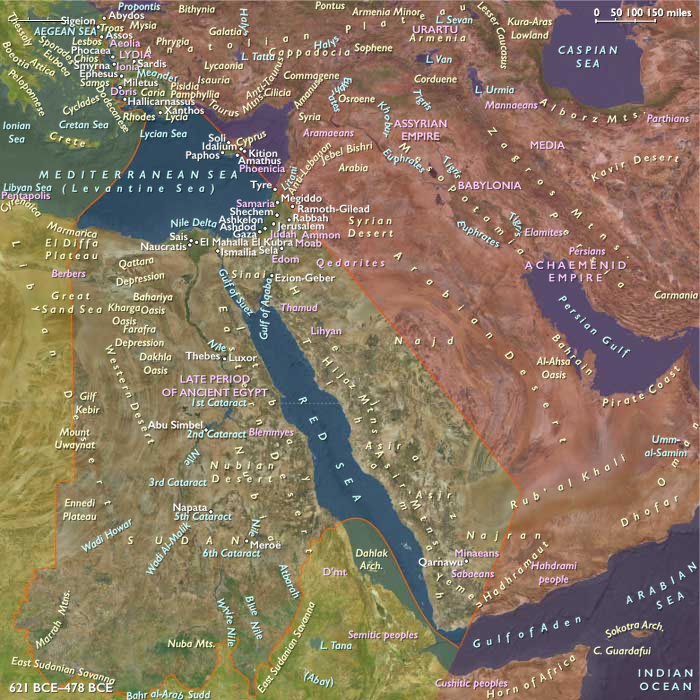
Following Cyrus the Great's conquest of Babylon in 539 BCE, Judahites, exiled for nearly half a century, are permitted to return to their ancestral homeland. Under the leadership of Zerubbabel, a prince of the Davidic lineage, approximately forty thousand Judahites journey back to rebuild the sacred Temple in Jerusalem. Yet their return is marked by considerable hardship and opposition. Southern Judah, notably the region south of Hebron, has been settled by Edomites, while northern areas have fallen under the jurisdiction of the governor of Samaria. This complex political situation poses significant obstacles to the Judahite restoration efforts.
Transition and Conquest in Egypt
In Egypt, Pharaoh Amasis II, who had cultivated prosperous alliances and brought Egypt notable stability and economic growth, dies in 526 BCE. He is succeeded briefly by his son, who takes the throne as Psamtik III (Psammetichus III). However, Psamtik's reign is short-lived, as the Persian king Cambyses II, son and successor of Cyrus, swiftly capitalizes on Egyptian vulnerability. Within mere months of Psamtik III’s accession, Cambyses launches a decisive invasion, defeats the Egyptian forces, deposes the young pharaoh, and embarks upon the subjugation of all Egypt, bringing the entire Nile Valley under Persian domination.
Legacy of the Era
This era is characterized by profound geopolitical shifts. For the Judahites, the return from Babylonian captivity initiates a difficult but transformative chapter in their history, significantly reshaping their cultural and religious identity. Simultaneously, Cambyses' invasion signals the end of Egypt's native Saite dynasty and marks the integration of Egypt into the expansive Persian Empire, heralding a new period of imperial rule and cultural integration in the Near East.
People
Groups
Subjects
Regions
Subregions
Related Events
Showing 10 events out of 65787 total
Years: 537BCE - 526BCE
People
Groups
Subjects
Regions
Subregions