
Near East (513–502 BCE): Samaritan Identity and …
Years: 513BCE - 502BCE
Near East (513–502 BCE): Samaritan Identity and Ionian Intrigue
Samaritan Origins and Religious Identity
In the wake of the Assyrian conquest centuries earlier, the post-exilic population of Samaria is described by Jewish tradition as colonists introduced from Mesopotamia who adopted a form of Judaism regarded by mainstream Jews as distorted. Known as Shomronim (Samaritans) among Hebrew-speakers, they are referred to pejoratively in the Talmud—the rabbinical compilation of Jewish law and commentary—as Kutim, implying descent from settlers originally from the Mesopotamian city of Cuthah.
The Samaritans themselves, however, firmly maintain a distinct narrative: they identify as the direct descendants of those Israelites of the ancient northern kingdom who escaped deportation following the Assyrian conquest of 722 BCE. Asserting their lineage from the tribes of Ephraim and Manasseh, they refer to themselves as Bene-Yisrael ("Children of Israel") or Shamerim ("Observant Ones"), emphasizing their adherence exclusively to the Pentateuch—the first five books of the Hebrew Bible—as their canonical scripture. Rejecting all other prophets, the Samaritans uniquely revere Moses alone as a prophet.
Modern scholarship suggests that the Samaritan community likely emerged from a blend of indigenous northern Israelites who remained after the Assyrian deportations, intermarried and integrated with Assyrian-introduced colonists, resulting in their distinctive religious and ethnic identity.
Miletus, Histiaeus, and Persian Politics
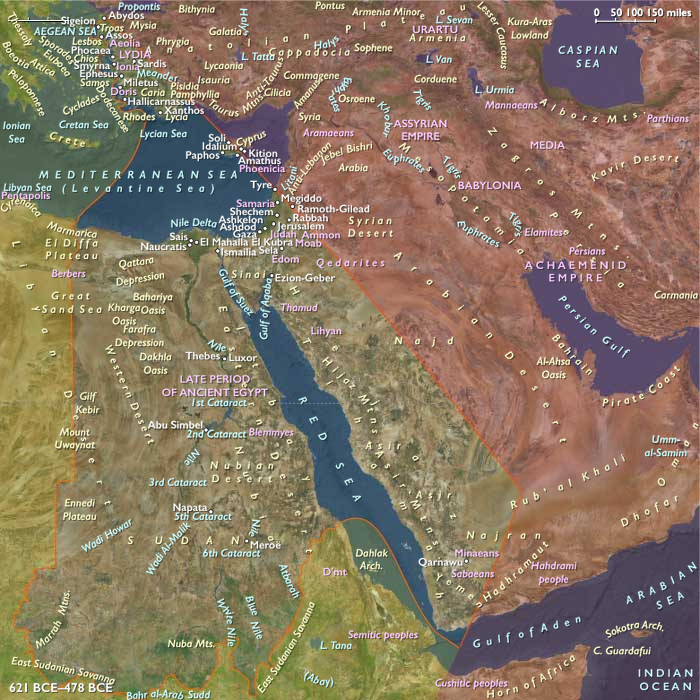
Meanwhile, political tensions rise in Anatolia. Histiaeus, the tyrant of Miletus, comes to prominence by offering crucial support to Persian King Darius I during his military campaign against the Scythians around 513 BCE. Herodotus records that Histiaeus convinces fellow Ionian tyrants not to destroy the strategic bridge over the Danube River, facilitating the safe return of the Persian army from Scythian territory. In gratitude, Darius grants Histiaeus control over territory in Thrace.
However, this close relationship soon sours. Darius, increasingly wary of Histiaeus’s growing influence and suspicious of his intentions, summons him to the Persian capital of Susa, effectively placing him under polite but strict confinement to limit his political power. With Histiaeus sidelined, governance of Miletus passes to his ambitious son-in-law, Aristagoras—a decision that sets the stage for forthcoming unrest in the Ionian region, ultimately leading toward the pivotal Ionian Revolt against Persian domination.
Legacy of the Era
The period between 513 and 502 BCE thus marks an important intersection of religious identity formation in the Levant and escalating geopolitical tensions in the Greek-inhabited territories of Anatolia. The crystallization of Samaritan identity, with its enduring religious and cultural distinctiveness, coincides with political maneuvers and tensions in the western reaches of the Persian Empire—developments that foreshadow greater conflict and transformation in the region.
People
Groups
Topics
Subjects
Regions
Subregions
Years: 513BCE - 502BCE
People
Groups
Topics
Subjects
Regions
Subregions