
Near East (333–322 BCE): Alexander’s Conquests and …
Years: 333BCE - 322BCE
Near East (333–322 BCE): Alexander’s Conquests and the Macedonian Empire
The year 333 BCE inaugurates the Hellenistic Age in the eastern Mediterranean and the Near East, as Alexander III of Macedon decisively defeats the Persian Empire, ushering in profound geopolitical and cultural transformations across the region.
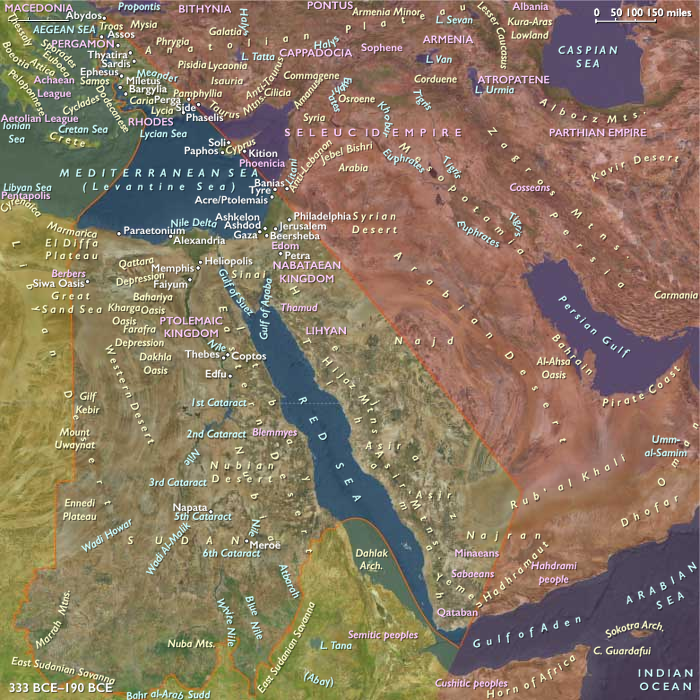
Alexander’s conquest begins with significant military victories at the battles of the Granicus (334 BCE) and the Issus (333 BCE). Following these triumphs, he systematically campaigns through Asia Minor, the Levant, Egypt, Assyria, Babylonia, and Persia. Alexander’s occupation of Egypt marks a pivotal moment as he is welcomed as pharaoh, reflecting his strategic adoption of local governance and religious practices to solidify his rule.
The decisive battle at Gaugamela (331 BCE) culminates in the collapse of the Persian Empire and the flight of Persian King Darius III, allowing Alexander to assume control of the vast Persian territories. However, his dominion remains challenged, necessitating continued military efforts to consolidate authority. Alexander integrates various conquered peoples by adapting administrative structures, encouraging intermarriage between Macedonians and local populations, and founding new cities to anchor his empire, notably Alexandria in Egypt (331 BCE).
While Alexander continues his ambitious military expeditions into Central Asia and the Indian subcontinent, his increasingly weary troops mutiny, compelling his return westward. His remarkable empire-building is abruptly curtailed by his premature death from fever in Babylon in 323 BCE.
Alexander’s sudden demise precipitates immediate succession crises, resolved temporarily through the Partition of Babylon (323 BCE), orchestrated primarily by Perdiccas. Macedonian generals, including Ptolemy Soter, Seleucus, Antigonus Monophthalmus, and Antipater, claim governance over fragmented portions of Alexander's territories, setting the stage for prolonged conflicts among these Diadochi (successors).
Philip III Arrhidaeus, Alexander’s half-brother, is installed as nominal king alongside Alexander's infant son, Alexander IV, under the regency of Perdiccas. Meanwhile, the Lamian War (323–322 BCE) erupts in Greece, involving Athens and allied city-states against Macedonian control, ultimately resulting in a Macedonian victory and reinforcing Macedonian hegemony in the region.
By 322 BCE, the Near East stands at the cusp of significant fragmentation, poised between Alexander’s unifying legacy and the divisive ambitions of his successors, signaling a prolonged era of Hellenistic influence and rivalry.
People
- Alexander IV of Macedon
- Alexander the Great
- Antigonus I Monophthalmus
- Antipater
- Darius III
- Perdiccas
- Philip III Arrhidaeus
- Ptolemy I Soter
- Seleucus I
Groups
- Greeks, Classical
- Macedon, Argead Kingdom of
- Achaemenid, or First Persian, Empire
- Athens, City-State of
Topics
- Alexander the Great, Wars of
- Issus, Battle of, or at
- Tyre, Siege of
- Guagamela (Arbela), Battle of
- Alexander's Asiatic Campaign
- Diadochi, Wars of the
- Lamian War
Subjects
Regions
Subregions
Related Events
Showing 1 events out of 1 total
Years: 333BCE - 322BCE
People
- Alexander IV of Macedon
- Alexander the Great
- Antigonus I Monophthalmus
- Antipater
- Darius III
- Perdiccas
- Philip III Arrhidaeus
- Ptolemy I Soter
- Seleucus I
Groups
- Greeks, Classical
- Macedon, Argead Kingdom of
- Achaemenid, or First Persian, Empire
- Athens, City-State of
Topics
- Alexander the Great, Wars of
- Issus, Battle of, or at
- Tyre, Siege of
- Guagamela (Arbela), Battle of
- Alexander's Asiatic Campaign
- Diadochi, Wars of the
- Lamian War
Subjects
Regions
Subregions