
Near East (33–22 BCE): Rome Conquers Egypt …
Years: 33BCE - 22BCE
Near East (33–22 BCE): Rome Conquers Egypt and Ends the Hellenistic Era
The Roman Republic, increasingly dominated by Octavian, confronts Mark Antony following Antony's betrayal and his alliance with the Egyptian queen Cleopatra VII. In 32 BCE, the Roman Senate formally declares war against Cleopatra, characterizing Antony as a traitor for siding with Egypt against Rome. The decisive confrontation occurs at the Battle of Actium in 31 BCE, where Octavian, aided by his general and close ally Marcus Agrippa, achieves a conclusive naval victory.
Following their defeat at Actium, Antony and Cleopatra retreat to Alexandria. Octavian besieges the city, which falls in 30 BCE. Faced with inevitable capture, both Antony and Cleopatra choose suicide, Antony by sword and Cleopatra reportedly by the bite of an asp. With their deaths, the centuries-old Ptolemaic Kingdom concludes, marking the end of the Hellenistic Age.
Egypt is annexed by Rome in 30 BCE, becoming a Roman province governed directly by Octavian’s appointed prefects. The wealth and resources of Egypt, particularly grain, significantly bolster Rome’s imperial strength, reinforcing Octavian's political dominance in Rome. The Roman Republic is poised for its transition into the Roman Empire, with Octavian—soon to be named Augustus—as its first emperor.
Legacy of the Era
The era from 33 to 22 BCE witnesses Rome’s consolidation of power over Egypt and the broader Near East, bringing an end to the Hellenistic kingdoms. This period definitively transforms the geopolitical landscape of the eastern Mediterranean, firmly embedding Roman administrative structures and cultural influence in a region historically shaped by diverse local traditions and Hellenistic governance.
People
Groups
- Roman Republic
- Greeks, Hellenistic
- Egypt, Ptolemaic Kingdom of
- Parthian Empire
- Egypt (Roman province)
- Roman Principate (Rome)
Topics
Commodoties
Subjects
Regions
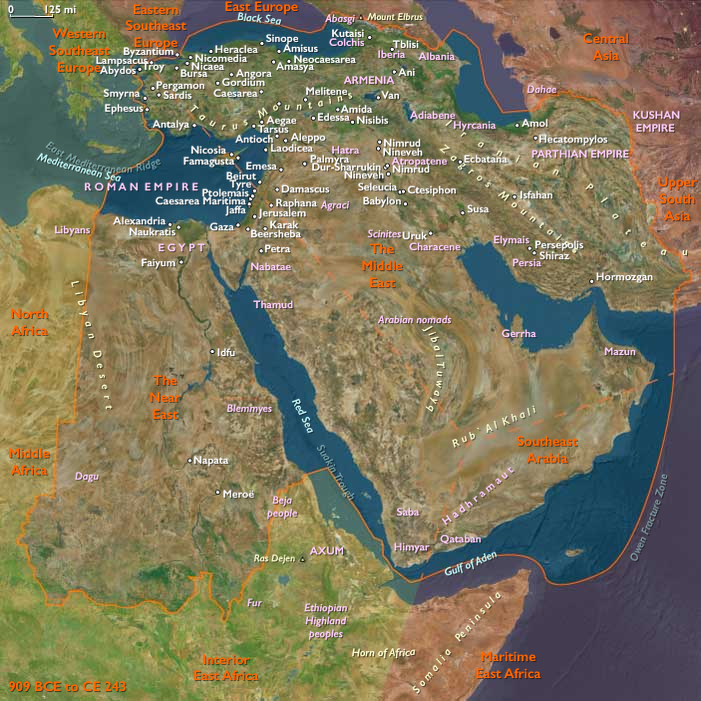
Subregions
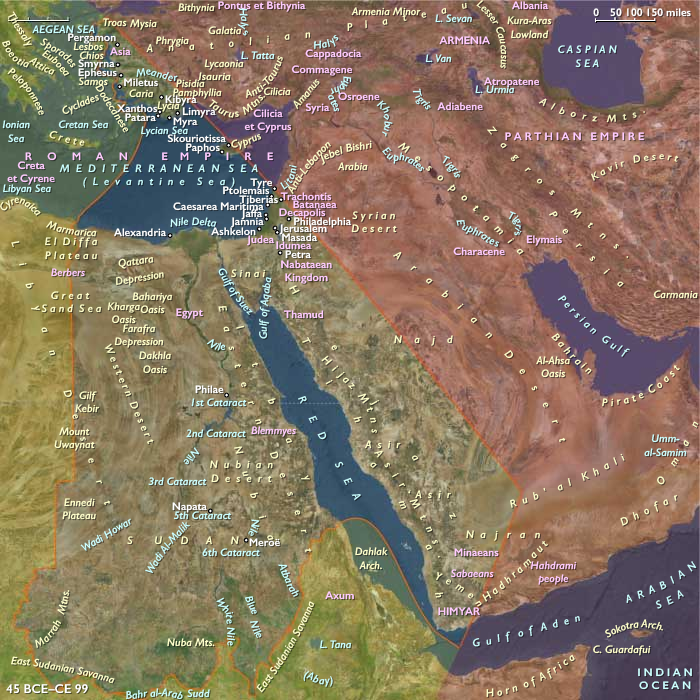
Related Events
Showing 10 events out of 16 total
Years: 33BCE - 22BCE
People
Groups
- Roman Republic
- Greeks, Hellenistic
- Egypt, Ptolemaic Kingdom of
- Parthian Empire
- Egypt (Roman province)
- Roman Principate (Rome)
Topics
Commodoties
Subjects
Regions
Subregions