
Near East (393–382 BCE): Egyptian Revolt and …
Years: 393BCE - 382BCE
Near East (393–382 BCE): Egyptian Revolt and Persian Reassertion
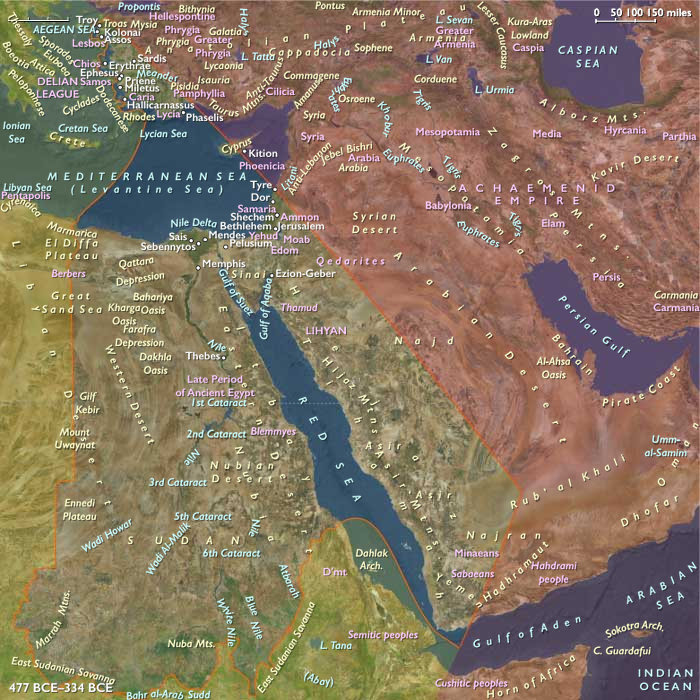
Between 393 and 382 BCE, the Near East witnesses renewed tensions and geopolitical maneuvering, particularly centered around Egypt’s resistance against Persian dominion. Egyptian king Hakor boldly revolts against Persian King Artaxerxes II in 390 BCE. To support his rebellion, Hakor forms a strategic tripartite alliance with Evagoras, king of Cyprus, and with the city-state of Athens.
This alliance profoundly impacts the broader geopolitical landscape. Persia, responding strategically, begins to support Sparta in the ongoing Corinthian War in Greece, a move designed to counterbalance Athenian support for Egypt. This Persian intervention eventually leads to the Peace of Antalcidas in 387/6 BCE, by which Artaxerxes II asserts Persian authority over the Greek cities of Asia Minor and Cyprus, granting autonomy to the Greek city-states of mainland Greece provided they abstain from aggression against Persia.
With the Greek front stabilized, Persia redirects its military attention fully toward Egypt. Despite repeated assaults from 385 to 383 BCE, Persian forces, countered by the capable defense led by Hakor and the strategic assistance of the Athenian general Chabrias, fail to subdue Egypt decisively. The resilience of Hakor’s Egypt in this conflict highlights the persistent determination for regional autonomy, illustrating the ongoing struggle between local independence and Persian imperial ambitions.
People
Groups
- Cyprus, Classical
- Sparta, Kingdom of
- Egypt (Ancient), Late Period of
- Achaemenid, or First Persian, Empire
- Athens, City-State of
Topics
Subjects
Regions
Subregions
Related Events
Showing 5 events out of 5 total
Years: 393BCE - 382BCE
People
Groups
- Cyprus, Classical
- Sparta, Kingdom of
- Egypt (Ancient), Late Period of
- Achaemenid, or First Persian, Empire
- Athens, City-State of
Topics
Subjects
Regions
Subregions