
Near East (52–63 CE): Procuratorial Rule and …
Years: 52 - 63
Near East (52–63 CE): Procuratorial Rule and Rising Unrest
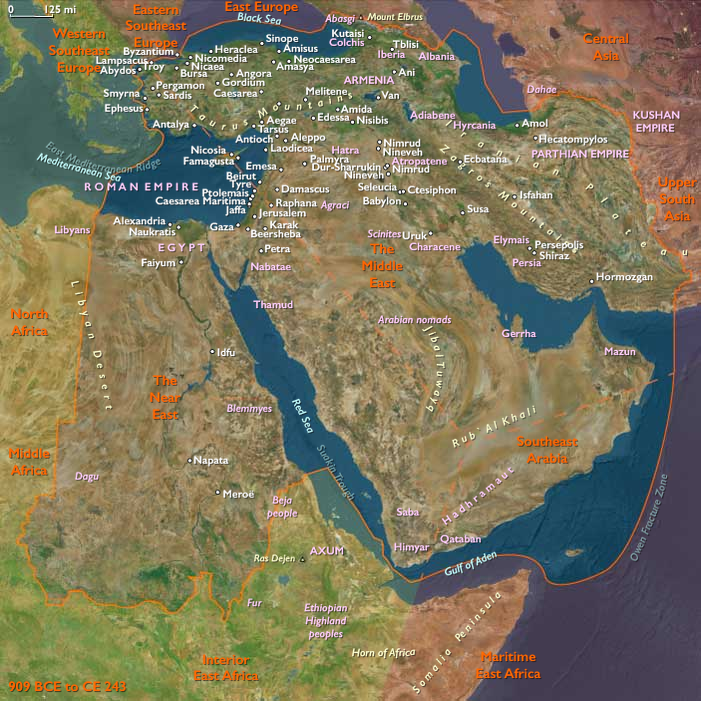
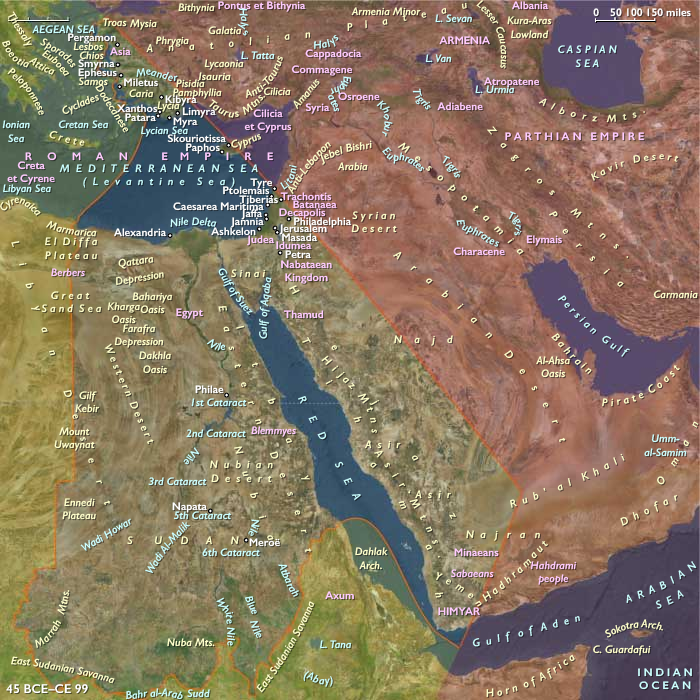
This era sees the Near East continuing under semiautonomous client-state governance, with Judea and Galilee operating under the tribute system imposed by Roman authorities. Jews largely accept the payment of tribute but strongly resist the imposition of any graven images within their Temple, a point of contention that periodically strains relations with Rome.
The governance of Judea and surrounding regions by Roman procurators during this period frequently leads to mismanagement, causing significant disturbances. The administration of Ventidius Cumanus had already been marked by unrest, and tensions further escalate under his successor, Felix, who takes office in 52 CE. Felix's tenure is characterized by frequent outbreaks of open rebellion, fueled by oppressive policies and insensitivity toward local customs and traditions.
Felix’s inability to balance Roman interests with local sensibilities exacerbates existing tensions, laying the groundwork for more serious rebellions. His tenure marks a significant deterioration in Roman-Jewish relations, setting the stage for greater conflicts in the ensuing decades.
Legacy of the Era
The period from 52 to 63 CE underscores the challenges of Roman provincial administration, highlighting how ineffective governance can swiftly transform manageable tensions into open revolt. The increasing unrest and rebellion during Felix's procuratorship serve as a critical precursor to the broader instability that will culminate in the Great Jewish Revolt later in the century.
People
Groups
Topics
Subjects
Regions
Subregions
Related Events
Filter results
Showing 10 events out of 61744 total
Emperor Claudius and the Expansion of the Roman Empire (41–54 CE)
Emperor Claudius (r. 41–54 CE), known for his shrewd administrative skills and focus on imperial stability, actively expanded Roman citizenship and established new Roman cities throughout the empire. He recognized that urbanization and integration of provincial elites were key to maintaining imperial control and governance.
Claudius’ Territorial Expansions
During his reign, several key regions were incorporated into the Roman Empire, strengthening Rome’s dominance in Western Europe, North Africa, and beyond:
1. The Roman Conquest of Britain (43 CE)
- Under Claudius, Rome finally launched the long-awaited invasion of Britain, previously attempted under Julius Caesar (55–54 BCE) and planned but abandoned by Caligula (40 CE).
- Aulus Plautius led the campaign with four legions, successfully defeating the Catuvellauni and their allies.
- Claudius personally traveled to Britain to accept the submission of local chieftains, marking the formal annexation of Britannia as a Roman province.
- Roman fortresses, roads, and cities were established, including Camulodunum (Colchester), the first provincial capital.
2. Annexation of Mauretania (42 CE)
- Mauretania, previously a client kingdom, was formally annexed into the empire after the execution of its last king, Ptolemy of Mauretania (40 CE).
- The kingdom was divided into two new provinces:
- Mauretania Tingitana (modern Morocco)
- Mauretania Caesariensis (modern Algeria)
- This secured Roman dominance over North Africa, allowing easier control of trade and military movementsalong the western Mediterranean.
3. The Integration of Thrace (46 CE)
- Thrace, previously a client kingdom, was incorporated into the empire after the death of King Rhoemetalces III.
- Rome stationed legions in the region, securing its strategic position near the Danube frontier and preventing incursions from barbarian tribes.
4. The Formalization of the Gallic Provinces
- Although Gallia had been conquered by Julius Caesar (58–50 BCE), Claudius reorganized the region into formal provinces, strengthening its administrative structure:
- Gallia Lugdunensis
- Gallia Belgica
- Gallia Aquitania
- These changes further Romanized Gaul, granting citizenship to local elites and promoting the growth of Roman cities and infrastructure.
Claudius’ Administrative and Urbanization Policies
- Claudius expanded Roman citizenship, granting legal rights to provincial elites, helping integrate them into the imperial system.
- He established new Roman colonies across the empire, reinforcing loyalty to Rome and fostering economic development.
- His policies ensured that the provinces were not merely conquered lands, but integrated parts of the Roman world, securing long-term stability and prosperity.
Legacy of Claudius’ Expansions
- By expanding Rome’s borders, Claudius solidified control over Western Europe, North Africa, and the Balkans.
- His emphasis on provincial urbanization helped spread Roman law, culture, and infrastructure across newly incorporated territories.
- The annexation of Britain, in particular, marked the beginning of nearly 400 years of Roman rule, shaping the island’s historical and cultural trajectory.
Claudius’ reign cemented Rome’s position as the dominant power of the ancient world, ensuring that its frontiers, administration, and economy remained strong for generations to come.
The Middle East: 52–63 CE
The Roman-Parthian Struggle for Armenia
During this era, the longstanding rivalry between Rome and Parthia over influence in Armenia escalates into open conflict. Although Armenia had remained a Roman client kingdom since the reign of Emperor Augustus, in 52/53 CE the Parthian king Vologases I capitalizes on Roman distraction and successfully installs his brother, Tiridates, on the Armenian throne, challenging Roman regional hegemony.
The timing coincides with the accession of Emperor Nero in 54 CE, who, eager to assert his imperial authority, initiates a vigorous military response. Under the command of the accomplished Roman general Gnaeus Domitius Corbulo, Rome swiftly defeats Armenian forces loyal to Tiridates. Corbulo's successful campaigns culminate in placing the pro-Roman candidate, Tigranes VI, upon the Armenian throne. Believing their mission accomplished, Roman forces withdraw, leaving behind a seemingly stable client state.
However, internal Parthian disturbances that had initially distracted Vologases are soon resolved, enabling him to redirect his full attention back to Armenia. Renewed conflict ensues, and after a protracted period of inconclusive skirmishes, the Parthians decisively defeat Roman forces at the Battle of Rhandeia in 62 CE.
In the wake of this significant defeat, Rome and Parthia agree to a diplomatic compromise: henceforth, Armenia's king must be a Parthian prince from the Arsacid dynasty, subject to formal approval by the Roman emperor. This arrangement, while acknowledging Parthian influence, preserves Roman prestige and diplomatic involvement in the region.
This conflict marks the first direct Roman-Parthian military confrontation since the disastrous campaign of Crassus in 53 BCE and Mark Antony’s ill-fated invasions nearly a century earlier. It inaugurates a prolonged series of struggles between the two empires for dominance over strategically critical Armenia.
Armenia has been a Roman client state since the days of Emperor Augustus, but in 52/53 the Parthians succeed in installing their own candidate, Tiridates, on the Armenian throne.
These events coincide with the accession of Nero to the imperial throne in Rome, and the young emperor decides to react vigorously.
The war, which is the only major foreign campaign of his reign, begins with rapid success for the Roman forces, led by the able general Gnaeus Domitius Corbulo.
They overcome the forces loyal to Tiridates, install their own candidate, Tigranes VI, on the Armenian throne, and leave the country.
The Romans are aided by the fact that the Parthian king Vologases is embroiled in the suppression of a series of revolts in his own country.
As soon as these have been dealt with, however, the Parthians turn their attention to Armenia, and after a couple of years of inconclusive campaigning, inflict a heavy defeat on the Romans in the Battle of Rhandeia.
The conflict ends soon after, in an effective stalemate and a formal compromise: a Parthian prince of the Arsacid line will henceforth sit on the Armenian throne, but his nomination has to be approved by the Roman emperor.
This conflict is the first direct confrontation between Parthia and the Romans since Crassus' disastrous expedition and Mark Antony's campaigns a century earlier, and is the first of a long series of wars between Rome and Iranian powers over Armenia.
Judea and Galilee have from CE 6 effectively operated as semiautonomous client-states under Roman tribute.
Jews for the most part are willing to pay tribute, although they complain when it is excessive, and absolutely refuse to allow a graven image in their Temple although some emperors have considered imposing one.
The primary tasks of the tetrarch and high priest are to collect tribute, persuade the Romans not to interfere with the Temple, and ensure that the Jews not rebel.
Disturbances in Judea during the early years of procuratorial rule are frequent and largely caused by maladministration.
Serious trouble had arisen under Ventidius Cumanus; and under the imperial freedman Felix, who in CE 52 succeeds him, rebellion becomes open, though sporadic.
The multitiered Pont du Gard, a splendid example of Roman aqueduct engineering, is constructed over a gorge located just outside Nimes to carry the aqueduct channel to a freshwater source about fifteen miles (twenty-five kilometers) away.
Three tiers of stone arches support a water channel, and a footbridge runs among the first tier.
The construction of the aqueduct has long been credited to Augustus' son-in-law and aide, Marcus Vipsanius Agrippa, around the year 19 BCE.
At the time, he was serving as aedile, the senior magistrate responsible for managing the water supply of Rome and its colonies.
Émile Espérandieu, writing in 1926, linked the construction of the aqueduct with Agrippa's visit to Narbonensis in that year (Bromwich, James [2006].
Roman Remains of Southern France: A Guide Book.
Routledge.
p.
110.).
Newer excavations, however, suggest the construction may have taken place between 40 and 60 CE.
Tunnels dating from the time of Augustus had to be bypassed by the builders of the Nîmes aqueduct, and coins discovered in the outflow in Nîmes are no older than the reign of the emperor Claudius (41-54 CE).
On this basis, a team led by Guilherm Fabre has argued that the aqueduct must have been completed around the middle of the first century CE (Fabre, G, Fiches, J.-L., and Paillet, J.-L. 1991.
"Interdisciplinary Research on the Aqueduct of Nimes and the Pont du Gard."
Journal of Roman Archaeology 4, 63-88).
It is believed to have taken about fifteen years to build, employing between eight hundred and one thousand workers.
Mediterranean Southwest Europe (52–63 CE): Cultural Flourishing and Artistic Innovations
The era 52–63 CE is notable for its cultural achievements and artistic innovations, reflecting the stability and prosperity secured during Claudius’s reign and continuing under Nero’s early rule. This period highlights advancements in Roman art and monumental architecture, particularly in funerary traditions and public representations.
Development of Roman Sarcophagi
During this era, the "Roman type" of sarcophagus gains prominence, characterized by its intricate carvings in high relief. These sarcophagi often depict elaborate scenes, including decorative garlands, vivid representations of battles, and complex mythological narratives. Such ornate burial vessels exemplify Roman artistry, reflecting societal values and the prestige of the deceased.
Cultural and Artistic Patronage under Nero
With Nero ascending to the throne in 54 CE after Claudius’s death, the empire initially experiences continued stability and cultural patronage. Nero actively supports artistic and cultural endeavors, significantly influencing Roman art, theater, music, and architecture. His reign, initially well-received, becomes synonymous with a heightened artistic sensibility and extensive public spectacles.
Urban and Architectural Expansion
Nero’s early reign sees ambitious urban development projects throughout Rome and its provinces. Significant infrastructure enhancements include theaters, baths, and public spaces, contributing to civic pride and the empire’s cultural dynamism. These projects reinforce Rome's imperial image, demonstrating power, wealth, and cultural sophistication.
Social and Economic Continuity
Economically, Mediterranean Southwest Europe continues to benefit from stable governance and robust trade networks established during previous reigns. Roman administrative and economic structures sustain prosperity, fostering vibrant marketplaces and extensive regional trade.
Early Signs of Nero’s Controversial Leadership
While Nero initially enjoys popularity, early indicators of his controversial and extravagant leadership style emerge, notably in his lavish expenditures on personal luxuries and extravagant artistic productions. Though still popular with the general populace due to public entertainment and cultural patronage, his behavior increasingly alarms Rome's political elite.
Legacy of the Era
The era 52–63 CE is characterized by significant cultural flourishing and artistic development, reflecting Rome’s broader stability and wealth. The prominence of ornate Roman sarcophagi and Nero’s early cultural patronage leave a lasting artistic legacy, even as early signs of his later contentious leadership begin to appear.
The "Roman type" of sarcophagus is carved in high relief, often with representations of garlands, battles, and mythological subjects.
North Africa (52–63 CE)
Roman Consolidation, Urban Development, and the Extinction of Silphium
Roman Provincial Administration and Stability
From 52 to 63 CE, Roman governance in Africa Proconsularis reinforces regional stability and economic prosperity through continued investments in infrastructure and governance reforms. Major cities including Utica, Leptis Magna, and Caesarea (Cherchell) flourish, benefiting from expanded trade networks and integrated administrative policies that strengthen their roles as essential Roman Mediterranean hubs.
Numidia: Continued Economic Growth and Cultural Integration
Numidia sustains its prosperity under effective Roman administration, which promotes agricultural productivity, trade enhancement, and social cohesion. Numidian communities harmoniously integrate indigenous traditions with Roman governance, ensuring ongoing economic stability and cultural resilience.
Mauretania: Client-Kingdom Prosperity and Urban Expansion
Under the rule of the client king Ptolemy of Mauretania, grandson of Cleopatra and Mark Antony, Mauretania experiences a period of notable economic prosperity. Caesarea, renamed and developed extensively by his father, King Juba II, continues to thrive as a significant center of commerce and culture, drawing wealth from vibrant trade in grain, olive oil, and luxury goods. The city's enhanced infrastructure, including new buildings and monuments, reinforces Mauretania’s strategic importance and regional influence within the Roman Empire.
Cyrenaica: Decline and the Extinction of Silphium
Cyrenaica's economic vitality, historically bolstered by commerce in grain, wine, wool, and livestock, faces a significant turning point. The Greek Pentapolis—Cyrene, Barce, Euhesperides, Teuchira, and Apollonia—remains active but increasingly dependent on Roman administrative and economic structures. By this time, silphium, once integral to Cyrenaica's economy and prominently depicted on local coinage, has reached extinction due to relentless overharvesting and the inability to cultivate it. The Roman historian Pliny notes that the last known stalk of silphium was presented to Emperor Nero as a curiosity, symbolically marking the end of an economic era in the region.
Berber Communities: Economic Participation and Cultural Resilience
Berber populations remain economically active, particularly through prosperous coastal cities such as Oea (Tripoli). Inland Berber tribes continue to preserve traditional governance systems and cultural practices, benefiting indirectly from thriving coastal trade, reinforcing regional economic integration and cultural continuity.
Garamantes: Saharan Trade and Economic Connectivity
The Garamantes maintain their critical role in trans-Saharan trade, effectively managing caravan routes and employing sophisticated agricultural practices to sustain oasis settlements. Their strategic control supports robust economic exchanges linking sub-Saharan Africa with Mediterranean markets, ensuring continued prosperity and cultural integration.
Mauri (Moors) and Saharan Pastoral Nomads
The Mauri (Moors) uphold their regional prominence through diplomatic relations and dynamic economic activities, significantly contributing to the ongoing stability and prosperity of western North Africa.
Saharan pastoral nomads remain pivotal in facilitating extensive trade networks, cultural exchanges, and information flows, thereby reinforcing the interconnectedness and resilience of the region.
Cultural Syncretism and Regional Integration
Ongoing interactions among Berber, Roman, Greek, Garamantian, Musulami, Gaetulian, Mauri, and Saharan pastoral groups enrich the region’s artistic, craft, and religious traditions. Religious syncretism remains robust, blending indigenous Berber beliefs harmoniously with Roman, Greek, Phoenician, and Saharan spiritual practices, reflecting North Africa’s enduring cultural diversity.
Foundation for Long-Term Stability and Prosperity
By 63 CE, North Africa continues to display significant economic strength, cultural vitality, and regional stability. Effective Roman provincial governance, sustained urban growth, vibrant Berber communities, enduring Saharan trade networks, and the symbolic extinction of silphium collectively affirm the region's lasting importance within the Mediterranean geopolitical framework.
Atlantic Southwest Europe (52–63 CE): Heightened Roman Provincial Prosperity and Cultural Flourishing
Between 52 and 63 CE, Atlantic Southwest Europe—covering northern and central Portugal, Galicia, Asturias, Cantabria, and northern Spain south of the Franco-Spanish border (43.05548° N, 1.22924° W)—reached a notable peak of economic prosperity, provincial stability, and cultural synthesis under Roman rule. During the later reign of Emperor Claudius and the early years of Nero, the region continued integrating deeply into Mediterranean trade networks, firmly embedding slavery within regional economies. Indigenous cultural identities persisted robustly, reflecting creative adaptation and resilience amidst growing Roman influence.
Political and Military Developments
Consolidated Stability under Roman Administration
-
Roman provincial administration remained stable and highly effective, fostering internal peace and economic prosperity. Well-established governance structures—reinforced by fortified towns, military garrisons, urban centers, and extensive road networks—secured continued provincial stability and efficient administration.
-
Local tribal elites maintained their active roles within the Roman provincial framework, facilitating seamless administrative integration, social cohesion, and regional prosperity.
Northern Tribes: Complete Provincial Integration
-
Previously resistant northern tribes—Gallaeci, Astures, and Cantabri—fully accepted and benefitted from Roman provincial governance, cooperating actively to maintain regional stability and economic prosperity.
-
The Vascones maintained effective diplomatic neutrality, preserving territorial autonomy, distinct cultural identity, and internal stability within the stable provincial system.
Economic and Technological Developments
Peak Economic Prosperity and Mediterranean Trade Integration
-
Atlantic Southwest Europe's economy flourished, deeply integrated into Roman-controlled Mediterranean trade networks. Regional exports—metals (silver, copper, tin), salt, agricultural products, timber, textiles, livestock, and especially slaves—thrived, while imports of luxury items, fine ceramics, wine, olive oil, and advanced iron products further fueled regional prosperity.
-
Provincial elites experienced substantial economic benefits, reinforcing regional social stratification, specialization, and economic dependence on Mediterranean commerce.
Continued Importance of Slavery
-
Slavery remained central to regional economic structures, employed extensively in mining, agriculture, domestic roles, artisanal production, and urban construction. A robust slave trade further entrenched slavery deeply into regional economic and societal frameworks, influencing social hierarchies.
Advancements in Metallurgy and Infrastructure
-
Metallurgical advancements, notably ironworking, continued to enhance agricultural productivity, artisanal skills, and military effectiveness. Skilled local artisans produced sophisticated weapons, armor, agricultural tools, and decorative items, integrating indigenous craftsmanship with Roman technological influences.
-
Infrastructure projects—including extensive roads, aqueducts, fortified settlements, bridges, and urban development—further facilitated trade, economic growth, and administrative stability.
Cultural and Religious Developments
Flourishing Cultural Integration and Artistic Expression
-
Material culture maintained dynamic integration of indigenous Iberian traditions, Celtic motifs, and Roman artistic influences. Elaborate metalwork, decorative jewelry, pottery, ceremonial artifacts, and everyday items demonstrated vibrant cultural identities and resilience.
-
Local tribal cultures—especially among the Lusitanians, Gallaeci, Astures, Cantabri, and Vascones—continued thriving, creatively adapting within the integrated Roman provincial context.
Persistent Ritual Traditions and Cultural Continuity
-
Ritual practices persisted actively, blending indigenous Iberian, Celtic, and Roman religious traditions. Sacred sites, ritual landscapes, and communal ceremonies continued reinforcing communal cohesion, cultural continuity, and tribal identities.
-
Ancestral rites, local festivals, and traditional warrior rituals remained vibrant, strengthening social solidarity, regional identity, and cultural resilience within the Romanized environment.
Notable Tribal Groups and Settlements
-
Lusitanians: Thrived economically and culturally within the stable Roman provincial framework, experiencing sustained prosperity.
-
Vettones and Vaccaei: Maintained territorial integrity, economic prosperity, and local autonomy through continued cooperation with Roman authorities.
-
Gallaeci, Astures, Cantabri: Fully integrated into provincial governance, actively participating in regional prosperity while preserving local identities and traditions.
-
Vascones: Successfully maintained territorial autonomy, diplomatic neutrality, cultural distinctiveness, and internal stability within provincial administration.
Long-Term Significance and Legacy
Between 52 and 63 CE, Atlantic Southwest Europe:
-
Reinforced comprehensive Roman provincial stability, significantly shaping long-term regional political and economic trajectories.
-
Achieved peak integration into Mediterranean economic networks, permanently establishing slavery as an essential component of the regional economy and society.
-
Demonstrated enduring cultural resilience and adaptability, preserving dynamic local identities and traditions within the integrated Roman provincial framework.
This period solidified Atlantic Southwest Europe’s status as a prosperous, culturally vibrant, and stable province within the Roman Empire, profoundly shaping its historical legacy.
Years: 52 - 63
People
Groups
Topics
Subjects
Regions
Subregions