
Near East (357–346 BCE): Regional Power Shifts …
Years: 357BCE - 346BCE
Near East (357–346 BCE): Regional Power Shifts and Persian Consolidation
From 357 to 346 BCE, the Near East experiences significant shifts as Persian power reasserts itself following the Revolt of the Satraps. With the internal rebellion subdued and regional autonomy diminished, Persian authority undergoes a period of relative stabilization, though local dynamics continue to evolve, shaping new political and cultural landscapes.
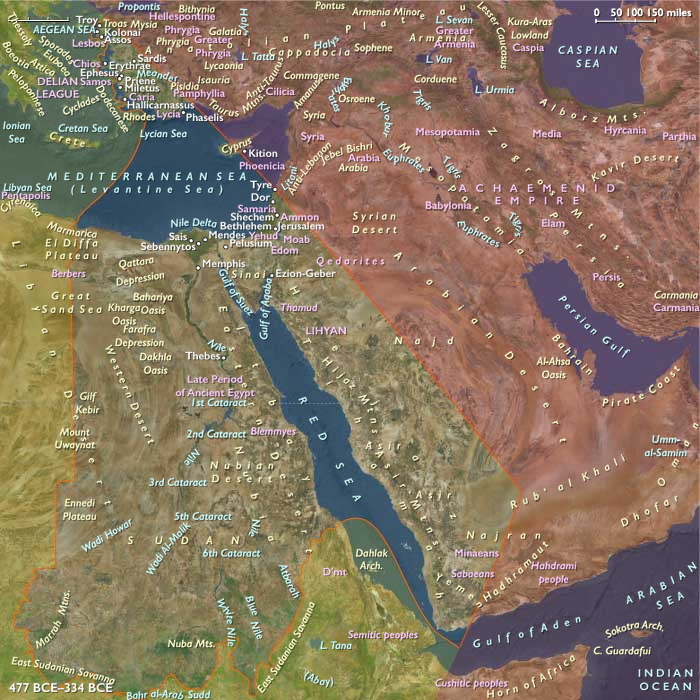
In southwestern Anatolia, Mausolus of Caria strengthens his semi-autonomous rule, balancing Persian oversight with local Hellenizing policies. His capital, Halicarnassus, grows in prominence as he invests extensively in monumental architecture, attracting artisans and scholars, and turning the city into a significant cultural hub.
Nearby, in Lydia and Ionia, Persian influence solidifies under satrapal governors such as Autophradates, who oversee the integration of Greek cities more closely into the imperial framework. Despite occasional frictions, the relative peace enables commercial prosperity in these coastal cities, enhancing their roles as vital centers of Mediterranean trade.
In Judah, now officially recognized as Yehud, Persian authority remains relatively benevolent but firm, with local administration entrusted to high priests who maintain a degree of political and religious autonomy. The religious center at Jerusalem experiences growth and consolidation, emphasizing adherence to traditional Jewish laws and customs, further distinguishing the local population from neighboring peoples.
Simultaneously, Persian dominion in Cyprus, Phoenicia, and Egypt remains contentious. Efforts to assert firmer control over Egypt, in particular, remain challenging due to persistent local resistance and sporadic revolts. Egypt's attempts to reassert its independence intermittently disrupt Persian ambitions and demonstrate the enduring difficulties of managing distant imperial territories.
By 346 BCE, while the Persian Empire continues to face external and internal challenges, its control over the Near East region is effectively consolidated. This period marks a complex interplay of imperial ambition, regional autonomy, and cultural synthesis, profoundly shaping the political landscape of the Near East.
People
Groups
- Cyprus, Classical
- Egypt (Ancient), Late Period of
- Yehud Medinata
- Achaemenid, or First Persian, Empire
- Jews
Topics
Subjects
Regions
Subregions
Years: 357BCE - 346BCE
People
Groups
- Cyprus, Classical
- Egypt (Ancient), Late Period of
- Yehud Medinata
- Achaemenid, or First Persian, Empire
- Jews
Topics
Subjects
Regions
Subregions