
Near East (477–334 BCE): Cultural Shifts, Religious …
Years: 477BCE - 334BCE
Near East (477–334 BCE): Cultural Shifts, Religious Developments, and Persian Influence
From 477 to 334 BCE, the Near East experiences significant cultural shifts, religious developments, and fluctuating Persian dominance, profoundly influencing the region's historical trajectory.
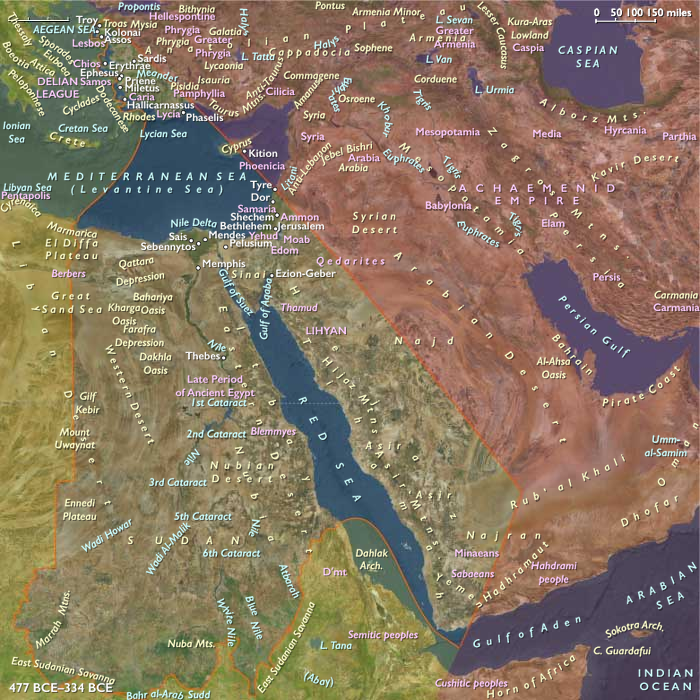
In Egypt, periodic revolts, frequently supported by Greek military assistance, initially fail to break Persian dominance until 404 BCE. Subsequently, Egypt achieves a tenuous independence under a series of short-lived native dynasties—the Twenty-eighth, Twenty-ninth, and Thirtieth—until 343 BCE, when Persia reinstates oppressive control, marking the Thirty-first Dynasty or second Persian occupation, persisting until Alexander the Great’s arrival in 332 BCE. Egyptian resistance to Persian hegemony underscores the complexities of imperial governance, particularly in distant and culturally distinct provinces.
Meanwhile, in southwestern Anatolia and neighboring Greek territories under Persian rule, cultural expression flourishes. Praxiteles creates the celebrated Aphrodite of Cnidus, a revolutionary depiction of the nude goddess Aphrodite. Initially rejected for its boldness by Kos, the statue finds acclaim in Knidos, becoming one of the ancient world’s most famous artworks and emblematic of the cultural vitality within Persian-controlled Greek cities.
In Judah, now known as Yehud, Persian authority is relatively firm yet accommodating. Local high priests administer Yehud, preserving political and religious autonomy centered around Jerusalem. Emphasis on Torah adherence, Sabbath observance, dietary laws, and rituals like circumcision solidify Jewish cultural identity, ensuring community cohesion and distinctiveness within the Persian Empire. The compilation and editing of significant texts, including Leviticus, Numbers, and portions of Zechariah, during the Persian period, further strengthens religious and cultural identity.
The Persian provinces of Samaria and Ammon remain under governors of local elite families, notably the houses of Sanballat and Tobiah. Rejected by Judahite returnees from Babylon, the Samaritans build their own temple in Shechem at Mount Gerizim, asserting their distinct identity and religious practices.
Throughout this period, Persian dominance encounters recurring challenges, notably the Revolt of the Satraps (362–359 BCE), led by regional governors such as Orontes, Mausolus of Caria, Autophradates of Lydia, and Datames of Cappadocia. Despite initial success and support from Greek cities and external powers like Sparta and Athens, internal distrust and betrayals ultimately cause the rebellion's collapse, allowing Persia to restore centralized authority.
As Persian influence solidifies post-rebellion, regional powers like Mausolus in Caria balance imperial oversight with localized governance, creating flourishing cultural hubs like Halicarnassus. Cities in Lydia, Ionia, and Cyprus similarly experience prosperity and cultural vibrancy under stabilized Persian rule.
By 334 BCE, the Near East emerges as a rich tapestry of Persian political control, dynamic local cultures, and significant religious evolution, laying the groundwork for the transformative impacts of Alexander the Great's imminent campaigns.
People
Groups
- Greeks, Classical
- Egypt (Ancient), Late Period of
- Yehud Medinata
- Achaemenid, or First Persian, Empire
- Jews
Topics
Subjects
Regions
Subregions
Related Events
Showing 10 events out of 65541 total
Years: 477BCE - 334BCE
People
Groups
- Greeks, Classical
- Egypt (Ancient), Late Period of
- Yehud Medinata
- Achaemenid, or First Persian, Empire
- Jews
Topics
Subjects
Regions
Subregions