
Near East (285–274 BCE): Emergence of the …
Years: 285BCE - 274BCE
Near East (285–274 BCE): Emergence of the Hellenistic Monarchies and Cultural Flourishing
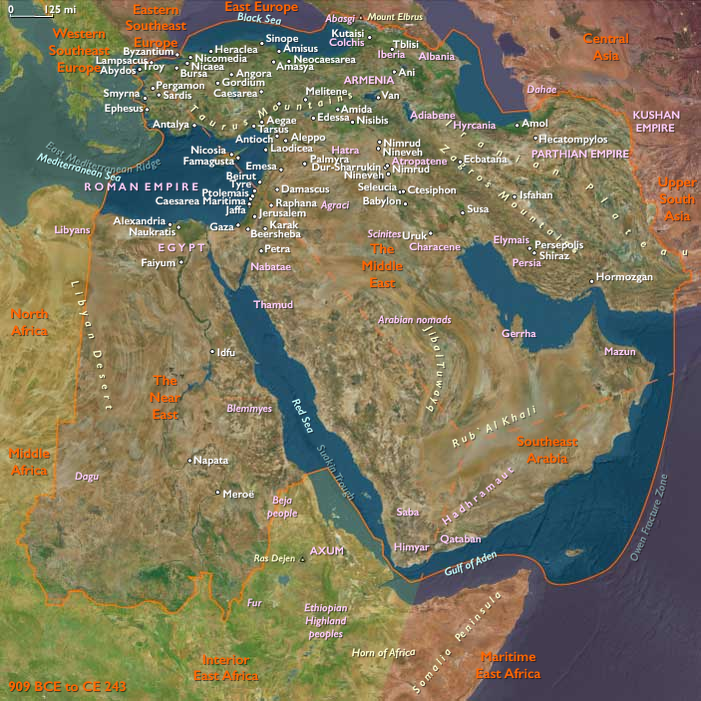
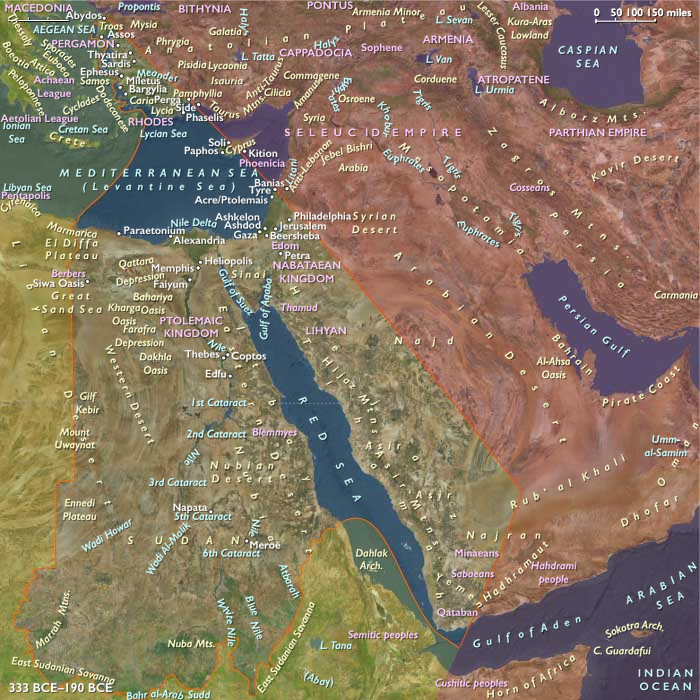
By 275 BCE, three distinct Macedonian dynasties solidify control over major segments of Alexander the Great’s fractured empire. In Macedonia and its Greek dependencies, the Antigonids, successors of Antigonus I Monophthalmus, rule securely. To the east, the vast Asian provinces are dominated by the Seleucids, descendants of Seleucus I Nicator. Meanwhile, Ptolemy I Soter and his successors—the Ptolemies—govern Egypt, with additional territories including Lycia and Caria in Anatolia. Most other parts of Anatolia, however, remain under Seleucid authority.
These emerging Hellenistic monarchies, characterized by centralized military rule yet lacking Alexander’s organizational genius, continuously clash with each other and face internal instability. A notable instance is the conflict between Antiochus I, the Seleucid king striving to extend his control in Syria and Anatolia, and Egypt’s Ptolemy II Philadelphus. Antiochus suffers defeat in 280 BCE during the Damascene War, and in 274 BCE, hostilities renew with the onset of the First Syrian War. Ptolemy II, benefiting from his strategic acumen and recent marriage to his influential sister, Arsinoe II, maintains a stable court and emerges as a capable military leader.
Culturally, the influence of Greek art and scholarship proliferates across the Near East, reflecting broader trends of Hellenization. Ptolemy II enhances Alexandria’s prestige as a center of learning and innovation by founding the Museum (Mouseion)—a renowned institution housing scholars and artists—and the great Library of Alexandria. Additionally, the construction of the towering Pharos of Alexandria, designed by Sostratus of Cnidus, marks a significant technological and architectural achievement. Standing more than 350 feet (approximately 110 meters) high, this lighthouse—counted among the Seven Wonders of the Ancient World—employs a sophisticated system of mirrors to project constant fires of resinous wood or oil, visible up to thirty miles away. It remains the archetype for lighthouses for centuries to follow.
People
- Antigonus I Monophthalmus
- Antiochus I Soter
- Arsinoë II
- Ptolemy I Soter
- Ptolemy II Philadelphus
- Seleucus I
- Sostratus of Cnidus
Groups
Topics
Subjects
Regions
Subregions
Years: 285BCE - 274BCE
People
- Antigonus I Monophthalmus
- Antiochus I Soter
- Arsinoë II
- Ptolemy I Soter
- Ptolemy II Philadelphus
- Seleucus I
- Sostratus of Cnidus
Groups
Topics
Subjects
Regions
Subregions