
Near East (388–531 CE): Religious and Political …
Years: 388 - 531
Near East (388–531 CE): Religious and Political Transitions
From 388 to 531 CE, the Near East experiences profound religious schisms, shifts in political control, and enduring cultural developments. These changes profoundly influence subsequent historical trajectories.
Religious Schism and Ecclesiastical Authority
The religious landscape is significantly altered by the Council of Chalcedon in 451 CE, which creates a major theological and political rift within Christianity. The council declares Christ as having two distinct natures, fully human and fully divine, contrasting sharply with the Coptic Monophysite belief dominant in Egypt, which posits Christ as having one divine-human nature. This theological divergence initiates a lasting schism, causing the Egyptian Church to separate from the authority of Constantinople and broader Catholic Christendom. The Coptic Church henceforth exists independently, profoundly shaping Egyptian religious identity.
Cyprus also asserts ecclesiastical independence, confirmed by Emperor Zeno following the discovery of the tomb of Saint Barnabas with an alleged apostolic gospel. The Church of Cyprus is thus granted autocephalous status, equal in ecclesiastical rank to the major patriarchates of Antioch, Jerusalem, Alexandria, and Constantinople.
Political Shifts and Imperial Fragmentation
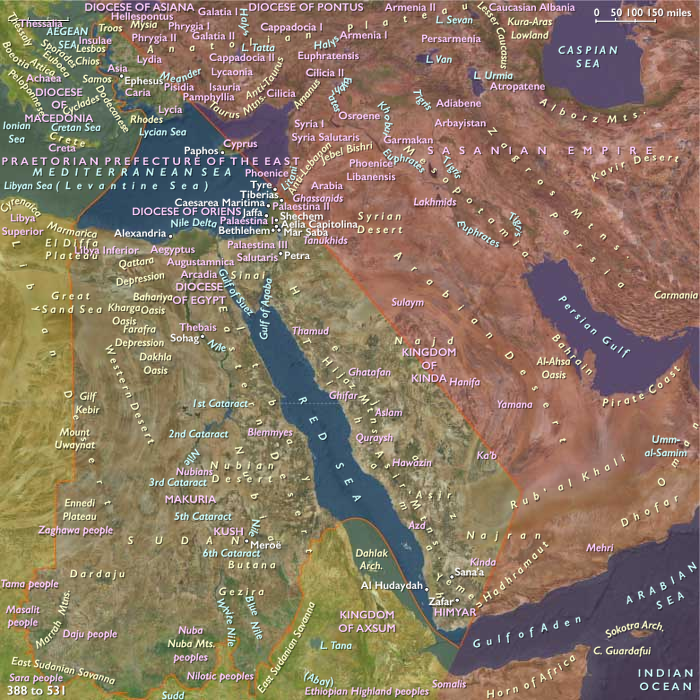
Following the division of the Roman Empire in 395 CE, Palestine and Egypt fall under Eastern Roman (Byzantine) jurisdiction, governed from Constantinople. Imperial administration becomes increasingly centralized, contributing to tensions between local populations and distant Byzantine authority.
The political autonomy of Jewish communities in Palestine ends decisively with the abolition of the patriarchate around 425 CE. The Jewish office of Nasi (prince), a remnant of the ancient Sanhedrin, is dissolved, marking a final blow to Jewish political independence in the region.
Socioeconomic and Cultural Developments
Three successor states emerge from the remnants of the Meroitic kingdom by the sixth century CE: Nobatia in the north, Makuria centrally located around Dongolah, and Alodia in the southern region around Sawba. These states, led by warrior aristocracies, continue to adopt Greek titles and administrative models reflecting Roman influence.
The city of Najran, in present-day Saudi Arabia, develops as a significant Christian center with established ecclesiastical structures, even as it is ruled by a Jewish king. Meanwhile, the Arabian Peninsula sees diverse religious practices; in Mecca, pilgrimage traditions focused on sacred sites become integral to local prosperity.
Intellectual and Religious Legacies
The period sees continued intellectual activity, particularly within Jewish scholarly circles. The Talmudic tradition flourishes, with ongoing compilation and commentary reflecting intense religious and intellectual dedication.
Monasticism, initiated earlier in Egypt and Syria, remains influential through figures such as Macarius the Elder. These monastic communities further reinforce Christianity’s cultural and spiritual reach in the Near East.
Legacy of the Age
The era from 388 to 531 CE marks critical transitions characterized by religious schisms, shifting political landscapes, and cultural consolidation. The consequences of the Chalcedonian schism, the final loss of Jewish political autonomy, and the rise of local Christian and monastic identities set enduring patterns that shape the Near East's religious, political, and cultural trajectories for centuries.
People
Groups
- Egyptians
- Kush, Kingdom of
- Meroë, Kingdom of
- Jews
- Himyarite Kingdom
- Aksum (or Axum), Kingdom of
- Egypt (Roman province)
- Christians, Early
- Syria Palæstina, Roman province of (Judea, Samaria, and Idumea)
- Christianity, Nicene
- Makuria, Kingdom of
- Nobatia, Kingdom of
- Roman Empire: Theodosian dynasty (Constantinople)
- Palaestina Prima (Roman province)
- Palaestina Salutaris (Roman province)
- Palaestina Secunda (Roman province)
- Christians, Monophysite
- Christianity, Chalcedonian
- Coptic Orthodox Church of Alexandria
- Roman Empire, Eastern: Leonid dynasty
- Alodia, or Alwa (Subah, or Soba), Kingdom of
- Roman Empire, Eastern: Justinian dynasty
Subjects
Regions
Subregions
Years: 388 - 531
People
Groups
- Egyptians
- Kush, Kingdom of
- Meroë, Kingdom of
- Jews
- Himyarite Kingdom
- Aksum (or Axum), Kingdom of
- Egypt (Roman province)
- Christians, Early
- Syria Palæstina, Roman province of (Judea, Samaria, and Idumea)
- Christianity, Nicene
- Makuria, Kingdom of
- Nobatia, Kingdom of
- Roman Empire: Theodosian dynasty (Constantinople)
- Palaestina Prima (Roman province)
- Palaestina Salutaris (Roman province)
- Palaestina Secunda (Roman province)
- Christians, Monophysite
- Christianity, Chalcedonian
- Coptic Orthodox Church of Alexandria
- Roman Empire, Eastern: Leonid dynasty
- Alodia, or Alwa (Subah, or Soba), Kingdom of
- Roman Empire, Eastern: Justinian dynasty
Subjects
Regions
Subregions