
Near East (244–387 CE): Christianity, Imperial Reforms, …
Years: 244 - 387
Near East (244–387 CE): Christianity, Imperial Reforms, and Cultural Shifts
Between 244 and 387 CE, the Near East experiences critical transformations through religious developments, imperial restructuring, and cultural shifts that profoundly shape regional dynamics.
Religious Developments and Imperial Christianity
The reign of Emperor Diocletian (284–305) is marked by severe persecutions against Christians, beginning in 303 CE, known as the "Era of Martyrs." Churches are demolished, sacred texts burned, and Christians persecuted throughout the empire. Many Egyptian Christians survive only because their labor is required in the empire's porphyry quarries and emerald mines.
The religious landscape dramatically shifts with Emperor Constantine I, who converts to Christianity and establishes it as the official religion of the empire by 312 CE. Constantine’s Edict of Milan (313 CE) guarantees religious freedom. He moves the imperial capital to Byzantium, renaming it Constantinople (modern-day Istanbul) in 330 CE, which becomes the center of Eastern Roman (Byzantine) political and religious authority.
Egypt experiences rapid Christianization, and by the mid-fourth century, the Egyptian Church is organized under the Patriarchate of Alexandria, second in rank only to Rome. The Council of Nicea (325 CE) affirms Alexandria’s influential status, profoundly shaping early Christian doctrines.
Imperial Administration and Regional Changes
Diocletian introduces significant administrative and fiscal reforms, dividing Egypt into three provinces to streamline governance. His restructuring of the Roman Empire divides jurisdiction into eastern Greek-speaking and western Latin-speaking halves, laying the groundwork for the eventual split between Eastern and Western Roman Empires.
Roman rule extends into the Nabataean kingdom when Emperor Trajan formally annexes the territory in 106 CE, establishing the Roman province of Arabia. The Nabataeans flourish culturally and economically under Roman administration, connected to broader imperial trade networks.
Cultural and Intellectual Contributions
Cultural developments include the influential mathematical contributions of Diophantus of Alexandria, whose seminal work, Arithmetica, introduces algebraic symbolism and sets foundational precedents for number theory. His innovative techniques, later termed Diophantine analysis, inspire centuries of mathematical inquiry.
Christian monasticism arises in the deserts of Egypt and Syria, pioneered by figures such as Saint Anthony the Great and Macarius the Elder, whose monastic communities form the spiritual and cultural backbone of Eastern Christianity.
Socio-Economic Exploitation and Decline
Roman rule in Egypt is characterized by economic exploitation, leading to progressive social and economic decline. The empire treats Egypt primarily as an agricultural estate to benefit Roman elites, with resources drained and minimal reinvestment into local infrastructure.
Despite this, Roman administrators continue religious and architectural traditions, such as completing the Temple of Isis on Philae Island and developing the distinctive Fayum mummy portraits—painted wood images placed on mummy coffins that demonstrate a unique synthesis of Egyptian and Greco-Roman artistic traditions.
Legacy of the Age
This era establishes Christianity as a dominant cultural and political force, restructures imperial governance, and experiences both significant cultural achievements and economic strain. The division of the Roman Empire, the institutionalization of Christianity, and notable cultural advancements set lasting patterns for the Near East’s historical trajectory.
People
Groups
- Egyptians
- Kush, Kingdom of
- Meroë, Kingdom of
- Jews
- Himyarite Kingdom
- Aksum (or Axum), Kingdom of
- Egypt (Roman province)
- Christians, Early
- Syria Palæstina, Roman province of (Judea, Samaria, and Idumea)
- Roman Empire (Rome): Non-dynastic
- Roman Empire: Tetrarchy
- Roman Empire: Constantinian dynasty (Nicomedia)
- Christianity, Nicene
- Roman Empire: Constantinian dynasty (Constantinople)
- Roman Empire: Valentinian dynasty (Rome)
- Roman Empire: Theodosian dynasty (Constantinople)
Topics
Subjects
Regions
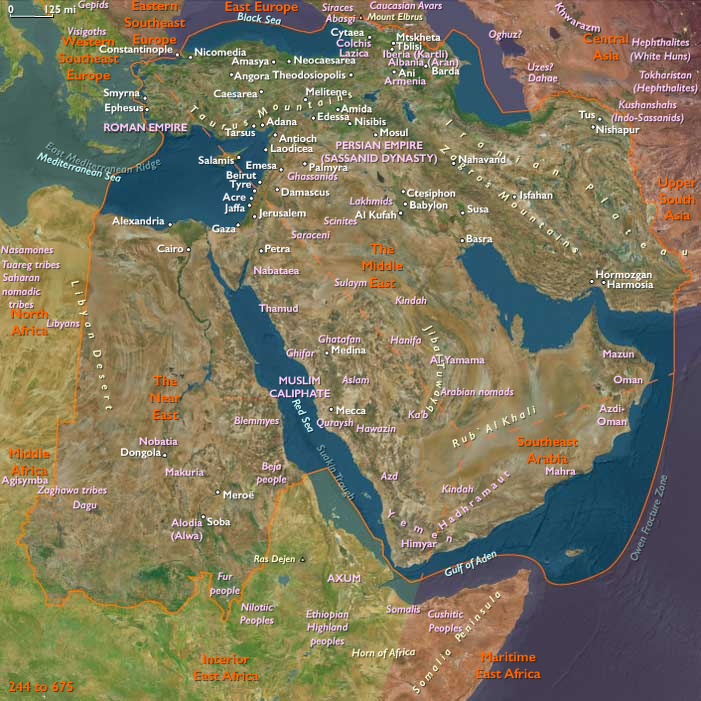
Subregions
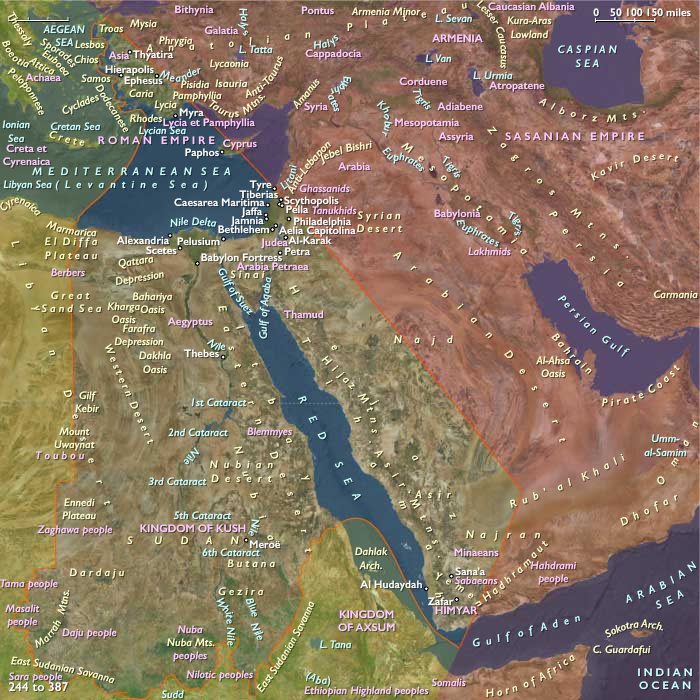
Related Events
Showing 10 events out of 60511 total
Years: 244 - 387
People
Groups
- Egyptians
- Kush, Kingdom of
- Meroë, Kingdom of
- Jews
- Himyarite Kingdom
- Aksum (or Axum), Kingdom of
- Egypt (Roman province)
- Christians, Early
- Syria Palæstina, Roman province of (Judea, Samaria, and Idumea)
- Roman Empire (Rome): Non-dynastic
- Roman Empire: Tetrarchy
- Roman Empire: Constantinian dynasty (Nicomedia)
- Christianity, Nicene
- Roman Empire: Constantinian dynasty (Constantinople)
- Roman Empire: Valentinian dynasty (Rome)
- Roman Empire: Theodosian dynasty (Constantinople)
Topics
Subjects
Regions
Subregions