
Near East (165–154 BCE): The Maccabean Revolt …
Years: 165BCE - 154BCE
Near East (165–154 BCE): The Maccabean Revolt and Seleucid Decline
The era from 165 to 154 BCE in the Near East is marked by heightened Jewish resistance against Greek cultural hegemony under Seleucid rule. The aggressive Hellenization efforts of Seleucid king Antiochus IV Epiphanes, including the erection of a statue to Zeus within the Jerusalem Temple, trigger widespread Jewish unrest. This culminates in the Maccabean Revolt, which begins in earnest in 165 BCE.
The revolt is sparked by Mattathias the Hasmonean, a rural Jewish priest from Modiin, who defies Antiochus IV's decrees forbidding traditional Jewish practices. After Mattathias publicly kills a Hellenistic Jew who attempts to sacrifice to a pagan idol, he flees to the Judean wilderness with his five sons, igniting an armed rebellion. Upon Mattathias' death around 166 BCE, his son Judas Maccabee assumes leadership of the insurgency, leading effective guerrilla campaigns against both Seleucid forces and Hellenized Jews. The name "Maccabees," derived from the Hebrew word for "hammer," aptly symbolizes the fierce and relentless tactics employed by Judas's forces.
Judas Maccabee and his followers achieve significant victories, notably reclaiming and ritually cleansing the Jerusalem Temple, thereby restoring traditional Jewish worship. Jonathan Maccabee is installed as high priest. Although Seleucid commander Lysias attempts to suppress the revolt with a large military force, internal Seleucid political upheaval following Antiochus IV's death ultimately compels him to withdraw and reach a political compromise. This compromise restores religious freedoms to the Jews, marking a significant turning point in Jewish history.
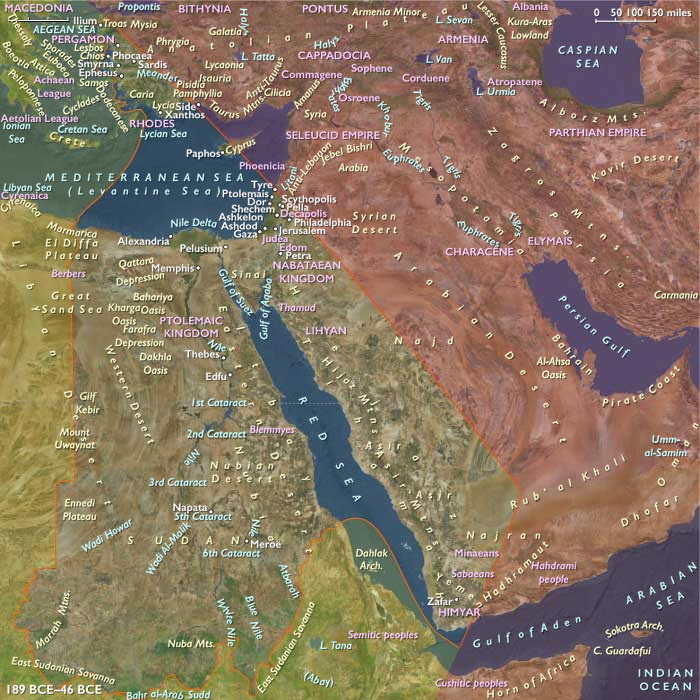
The aftermath of Antiochus IV’s demise accelerates the weakening of the Seleucid Empire, characterized by the loss of regions such as Commagene in Syria and Judea in Palestine. This erosion of Seleucid power significantly reshapes the political landscape of the Near East.
Legacy of the Era
The Maccabean Revolt represents a critical juncture in Jewish history, laying the foundation for Jewish autonomy and cultural resilience against external pressures. The events of this period underscore the declining strength of the Seleucid Empire and the increasingly complex dynamics between Hellenistic rulers and local populations, setting the stage for future developments in the region.
People
Groups
Topics
Subjects
Regions
Subregions
Years: 165BCE - 154BCE
People
Groups
Topics
Subjects
Regions
Subregions