
Near East (184–195 CE): Imperial Stability, Christian …
Years: 184 - 195
Near East (184–195 CE): Imperial Stability, Christian Scholarship, and Jewish Continuity
In the period 184–195 CE, the Near East experiences relative stability under Roman imperial rule, fostering continued growth of established religious and intellectual communities. Christianity expands quietly but steadily, gaining converts among urban populations, particularly in Alexandria, Antioch, and other cities of Asia Minor and Syria. Despite occasional local persecutions, early Christian scholars emerge, articulating theological doctrines and providing organized structures for communities.
Notably, Clement of Alexandria, active during this era, contributes significantly to the intellectual defense and expansion of Christianity. His works synthesize Christian theology with Greek philosophical thought, marking a decisive step in the integration of Hellenistic culture with Christian teachings.
In Jewish communities, the scholars (Amoraim) build upon the earlier redaction of the Mishnah, developing interpretations and commentary that will eventually be codified into the Gemara. Galilee, under continued Roman oversight, flourishes as a center of Jewish learning and cultural resilience, fostering an environment of scholarship that ensures continuity of Jewish identity and religious tradition.
At the same time, economic prosperity under Rome stimulates commerce and cultural exchange throughout the Near East, strengthening connections across the Mediterranean world.
Legacy of the Era
Between 184 and 195 CE, the Near East witnesses the deepening roots of Christianity through scholarly synthesis and community organization, alongside a thriving Jewish intellectual tradition. Both groups, despite challenges, maintain their distinct identities and religious integrity, ensuring their enduring cultural and spiritual legacies.
People
Groups
- Polytheism (“paganism”)
- Jews
- Greeks, Hellenistic
- Egypt (Roman province)
- Christians, Early
- Roman Empire (Rome): Flavian dynasty
- Syria Palæstina, Roman province of (Judea, Samaria, and Idumea)
Topics
Subjects
Regions
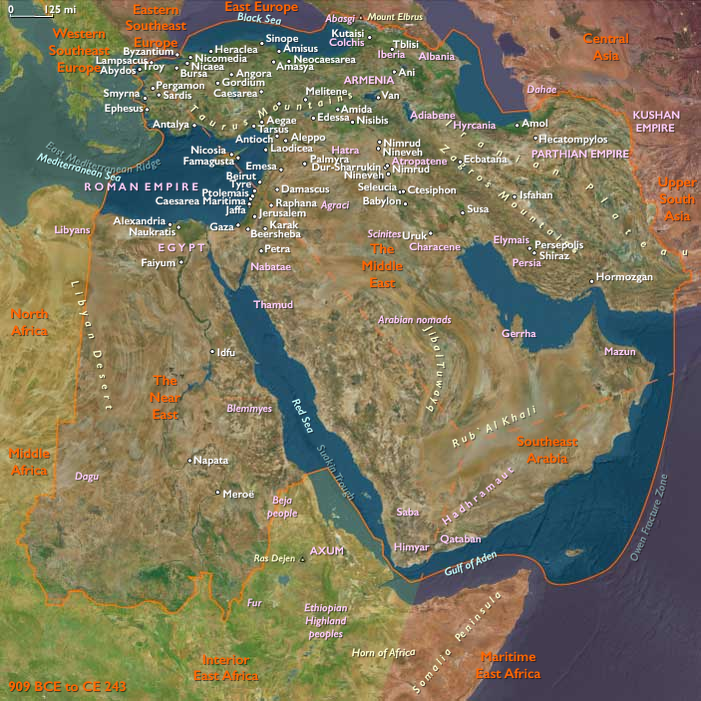
Subregions
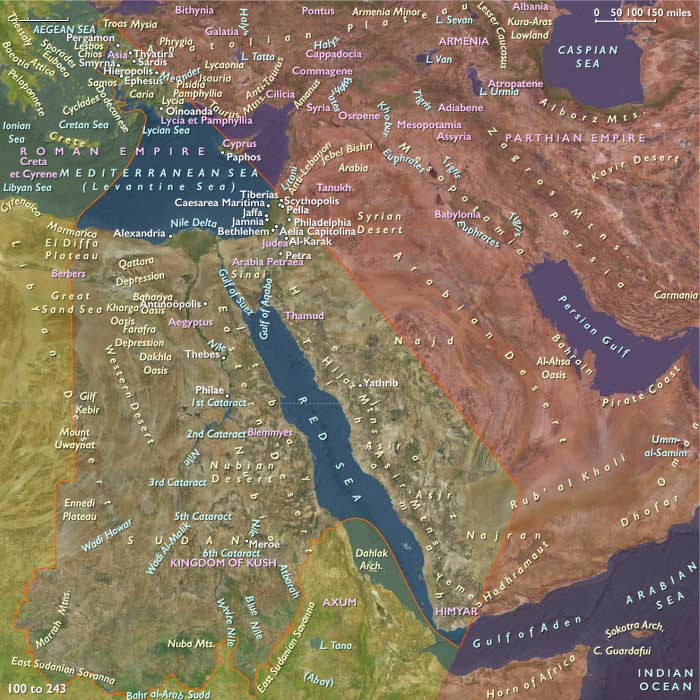
Related Events
Showing 10 events out of 13 total
Years: 184 - 195
People
Groups
- Polytheism (“paganism”)
- Jews
- Greeks, Hellenistic
- Egypt (Roman province)
- Christians, Early
- Roman Empire (Rome): Flavian dynasty
- Syria Palæstina, Roman province of (Judea, Samaria, and Idumea)
Topics
Subjects
Regions
Subregions