
Near East (117–106 BCE): Rise of the …
Years: 117BCE - 106BCE
Near East (117–106 BCE): Rise of the Himyarites and Changing Trade Dynamics
The period from 117 to 106 BCE sees significant geopolitical and economic transformations, particularly in southwestern Arabia, driven by shifts in trade routes and regional power dynamics.
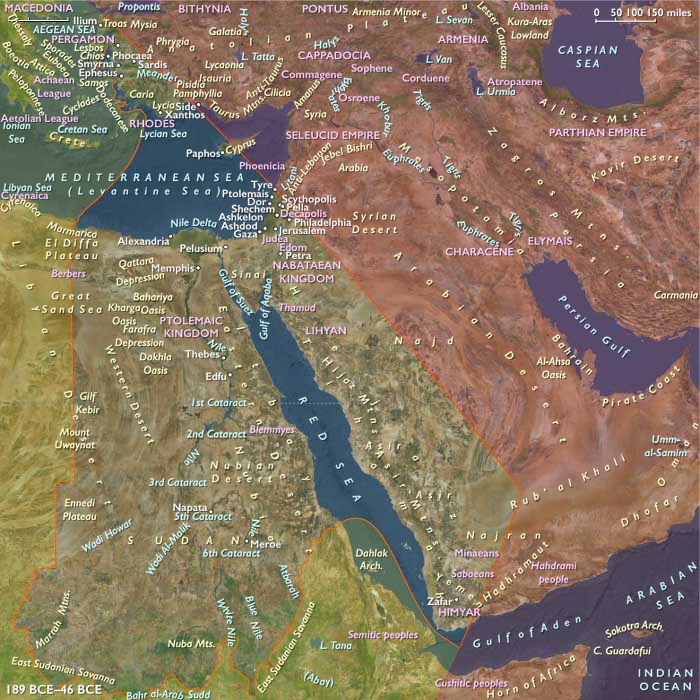
The Himyarites, a prominent tribal confederacy in the region of southwestern Arabia, rise to prominence around 115 BCE, overtaking their Sabaean kin. Their ascendancy is likely facilitated by the discovery and utilization of a sea route from Egypt to India, which undermines the inland trade dominance of the Sabaean kingdom. This shift redirects economic power from traditional overland routes to coastal maritime trade, significantly reshaping the regional economic landscape.
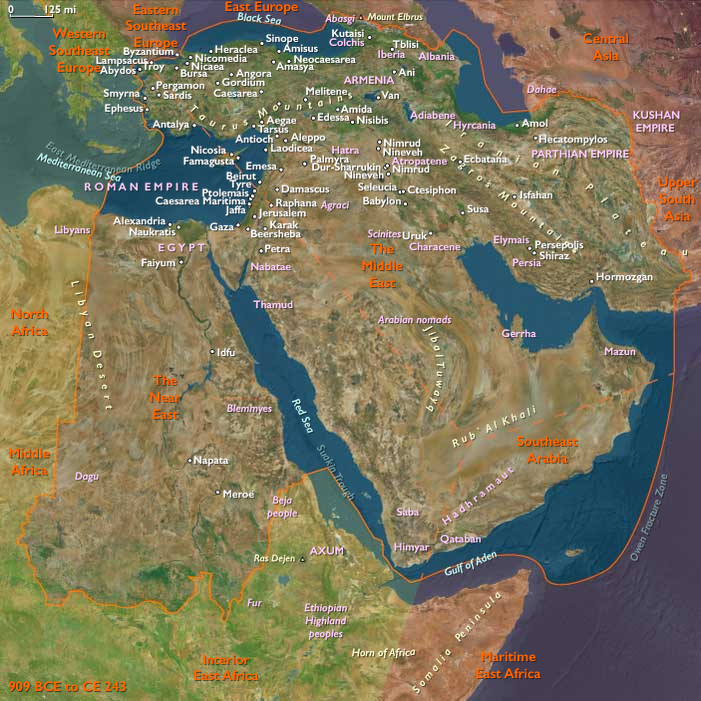
Centered at their capital Zafar, located southwest of Yarim in what is today southern Yemen, the Himyarites inherit and build upon Sabaean language, culture, and institutions. Under Himyarite rule, cultural and political influence expands eastward toward the Persian Gulf and northward into the Arabian Desert, marking the kingdom as a dominant regional power. Zafar emerges as a celebrated urban center, renowned not only within Arabia but also recognized by Greek and Roman writers, highlighting its international significance in trade and cultural exchange.
Legacy of the Era
The era 117–106 BCE establishes the Himyarite kingdom as a major political and economic force in southwestern Arabia, altering longstanding trade networks and cultural dynamics. The Himyarite rise effectively transforms regional power balances, laying foundations that will significantly shape Arabian and broader Near Eastern geopolitics in subsequent centuries.
Groups
Subjects
Regions
Subregions
Related Events
Showing 10 events out of 62967 total
Years: 117BCE - 106BCE
Groups
Subjects
Regions
Subregions