Natoire carries out the first of his …
Years: 1735 - 1735
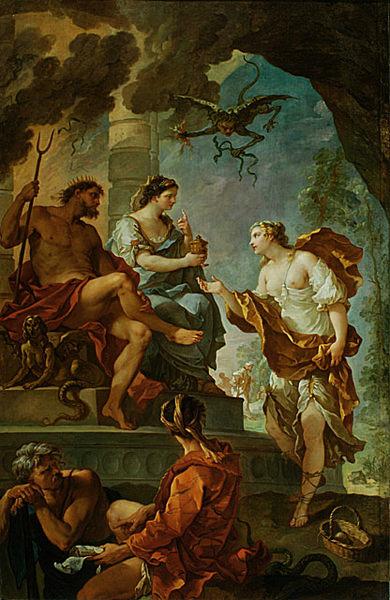
Natoire carries out the first of his tapestry cartoons for the series Histoire de Don Quichotte, woven in 1735 at the Manufacture de Beauvais, the first set for the fermier général Pierre Grimod du Fort (1692–1748).
Related Events
Filter results
Showing 10 events out of 27520 total
The Yongzheng Emperor has ruled the Qing Empire for thirteen years before dying suddenly in 1735 at age fifty-six.
Legend holds that he was assassinated by Lü Siniang, daughter of Lü Liuliang, whose family reportedly was executed for literary crimes against the Manchu Regime.
Another possible reason was that he had been a lover of Lü Siniang; Lü was the real mother of the Qianlong Empeor, but Yongzheng had refused to allow Lü to be the queen.
In reality, it is likely his death was the result of an overdose of the medication he was consuming, which he believed would prolong his life.
The Yongzheng Emperor's family life seems to have tragic undertones.
Of the fourteen children born to him and his Empress and consorts, only five are known to have survived to adulthood.
To prevent the succession tragedy which he had faced, he ordered his third son (Hongshi, an ally of Yinsi) to commit suicide in 1727.
He had also put in place a system to choose his successor in secret.
Yongzheng wrote his chosen successor's name on two pieces of paper, placed one piece of paper in a box and had the box stored behind the stele in the Qianqing Palace.
He then kept the other copy with him or hid it.
With his passing, the ministers were to compare the paper in the box and with the copy Yongzheng had.
If they were deemed identical, the person whose name was on the paper would be the new emperor.
His son Hongli, Prince Bao, had been adored both by his grandfather, the Kangxi Emperor and his father.
Some historians argue that the main reason why the Kangxi Emperor had appointed Yongzheng as his successor was because Hongli was his favorite grandson.
He felt that Hongli's mannerisms were very close to his own.
As a teenager, he was very capable in martial arts, and possessed a high literary ability.
After his father's succession in 1722, Hongli had become the Prince Bao.
Like many of his uncles, Hongli had entered into a battle of succession with his older half-brother Hongshi, who had the support of a large faction of court officials, as well as Yinsi, Prince Lian.
For many years the Yongzheng Emperor had not appointed anyone to the position of Crown Prince, but many in court had speculated his favoring of Hongli.
Hongli had gone on inspection trips to the south, and is known to be an able negotiator and enforcer.
He has also been chosen as chief regent on occasion, when his father was away from the capital.
Even before Hongli's succession is read out to the assembled court, it had been widely known who the new emperor would be.
As a favorite of his grandfather, Kangxi, and his father alike; Yongzheng had entrusted to the young Hongli a number of important ritual tasks to him while Hongli was still a prince, and included him in important court discussions of military strategy.
Hongli thus becomes the fifth emperor of the Qing dynasty under the era name of Qianlong, which means "Lasting Eminence".
The Yongzheng Emperor is interred in the Western Qing Tombs, one hundred and twenty kilometers (seventy-five miles) southwest of Beijing, in the Tailing mausoleum complex (known in Manchu as the Elhe Munggan).

Intensified contradictions over the results of the War of the Polish Succession, raids by the Crimean Tatars on the Cossack Hetmanate (Ukraine) at the end of 1735, and the Crimean khan's military campaign in the Caucasus form the casus belli of the Russo-Turkish War.
The government of Empress Anna Ioannovna on the eve of the war returns all the annexed territories to Persia as a prerequisite to constructing an alliance with Persians against Ottoman Turkey (which has been war with Persia since 1730), thus managing to secure a favorable international situation.
Russia also supports the accession to the Polish throne of Augustus III in 1735 instead of the French protégé Stanislaw I Leszczynski, nominated by pro-Turkish France.
The Basel problem, a famous problem in mathematical analysis with relevance to number theory, first posed by Pietro Mengoli in 1644, has withstood the attacks of the leading mathematicians of the day; it is solved in 1735 by Leonhard Euler.
Euler's solution brings him immediate fame at twenty-eight.
George Brandt, born in Riddarhyttan, Skinnskatteberg parish, Västmanland to Jurgen Brandt, a mineowner and pharmacist, and Katarina Ysing, is a professor of chemistry at Uppsala University.
He is able in about 1735 to show that cobalt is the source of the blue color in glass, which previously had been attributed to the bismuth found with cobalt.
He thus becomes the first person to discover a metal unknown in ancient times.
Tarło and the Dzikowska Confederation try to fight the Russians and Saxons, but their efforts are ineffective, and the confederation is eventually defeated.
Nadr, by threatening Russia with war at the end of 1735, forces this nation to relinquish its Caspian provinces to Persia.
Carl Linnaeus first classifies the poppy, Papaver somniferum (sleep-inducing) in his Genera Plantarum.
One of his major works, the first edition is published in 1735 during his stay in the Netherlands.
The book is published in Latin, as is customary for the scientific literature of its day.
In it, he outlines his ideas for the hierarchical classification of the natural world, dividing it into the animal kingdom (Regnum animale), the plant kingdom (Regnum vegetabile) and the "mineral kingdom" (Regnum lapideum).
There is significant debate in the scientific community, specifically in the French Academy of Sciences (Académie des sciences), as to whether the circumference of the Earth is greater around the Equator or around the poles.
French astronomer Jacques Cassini holds to the view that the polar circumference is greater.
Louis XV, the King of France, and the Academy send two expeditions to determine the answer: one is sent to Lapland, close to the North Pole, under Swedish physicist Anders Celsius and French mathematician Pierre Maupertuis.
The other mission is sent to Ecuador, at the Equator.
Previous accurate measurements had been taken in Paris by Cassini and others.
The equatorial mission is led by French astronomers Charles Marie de La Condamine, Pierre Bouguer, Louis Godin and Spanish geographers Jorge Juan and Antonio de Ulloa.
They are accompanied by several assistants, including the naturalist Joseph de Jussieu and Louis's cousin Jean Godin.
La Condamine will be joined in his journey down the Amazon by Ecuadoran geographer and topographer Pedro Maldonado. (Maldonado will later travel to Europe to continue his scientific work.)
The Ecuadoran expedition leaves France in May 1735.
The British and Dutch had offered to mediate peace talks between the various parties as early as February 1734.
Proposals were being circulated by early 1735.
As 1735 progresses, with the Austrians being in no real position to continue the fight, and the French concerned by the possible arrival of Russian reinforcements on the Rhine (which does eventually occur), negotiations continue through the summer of 1735.
French armies continue to advance along the Rhine, reaching as far as Mainz, but the growing imperial army, which comes to include troops from Russia that had assisted with the capture of Danzig, is able to prevent France from establishing a siege there, and Eugene goes on the offensive.
A force of thirty thousand under Friedrich Heinrich von Seckendorff crosses the Rhine and begins pushing the French back toward Trier, defeating them at Clausen in October 1735, in one of the last battles before preliminary peace terms are reached later in the month.
The Georgia Trustees propose three pieces of legislation to the Privy Council in 1735 and have the satisfaction of securing the concurrence of king and council.
An Indian act requires Georgia licenses for trading west of the Savannah River.
Another act bans the use of rum in Georgia.
A third act outlaws slavery in Georgia.
South Carolina protests the Indian act vehemently and objects to the Trustees' order to restrict the passage of rum on the Savannah River.
The Board of Trade sides with South Carolina, and a compromise is reached, allowing traders with Carolina licenses to continue their traditional trade west of the Savannah River.
The Trustees object to the Board of Trade's tampering and refrain from proposing any additional legislation requiring approval of the Privy Council.