
Emmanuel Chabrier's visit to Spain in 1882 …
Years: 1883 - 1883
Emmanuel Chabrier's visit to Spain in 1882 results in his most famous musical work, España (1883), a mixture of popular airs he had heard and his own imagination.
In the view of his friend Henri Duparc, this composition for orchestra demonstrates an individual style that seems to come from nowhere; other contemporary musicians are more condescending.
National qualities appear in Chabrier's serious music.
Of several stage works begun during the 1870s, his first to be completed is L'étoile, which had achieved forty-eight successful performances at the Théâtre des Bouffes Parisiens in 1877, showcasing his light touch, musical aplomb, and comic wit.
Chabrier's friends from the artistic avant-garde in Paris include Gabriel Fauré, Ernest Chausson, and Vincent d'Indy, as well as painters Henri Fantin-Latour, Edgar Degas and Édouard Manet, whose 'Thursday' soirées Chabrier attends, and writers such as Émile Zola, Alphonse Daudet, Jean Moréas, Jean Richepin, Auguste Villiers de l'Isle-Adam and Stéphane Mallarmé.
On a trip to Munich with Henri Duparc in 1879, he had discovered Wagner's masterpiece Tristan und Isolde.
This event had led him to realize his true passion for composition, and he had quit the Ministry of the Interior in 1880.
That year, he had composed his piano cycle Pièces pittoresques, of which the Idylle will greatly influenced Francis Poulenc.
Chabrier had plunged himself into the scores of Wagner, and became an important assistant to Charles Lamoureux in preparing concert performances of the German master's works in Paris.
He has traveled to London (1882) and Brussels (1883) to hear Wagner's Ring cycle.
However, the strength of Chabrier's musical personality and his essential 'Frenchness' of temperament and sensibility make it impossible for him to do more than experiment with Wagner's more superficial technical procedures, without getting involved in the aesthetic and philosophical theories.
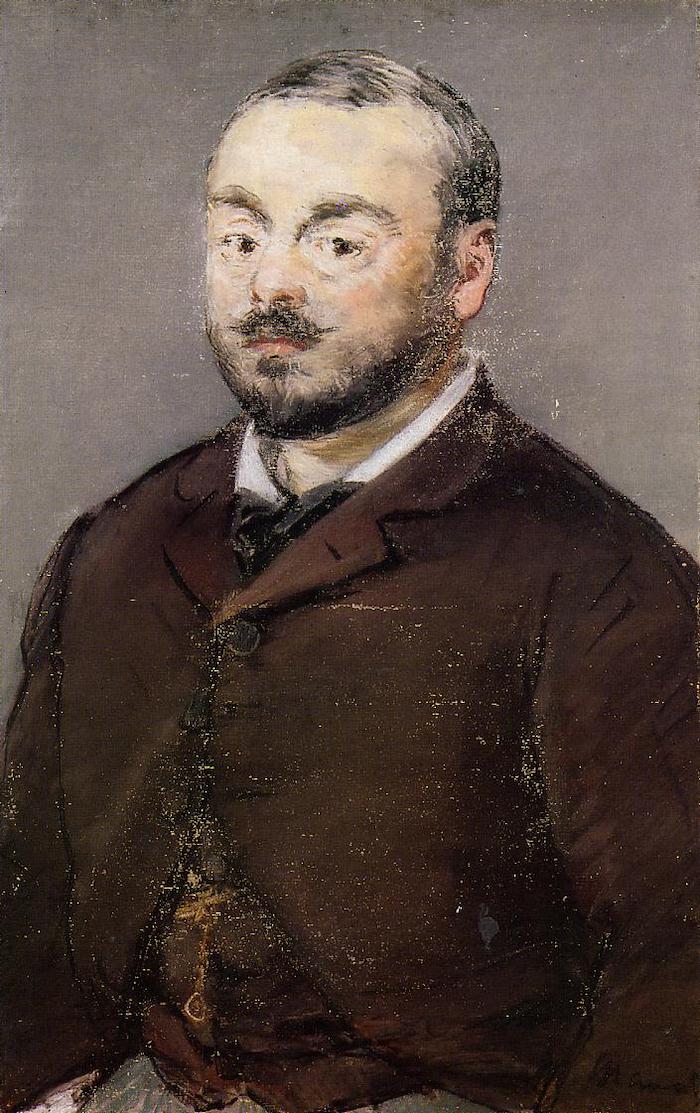
Emmanuel Chabrier, 1880, painting by Édouard Manet, Ordrupgaard Museum, Charlottenlund, Denmark.
Locations
People
- Edgar Degas
- Emmanuel Chabrier
- Gabriel Fauré
- Henri Duparc
- Henri Fantin-Latour
- Richard Wagner
- Stéphane Mallarmé
- Édouard Manet
- Émile Zola
Groups
Topics
Subjects
Regions
Subregions
Related Events
Showing 10 events out of 11215 total
Years: 1883 - 1883
Emmanuel Chabrier, 1880, painting by Édouard Manet, Ordrupgaard Museum, Charlottenlund, Denmark.
Locations
People
- Edgar Degas
- Emmanuel Chabrier
- Gabriel Fauré
- Henri Duparc
- Henri Fantin-Latour
- Richard Wagner
- Stéphane Mallarmé
- Édouard Manet
- Émile Zola
Groups
Topics
Subjects
Regions
Subregions