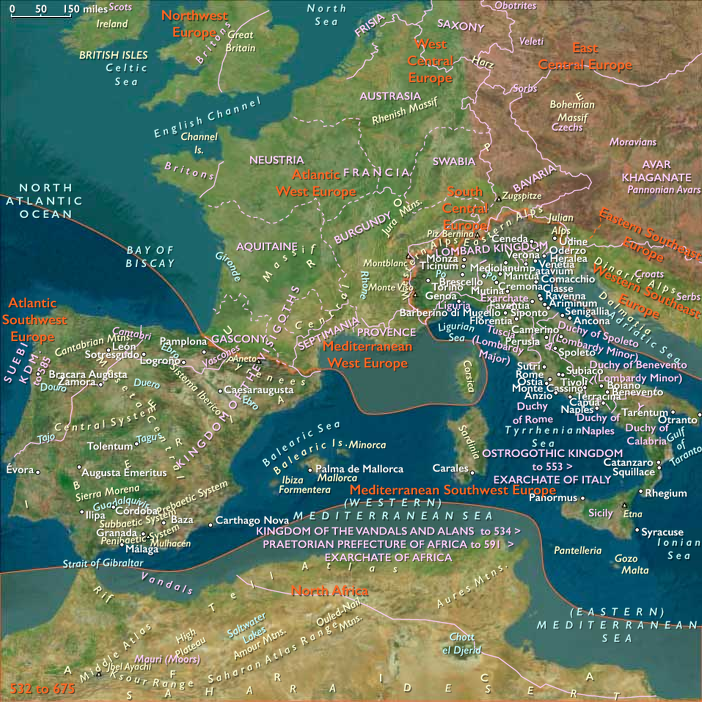
Narses proceeds to Rome, which falls with …
Years: 552 - 552
August
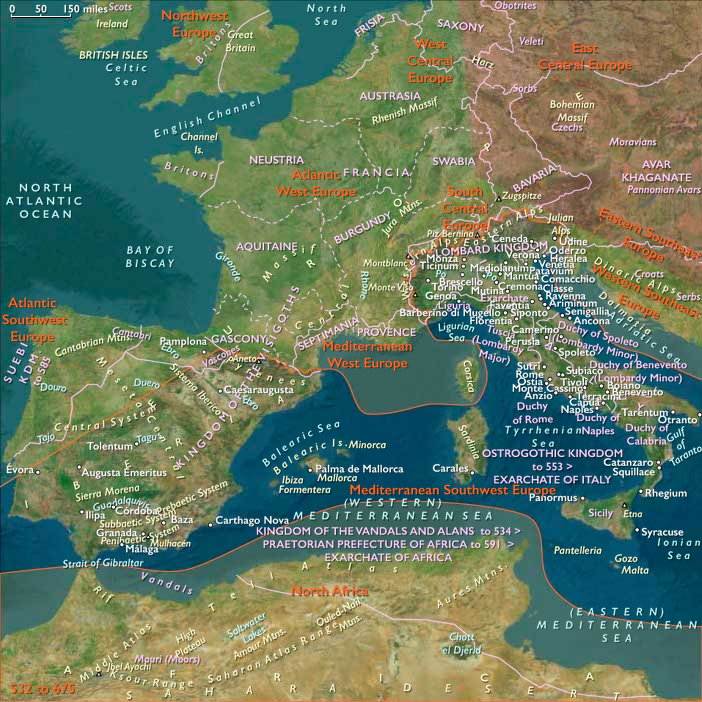
Narses proceeds to Rome, which falls with limited resistance.
Locations
People
Groups
- Goths (East Germanic tribe)
- East, or Oriens, Praetorian prefecture of
- Italy, Praetorian prefecture of
- Ostrogoths, Italian Kingdom of the
- Roman Empire, Eastern: Justinian dynasty
Topics
Commodoties
Subjects
Regions
Subregions
Related Events
Filter results
Showing 10 events out of 57601 total
Yuan succeeds Yu Zhang as emperor of the Liang Dynasty.
Japan’s Emperor Kimmei had recognized Buddhism as an official religion in 548. (This information conflicts with a tradition that has Buddhism entering Japan in 552 with priestly emissaries of southwestern Korea’s King Paekche.)
Japan’s first Buddhist temple is constructed to house a gilded bronze statue of the Buddha presented to Kimmei in 552 by the Korean king of Baekje.
According to one famous episode, shortly after the Soga clan had begun worshiping the new Buddha statue, a plague broke out, which the Mononobes promptly attribute to a curse by Japan's traditional deities as punishment for worshiping the foreign god.
Mononobe no Okoshi and his men promptly throw the statue into a river in Naniwa and burn the temple that the Sogas had built to house it.
The empire of the Rouran (also spelled Juan-Juan, Jwen-jwen, Jou-jan, Jeu-jen, or Geougen, and believed by scholars to be Mongols or Mongol-speaking peoples), encompasses a wide territorial stretch north of China from Manchuria to Turkistan.
Allied to the Hephthalites, the Rouran have engaged in continuous conflict with northern China’s Wei dynasty.
Little is known of the Rouran ruling elite, which the Book of Wei cited as an offshoot of the Xianbei.
The Rouran had subdued modern regions of Xinjiang, Mongolia, Central Asia, and parts of Siberia and Manchuria from the late fourth century.
Their frequent interventions and invasions had profoundly affected neighboring countries.
Within the Rouran confederation is a Turkic tribe noted in Chinese annals as the Tujue (Göktürks).
After a marriage proposal to the Rouran is rebuffed, the Tujue join with the Western Wei, successor state to the Northern Wei, and revolt against the Rouran.
In 552 (February 11 – March 10, 552), Tujue leader Bumin, of the Ashina clan, defeats the Rouran Khan Anagui north of Huaihuang (in the region administered by present-day Zhangjiakou, Hebei).
Bumin Qaghan, having united the local Turkic tribes and thrown off the yoke of the Rouran domination, in 552 founds the Göktürks Khaganate.
According to the Bilge Qaghan's memorial complex and the Kul Tigin's memorial complex, Bumin and Istämi ruled people by Turkic laws and they developed them.
Silk fabrics, exported for centuries along caravan routes extending from central China through India to Baghdad, Damascus, and other trade centers in the Middle East, particularly Persia, are reexported to Mediterranean Europe, where the demand for it always exceeds the available supply.
With the source of the fiber kept a closely guarded secret by the Chinese, the domestic silk dyeing and weaving industry that has burgeoned in the Roman empire is unable to establish a non-Chinese supply of raw silk.
This changes in 552, when two Nestorian Persian monks who have lived in China bring with them to Constantinople the secret of silk production, smuggled in the form of mulberry seeds and silkworm eggs concealed inside their hollow bamboo canes.
Constantinople will quickly become the Occidental center of raw silk production, its silk fabrics traded throughout Europe and used for ecclesiastical vestments and sumptuous garments.
Gubazes, despite enduring harsh conditions in the winter of 551/552, rejects the peace offers conveyed by envoys from Mihr-Mihroe.
The Persians receive substantial reinforcements in 552, but their attacks on the fortresses held by Constantinople and the Lazi are repulsed.
Thurisind and Audoin again take to the field when the Lombard-Gepid truce expires in 552, and this time the clash is unavoidable.
Audoin had reached an agreement with Justinian by which Constantinople promises to send him military support in exchange for the five thousand five hundred Lombards sent to help the general Narses in the Emperor's war in Italy.
The two-year truce is now close to expiring and the Lombards ask Constantinople to respect the alliance which has been established between them.
The Emperor finds an excuse to break the new alliance with the Gepids by claiming they had again ferried Slav raiders.
He puts together an army with renowned commanders in its ranks such as Germanus' sons Justin and Justinian, Aratius, the Herulian Suartua, and Amalafrid, brother-in-law of Audoin.
A revolt that erupts in Ulpiana diverted the bulk of the army; only a force under Amalafrid reaches the battlefield.
Scholars debate when the third Lombard–Gepid War started; it is agreed that it took place two years after the second war.
The possible dates are either 551 or 552.
The 551 date is upheld by those who argue that since in 552 Audoin had already dispatched 5,500 of his warriors to Narses' Italian campaign, the third Lombard–Gepid War must have already ended by then; against this scholars such as Walter Pohl protest that this is in contradiction with Audoin's reproaches to Justinian on the few troops sent against the Gepids, despite his massive support to Narses.
When the treaty expires, Audoin attacks the Gepids and Thurisind is crushed in the decisive battle of the Asfeld held west of Sirmium.
The battle is mentioned by Jordanes in the Romana as one of the most bloody ever fought in the region, with no fewer than sixty thousand warriors killed.
The king's son Turismod also dies, killed by Audoin's son Alboin in a duel that, according to Paul the Deacon, decided both the battle and the war.
After the battle, the Gepids are never again able to play a formative role in the shaping of events.

The Gepids' defeat causes a geopolitical shift in the Pannonian Basin, as it ends the danger represented by the Gepids to the Empire.
The Gepids' utter defeat could have meant the end of their kingdom and its conquest by the Lombards, but Justinian, wanting to maintain an equilibrium in the region, imposes an "eternal peace" that saves the Gepids; it will be observed for ten years, surviving both Thurisind and Audoin.
It may be on this occasion, and not before the war, that Lombards and Gepids sent troops to Narses as part of the peace treaty imposed by Constantinople.
In this interpretation, the small number of Gepid warriors sent could be explained with the heavy losses taken in the war and the resentment felt towards Justinian.
The Emperor also imposes some territorial concessions on Thurisind, obligating him to return Dacia Ripensis and the territory of Singidunum.
To reach a complete peace Thurisind has first to deal with Ildigis, who had found hospitality at Thurisind's court.
Audoin demands yet again to have him turned in, and Justinian joins in the request.
Thurisind, despite his reluctance to resume the war with both Audoin and Justinian, does not want to openly breach the rules of hospitality and thus tries to evade the request by demanding in his turn to have Ostrogotha given to him; in the end, to avoid both openly giving in and at the same time renewing the war, both kings murder their respective guests but keep secret their involvement in the act.
Totila hopes to come to terms with Justinian, but the powerful imperial army, twenty thousand strong, under the eunuch commander Narses, is marching across the Apennines towards Rome.
Near the village of Taginae (traditionally located somewhere to the north of modern Gualdo Tadino), Narses encounters the fifteen thousand-man Ostrogothic army commanded by Totila, who had been advancing to intercept him.
Totila, finding himself considerably outnumbered, ostensibly enters into negotiations while planning a surprise attack, but Narses is not fooled by this stratagem.
In a narrow mountain valley, Narses deploys his army in a "crescent shaped" formation.
He dismounts his Lombard and Heruli cavalry mercenaries, placing them as a phalanx in the center.
On his left flank, he sends out a mixed force of foot and horse archers to seize a dominant height.
The Goths open the battle with a determined cavalry charge.
Halted by enfilading fire from both sides, the attackers are thrown back in confusion on the infantry behind them.
The imperial cataphracts (Clibanarii) sweep into the milling mass.
Totila had ordered his army to use only spears: the Roman victory is credited to imperial archers.
More than six thousand Goths, including Totila, are killed.
The remnants flee.
Justinian dispatches a small force (two thousand men) under Liberius to Hispania, according to the historian Jordanes; the imperial troops makes landfall in June or July 552, probably at the mouth of the Guadalete or perhaps Málaga.
Liberius joins with Athanagild to defeat Agila as he marches south from Mérida towards Seville in August or September 552.
Years: 552 - 552
August
Locations
People
Groups
- Goths (East Germanic tribe)
- East, or Oriens, Praetorian prefecture of
- Italy, Praetorian prefecture of
- Ostrogoths, Italian Kingdom of the
- Roman Empire, Eastern: Justinian dynasty