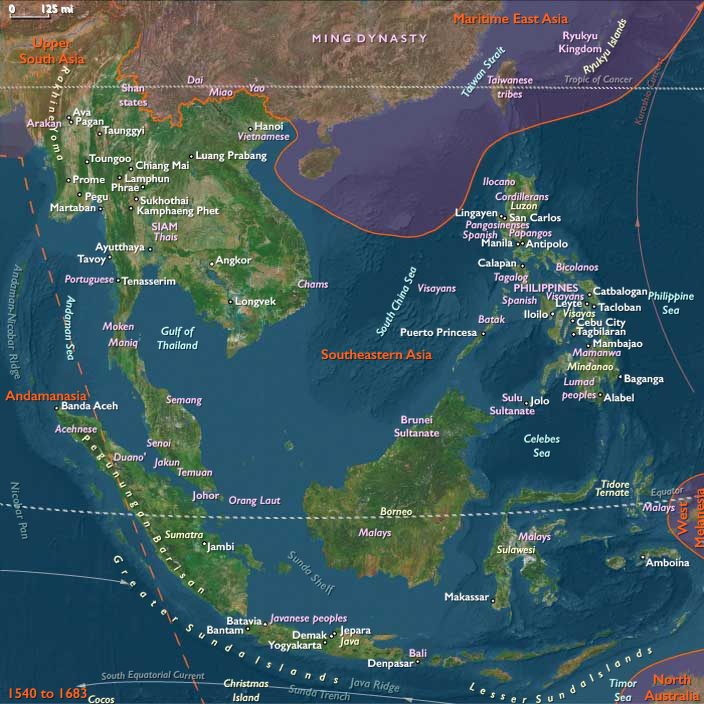
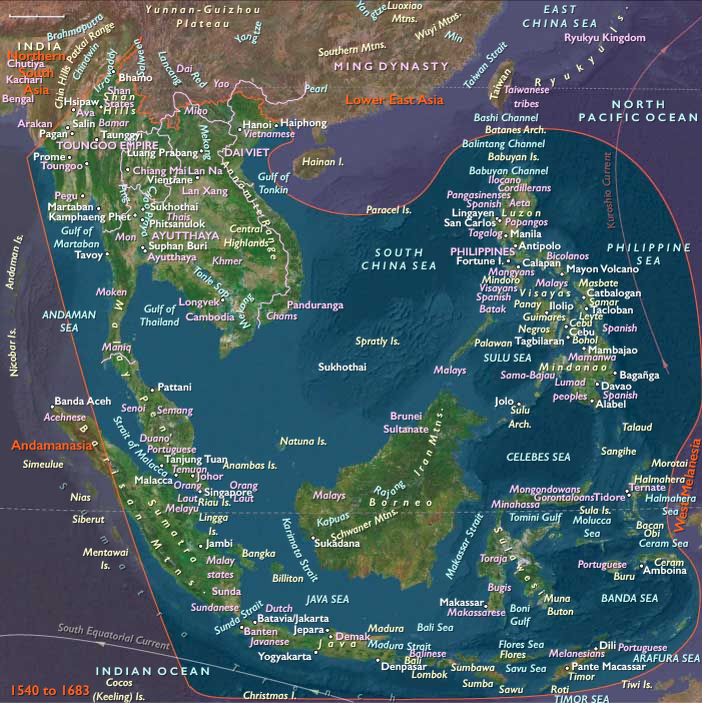
Narai's reign, under the auspices of French …
Years: 1662 - 1662
Narai's reign, under the auspices of French Jesuits who are given permission to settle in Ayutthaya in 1662, will see the first concerted attempt to convert the monarch to Catholicism, although Catholic missions have been present in Ayutthaya as early as 1567 under Portuguese Dominicans. (The conversion attempt will ultimately fail and arguably backfire but Catholics are to remain in Siam up to the present day.)
Locations
People
Groups
- Christians, Roman Catholic
- Ayutthaya (Siam), Thai state of
- Jesuits, or Order of the Society of Jesus
Topics
Commodoties
Subjects
Regions
Subregions
Related Events
Filter results
Showing 10 events out of 23 total
North Africa (1828–1971 CE): Colonial Rule, Anticolonial Resistance, and National Independence
Geographic & Environmental Context
The subregion of North Africa includes Morocco (with the Western Sahara), Algeria, Tunisia, and Libya. Anchors included the Atlas Mountains, the Tell plains, the Western Sahara desert corridor (later Spanish Sahara, with Río de Oro and Saguia el-Hamra), the Saharan oases, and the Mediterranean ports of Algiers, Tunis, Tripoli, Casablanca, and Tangier. From fertile valleys to arid desert, the region’s environments were reshaped by European conquest, settler colonization, and the struggles for independence.
Climate & Environmental Shifts
The 19th century saw cycles of drought and famine across the Maghreb, devastating rural populations in Algeria and Morocco. Locust swarms exacerbated hardship. In the 20th century, irrigation projects and colonial plantations transformed the Tell and oases, while mechanized drilling extended wells into the Western Sahara. By mid-century, desertification intensified, placing stress on nomadic pastoralists.
Subsistence & Settlement
-
Algeria: Invaded by France in 1830, Algeria became a settler colony. Vineyards, wheat fields, and citrus groves expanded, while Indigenous communities lost land through confiscation. Rural revolts erupted, most famously under Abdelkader (1832–1847).
-
Tunisia: Declared a French protectorate in 1881. Olive cultivation and grain exports were commercialized; Tunis and Sfax grew as administrative and commercial centers.
-
Morocco: The Alaouite dynasty endured until the French and Spanish protectorates were imposed in 1912, with Tangier as an international zone. Rural tribes and the Rif War (1921–1926) challenged European control.
-
Libya: Conquered by Italy in 1911 from the Ottomans. Settlers colonized Cyrenaica and Tripolitania, facing fierce resistance from the Sanusi order under Omar Mukhtar (1923–1931) until his capture and execution.
-
Western Sahara: Formally annexed as Spanish Sahara (1884), divided into Río de Oro and Saguia el-Hamra.Spanish rule was consolidated in the 20th century with coastal outposts at Villa Cisneros (Dakhla) and La Güera. Phosphate deposits at Bou Craa (discovered 1947) became central to Spain’s colonial interests.
Technology & Material Culture
Colonial regimes built railways, ports, and roads to export grain, oil, wine, phosphates, and petroleum. European-style cities rose alongside Indigenous medinas. Mosques, zawiyas, and Sufi shrines remained cultural anchors. In Libya and Algeria, resistance fighters wielded rifles and guerrilla tactics. In Morocco and the Western Sahara, nomads sustained camel caravans, tents, and oral poetry while gradually adapting to modern arms and vehicles introduced in mid-century.
Movement & Interaction Corridors
-
Saharan caravans dwindled as steamships and railroads dominated trade, though camel routes persisted into the 20th century.
-
Colonial export networks: Algeria’s wine and wheat fed French markets; Tunisia exported olives and phosphates; Morocco exported citrus, leather, and phosphates.
-
Western Sahara: Connected to the Canary Islands and Spain by shipping routes; nomadic Sahrawis crossed borders with Mauritania and Morocco.
-
Migration: Thousands of Algerians, Moroccans, and Tunisians migrated to France as laborers during both World Wars and afterward.
Cultural & Symbolic Expressions
Islam remained the core of identity, reinforced through the Sanusi order in Libya, reformist ulama in Algeria, and Sufi brotherhoods across Morocco and Tunisia. Oral poetry and tribal traditions preserved Saharan identity. Colonial regimes sponsored European schools, churches, and cultural institutions, but local resistance emphasized Arabic language, Islamic law, and national symbols. Postwar nationalism produced flags, anthems, and revolutionary heroes, linking independence to cultural revival.
Environmental Adaptation & Resilience
Villages intercropped cereals and legumes to survive drought. Nomadic tribes in the Sahara adjusted grazing routes and relied on kinship networks. During famines, zawiyas and religious waqf lands distributed food aid. Resistance fighters exploited deserts and mountains as refuges against colonial armies. In the 20th century, conservation of oases and state irrigation schemes aimed to stabilize fragile ecosystems, though often at high social cost.
Transition
By 1971 CE, North Africa had undergone sweeping transformation:
-
Algeria achieved independence in 1962 after a bloody war led by the FLN.
-
Tunisia became independent in 1956 under Habib Bourguiba.
-
Morocco regained independence in 1956 under Mohammed V and Hassan II.
-
Libya became independent in 1951 under King Idris; a 1969 coup brought Muammar Gaddafi to power.
-
Western Sahara remained under Spanish control as Spanish Sahara, its Sahrawi population marginalized even as Bou Craa phosphate mines and fisheries drew colonial investment.
North Africa, long a crossroads of Saharan caravans and Mediterranean seaports, entered the modern era with its states independent and assertive—except for the Western Sahara, where the unfinished struggle for decolonization would soon ignite.
North Africa (1828–1839 CE)
French Conquest and Algerian Resistance
The era from 1828 to 1839 in North Africa is dominated by France's colonial ambitions and the intense local resistance they provoke, reshaping regional dynamics and laying the foundations for profound political and social transformations.
French Invasion and the Fall of Algiers (1828–1830)
Tensions between France and Dey Hussein of Algiers escalate sharply following a diplomatic incident in 1827, prompting France to enforce a naval blockade lasting three years. Ultimately, France launches a decisive military invasion. On June 12, 1830, a French expeditionary force of approximately 34,000 soldiers lands at Sidi Ferruch, swiftly defeating the Ottoman defenses through superior artillery and organization. After a fierce three-week siege, Algiers falls, marked by widespread looting, desecration of mosques, and extensive property destruction, including the seizure of roughly fifty million francs from the city’s treasury. Dey Hussein flees into exile, terminating over three centuries of Ottoman rule.
Colonial Administration and European Settlement
Following Algiers' fall, European settlers rapidly occupy significant lands formerly controlled by Ottoman officials and indigenous Algerians. Under the military-led colonial administration known as the régime du sabre (government of the sword), French authorities prioritize settler economic interests, triggering displacement and disruption among local communities. Prominent French officials, including General Bertrand Clauzel, use their positions to promote extensive land speculation, transforming the agricultural landscape, particularly the fertile Mitidja Plain.
Abdelkader and the Algerian Resistance (1832–1839)
Almost immediately, determined resistance emerges against the French occupation, led notably by Abdelkader El Djezairi, a revered marabout chosen by tribal elders to spearhead a unified jihad in 1832. Abdelkader quickly consolidates broad tribal support throughout Algeria, founding an independent Islamic territorial state with its capital at Tlemcen. His government maintains a disciplined army, establishes efficient administrative structures, collects taxes, promotes education, and develops agricultural and manufacturing cooperatives, effectively controlling two-thirds of Algeria by 1839.
Despite a defeat by French General Thomas Bugeaud in 1836, Abdelkader successfully negotiates the Treaty of Tafna (1837), provisionally recognizing his authority. The French, however, deliberately breach this agreement by capturing Constantine in 1839, reigniting intense hostilities. Abdelkader resumes guerrilla warfare, launching bold attacks that briefly threaten Algiers itself, underscoring the depth and resilience of Algerian opposition.
Ottoman Reassertion in Tripoli (1832–1835)
In Tripoli, internal political divisions weaken the ruling Karamanli dynasty, prompting Yusuf Karamanli to abdicate in favor of his son Ali II in 1832. Persistent unrest leads to direct Ottoman intervention by Sultan Mahmud II, who dispatches troops ostensibly to restore order. In 1835, Ottoman forces forcibly remove Ali II, reintegrating Tripoli directly under Ottoman administration and conclusively ending Karamanli rule.
Increasing European Interests in Morocco and Tunisia
Morocco attracts significant attention from European powers, particularly France, due to its strategic coastal position and potential influence on the stability of French-held Algeria. Tunisia similarly experiences rising economic and political pressures from Europe, signaling impending transformations despite the absence of immediate direct colonial rule.
By the close of 1839, North Africa is on the brink of monumental changes, shaped by colonial interventions, vigorous local resistance, and the restructuring of traditional social and political orders.

The superior of a religious brotherhood, Muhieddine (Muhyi ad Din), who had spent time in Ottoman jails for opposing the dey's rule, launches attacks against the French and their Moroccan makhzen allies at Oran in 1832.
In the same year, tribal elders choose Muhieddine's son, twenty-five-year-old Abdelkader, to take his place leading the jihad.
Abdelkader, who is recognized as amir al muminin (commander of the faithful), quickly gains the support of tribes throughout Algeria.
A devout and austere marabout, he is also a cunning political leader and a resourceful warrior.
From his capital in Tlemcen, Abdelkader sets about building a territorial Muslim state based on the communities of the interior but drawing its strength from the tribes and religious brotherhoods.
By 1839 he controls more than two-thirds of Algeria.
His government maintains an army and a bureaucracy, collects taxes, supports education, undertakes public works, and establishes agricultural and manufacturing cooperatives to stimulate economic activity.
France has reason for concern that Britain, which is pledged to maintain the territorial integrity of the Ottoman Empire, will move to fill the vacuum left by a French pullout.
The French devise elaborate plans for settling the hinterland left by Ottoman provincial authorities in 1830, but their efforts at state building are unsuccessful on account of lengthy armed resistance.
The most successful local opposition immediately after the fall of Algiers is led by Ahmad ibn Muhammad, bey of Constantine.
He initiates a radical overhaul of the Ottoman administration in his beylik by replacing Turkish officials with local leaders, making Arabic the official language, and attempting to reform finances according to the precepts of Islam.
After the French fail in several attempts to gain some of the bey's territories through negotiation, an ill-fated invasion force led by Bertrand Clauzel has to retreat from Constantine in 1836 in humiliation and defeat.
Nonetheless, the French capture Constantine the following year.
Clauzel recognizes the farming potential of the Mitidja Plain and envisions the production there of cotton on a large scale.
As governor general (1835-36), he uses his office to make private investments in land and encourages army officers and bureaucrats in his administration to do the same.
This development creates a vested interest among government officials in greater French involvement in Algeria.
Commercial interests with influence in the government also begin to recognize the prospects for profitable land speculation in expanding the French zone of occupation.
They create large agricultural tracts, build factories and businesses, and exploit cheap local labor.
Most of France's actions in Algeria, not least the invasion of Algiers, are propelled by contradictory impulses.
In the period between Napoleon's downfall in 1815 and the revolution of 1830, the restored French monarchy is in crisis, and the dey is weak politically, economically, and militarily.
The French monarch seeks to reverse his domestic unpopularity.
As a result of what the French considers an insult to the French consul in Algiers by the dey in 1827, France blockades Algiers for three years.
France uses the failure of the blockade as a reason for a military expedition against Algiers in 1830.
To face the rench, the dey sends seven thousand janissaries, nineteen thousand troops from the beys of Constantine and Oran, and about seventeen thousand Kabyles.
The French establish a strong beachhead and pushed toward Algiers, thanks in part to superior artillery and better organization.
Algiers is captured after a three-week campaign, and Hussein Dey flees into exile.
French troops rape, loot (taking fifty million francs from the treasury in the Casbah), desecrate mosques, and destroy cemeteries.
It is an inauspicious beginning to France's self-described "civilizing mission," whose character on the whole is cynical, arrogant, and cruel.
In a bargain-hunting frenzy to take over or buy at low prices all manner of property—homes, shops, farms, and factories—Europeans pour into Algiers after it falls.
French authorities take possession of the beylik lands, from which Ottoman officials had derived income.
Over time, as pressures increased to obtain more land for settlement by Europeans, the state seizes more categories of land, particularly that used by tribes, religious foundations, and villages.
The new government, composed of liberal opponents of the Algiers expedition, is reluctant to pursue the conquest ordered by the old regime, but withdrawing from Algeria proves more difficult than conquering it.
A parliamentary commission that examines the Algerian situation concludes that although French policy, behavior, and organization are failures, the occupation should continue for the sake of national prestige.
In 1834 France annexes the occupied areas, which have an estimated Muslim population of about three million, as a colony.
Colonial administration in the occupied areas—the so-called regime du sabre (government of the sword)—is placed under a governor general, a high-ranking army officer invested with civil and military jurisdiction, who is responsible to the minister of war.
Abdelkader fights running battles across Algeria with French forces, which include units of the Foreign Legion, organized in 1831 for Algerian service.
Although his forces are defeated by the French under General Thomas Bugeaud in 1836, Abdelkader negotiates a favorable peace treaty the next year.
The treaty gains conditional recognition for Abdelkader's regime by defining the territory under its control and salvages his prestige among the tribes just as the shaykhs are about to desert him.
To provoke new hostilities, the French deliberately break the treaty in 1839 by occupying Constantine.
Abdelkader takes up the holy war again, destroys the French settlements on the Mitidja Plain, and at one point advances to the outskirts of Algiers itself.
He strikes where the French were weakest and retreats when they advance against him in greater strength.
The government moves from camp to camp with the amir and his army.
Gradually, however, superior French resources and manpower and the defection of tribal chieftains take their toll.
Years: 1662 - 1662
Locations
People
Groups
- Christians, Roman Catholic
- Ayutthaya (Siam), Thai state of
- Jesuits, or Order of the Society of Jesus