
Napoleon Bonaparte was born on August 15, …
Years: 1785 - 1785
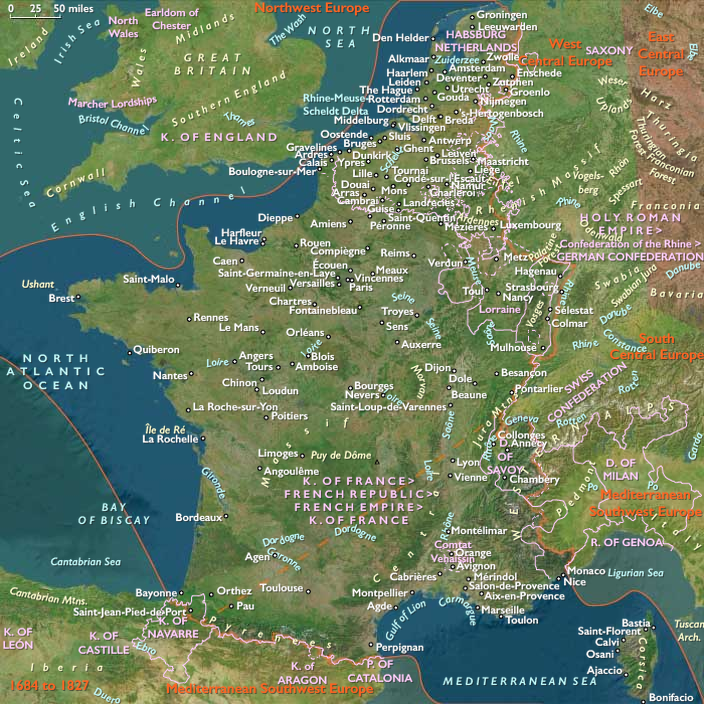
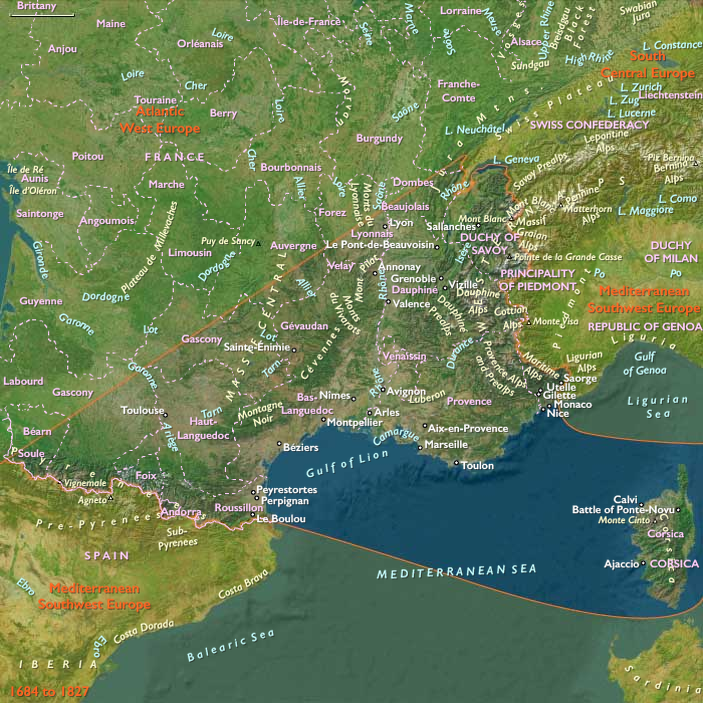
Napoleon Bonaparte was born on August 15, 1769, the second of eight children, in his family's ancestral home Casa Buonaparte, located in the town of Ajaccio, Corsica, a year after the island was transferred to France by the Republic of Genoa.
He was christened Napoleone di Buonaparte, probably acquiring his first name from an uncle (though an older brother, who did not survive infancy, was also named Napoleone).
He is called by this name until his twenties, when he adopts the more French-sounding Napoléon Bonaparte.
The Corsican Buonapartes originate from minor Italian nobility of Lombard origin, who had come to Corsica from Liguria in the sixteenth century.
2012 DNA tests found some of the family's ancestors were from the Caucasus region. (lefigaro.fr (15 January 2012). "Le Figaro – Mon Figaro : Selon son ADN,les ancêtres de Napoléon seraient du Caucase!".
Le Figaro.
Retrieved 28 June 2012.)
The study found haplogroup type E1b1c1* originating in Northern Africa circa 1200 BCE.
("Haplogroup of the Y Chromosome of Napoléon the First; Gerard Lucotte, Thierry Thomasset, Peter Hrechdakian; Journal of Molecular Biology Research".
December 2011.
Retrieved 28 June 2012.)
Naploeon’s father Nobile Carlo Buonaparte, an attorney, had been named Corsica's representative to the court of Louis XVI in 1777.
The dominant influence of Napoleon's childhood was his mother, Letizia Ramolino, whose firm discipline restrained a rambunctious child.
Napoleon has an elder brother, Joseph; and younger siblings Lucien, Elisa, Louis, Pauline, Caroline and Jérôme.
There were also two other children, a boy and girl, who were born before Joseph but died in infancy.
Napoleon was baptized as a Catholic just before his second birthday, on 21 July 1771 at Ajaccio Cathedral.
Napoleon's noble, moderately affluent background and family connections had afforded him greater opportunities to study than were available to a typical Corsican of the time.
In January 1779, Napoleon had enrolled at a religious school in Autun, mainland France, to learn French, and in May he was admitted to a military academy at Brienne-le-Château.
He speaks with a marked Corsican accent and will never learn to spell properly.
Teased by other students for his accent, Napoleon had applied himself to reading.
An examiner observed that Napoleon "has always been distinguished for his application in mathematics.
He is fairly well acquainted with history and geography...This boy would make an excellent sailor."
(McLynn, Frank (1998).
Napoleon, p.21.
Pimlico) On completion of his studies at Brienne in 1784, Napoleon had been admitted to the elite École Militaire in Paris; this had ended his naval ambition, which had led him to consider an application to the British Royal Navy.
Instead, he had trained to become an artillery officer and when his father's death reduced his income, had been forced to complete the two-year course in one year.
He is the first Corsican to graduate from the Ecole Militaire and is examined by the famed scientist Pierre-Simon Laplace, whom Napoleon will later appoint to the Senate.
Upon graduating in September 1785, Bonaparte is commissioned a second lieutenant in La Fère artillery regiment, initially serving served on garrison duty in Valence, Drôme.
Locations
People
Subjects
Regions
Subregions
Related Events
Showing 10 events out of 24657 total
Years: 1785 - 1785
Locations
People
Subjects
Regions
Subregions