
Atlantic West Europe (1684–1827 CE): Ports, Polders, …
Years: 1684 - 1827
Atlantic West Europe (1684–1827 CE): Ports, Polders, and Revolutions on an Ocean Rim
Geography & Environmental Context
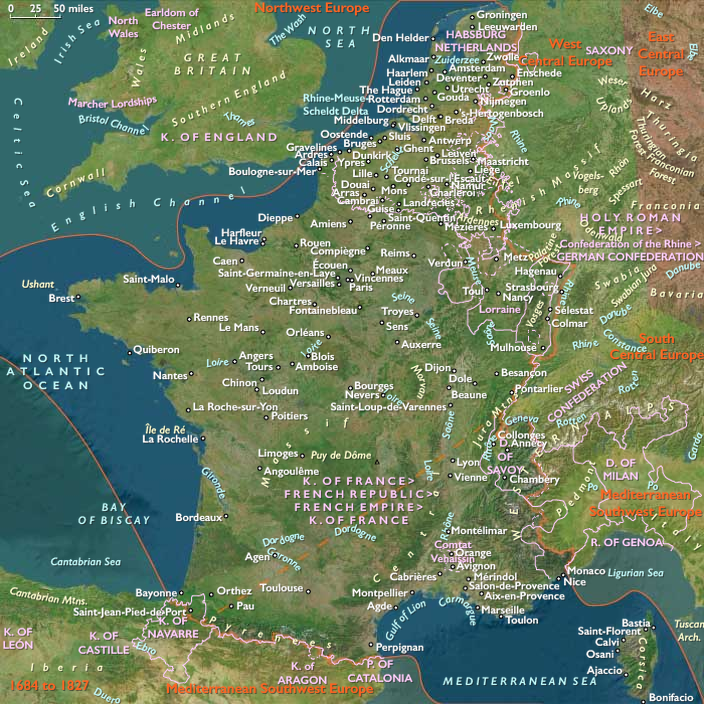
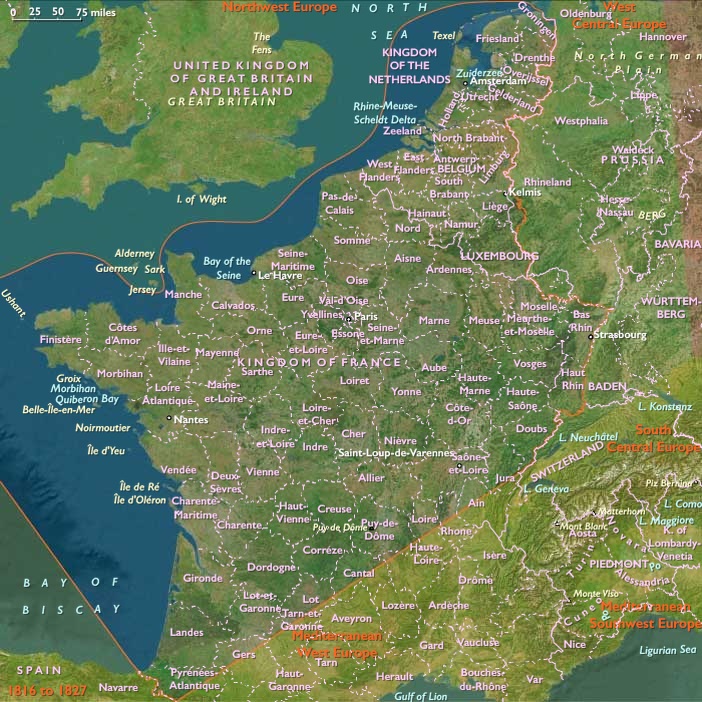
Atlantic West Europe includes the Atlantic and English Channel coasts of France, the Loire Valley, Burgundy, northern France (including Paris), and the Low Countries: Belgium, the Netherlands, and Luxembourg. Anchors include the Seine, Loire, Somme, Scheldt (Escaut), Meuse (Maas), and Rhine–Meuse–Scheldt delta, the Brittany and Cotentin peninsulas, and the Flemish and Dutch polders. The mix of estuaries, dunes, chalk cliffs, river basins, and reclaimed lowlands made an intensely maritime and fluvial landscape.
Climate & Environmental Shifts
In the tail of the Little Ice Age, the Great Frost (1709) and later 1816–1817 dearths (“Year Without a Summer”) hammered grain and wine. North Sea gales and storm surges tested dikes in the Low Countries; Channel tempests menaced fishing fleets and convoys. Yet temperate rains and silt-laden rivers regenerated soils, while coastal upwelling sustained rich fisheries.
Subsistence & Settlement
-
Grain & dairying: Wheat and rye dominated Paris’s provisioning basins; Flanders and Holland balanced grain with dairy, butter, and cheese.
-
Vine & orchard belts: Loire and Burgundy vineyards (Sancerre, Touraine, Côte d’Or) specialized in high-value wines; cider zones dotted Normandy and Brittany.
-
Maritime economies: Herring and cod fisheries (Channel/North Sea); salt works and oyster beds along the French Atlantic; river and coastal shipping sustained small ports and market towns.
-
Urban network: Paris concentrated administration, crafts, print, and finance; Amsterdam, Rotterdam, Antwerp, Ostend, and French ports—Le Havre, Rouen, Saint-Malo, Nantes, La Rochelle, Bordeaux, Brest, Dunkirk—linked hinterlands to Atlantic circuits.
Technology & Material Culture
Wind- and water-power drove mills, sawyers, and paper works; polder engineering (dikes, sluices, windpumps) extended arable land. Canalization—Briare, Centre, Loire–Bretagne, Saint-Quentin, Ourcq, and Dutch canal grids—knit river basins to seaports. Shipyards on the Seine, Loire, Gironde, and Dutch estuaries turned out warships and merchantmen. Textiles flourished: Flemish linens and lace; northern French woolens and printed cottons; Dutch and French faience and porcelain; urban book trades and scientific instruments fed Enlightenment cultures.
Movement & Interaction Corridors
-
Sea lanes & estuaries: Convoys moved colonial staples and manufactures through the Channel, Bay of Biscay, and Dutch delta; river barges provisioned Paris, Rouen, Nantes, Bordeaux, and the Low Countries’ ports.
-
Atlantic empires: Dutch carrying trade persisted though eclipsed by Britain; the Ostend Company briefly challenged monopolies (1720s). French ports (Nantes, Bordeaux, La Rochelle, Saint-Malo) prospered on Caribbean sugar and the triangular trade, then reeled under wartime blockades.
-
War regimes: The War of the Spanish Succession, Seven Years’ War, and Napoleonic Wars re-routed commerce; the Continental System and British blockades choked Atlantic exports, while smuggling through the North Sea and Brittany coasts proliferated.
-
Roads & canals: Turnpikes and towpaths, Dutch trekvaart passenger boats, and French royal canals shortened time–distance to market.
Cultural & Symbolic Expressions
Parisian salons, academies, and presses circulated Enlightenment ideas; the French Revolution (1789) unleashed sans-culottes politics, civic festivals, and new symbols. The Code civil (Code Napoléon) recast property and family law across annexed territories. In the Low Countries, Catholic processions and guild traditions coexisted with a vigorous print and mercantile culture; Antwerp and Amsterdam remained art and publishing hubs. Coastal ritual calendars—fishermen’s blessings, harvest fairs—endured beside neoclassical boulevards in rebuilt Le Havre and Bordeaux quays.
Environmental Adaptation & Resilience
-
Risk spreading: Mixed farming (grain–dairy–flax) and vineyard diversification buffered climate shocks; cider and beer substituted when wine failed.
-
Water management: Continuous dike raising, dune fixation, canal dredging, and bank revetments defended land and kept arteries open.
-
Provisioning systems: Parisian grain police, port granaries, and charitable confraternities cushioned bad years; Dutch urban poor relief and fish protein mitigated famine pulses.
-
Wartime elasticity: Neutral flags (at times), coastal cabotage, and river relays sustained minimal flows when ocean routes were interdicted.
Transition
Between 1684 and 1827, Atlantic West Europe moved from Dutch-led carrying trade toward a Paris-centered, French revolutionary–Napoleonic epoch and a rebalanced Low Countries. Port cities rose and fell with war and blockade; canals and polders bound sea to field; vineyards and dairying financed dense towns. By the 1820s, despite scars from blockades and dearth, the region had the infrastructure, market linkages, and legal reforms to launch nineteenth-century industrial and commercial expansion—its estuaries and capitals poised once more to meet the Atlantic winds.
People
- Charles X of France
- Denis Diderot
- Jean-Jacques Rousseau
- Louis XIV of France
- Louis XVI of France
- Louis XVIII of France
- Montesquieu
- Napoleon
- Voltaire
- William I of the Netherlands
Groups
- Christians, Roman Catholic
- Austria, Archduchy of
- Netherlands, United Provinces of the (Dutch Republic)
- Spain, Bourbon Kingdom of
- Prussia, Kingdom of
- Britain, Kingdom of Great
- French First Republic
- France, (first) Empire of
- Austrian Empire
- France, constitutional monarchy of
- Netherlands, Kingdom of The United
Topics
- Colonization of Asia, French
- Colonization of the Americas, French
- Enlightenment, Age of
- Nine Years' War
- Spanish Succession, War of the
- Seven Years' War
- French Revolution
- French Revolutionary Wars, or “Great French War”
- Napoleonic Wars
- Peninsular War
- French Invasion of Russia
- Congress of Vienna
- Western Architecture: Neoclassicism
Commodoties
Subjects
- Commerce
- Architecture
- Painting and Drawing
- Conflict
- Faith
- Government
- Scholarship
- Custom and Law
- Finance
- Metallurgy
Regions
Subregions
Years: 1684 - 1827
People
- Charles X of France
- Denis Diderot
- Jean-Jacques Rousseau
- Louis XIV of France
- Louis XVI of France
- Louis XVIII of France
- Montesquieu
- Napoleon
- Voltaire
- William I of the Netherlands
Groups
- Christians, Roman Catholic
- Austria, Archduchy of
- Netherlands, United Provinces of the (Dutch Republic)
- Spain, Bourbon Kingdom of
- Prussia, Kingdom of
- Britain, Kingdom of Great
- French First Republic
- France, (first) Empire of
- Austrian Empire
- France, constitutional monarchy of
- Netherlands, Kingdom of The United
Topics
- Colonization of Asia, French
- Colonization of the Americas, French
- Enlightenment, Age of
- Nine Years' War
- Spanish Succession, War of the
- Seven Years' War
- French Revolution
- French Revolutionary Wars, or “Great French War”
- Napoleonic Wars
- Peninsular War
- French Invasion of Russia
- Congress of Vienna
- Western Architecture: Neoclassicism
Commodoties
Subjects
- Commerce
- Architecture
- Painting and Drawing
- Conflict
- Faith
- Government
- Scholarship
- Custom and Law
- Finance
- Metallurgy
Regions
Subregions