
Napata has remained the center of the …
Years: 597BCE - 586BCE
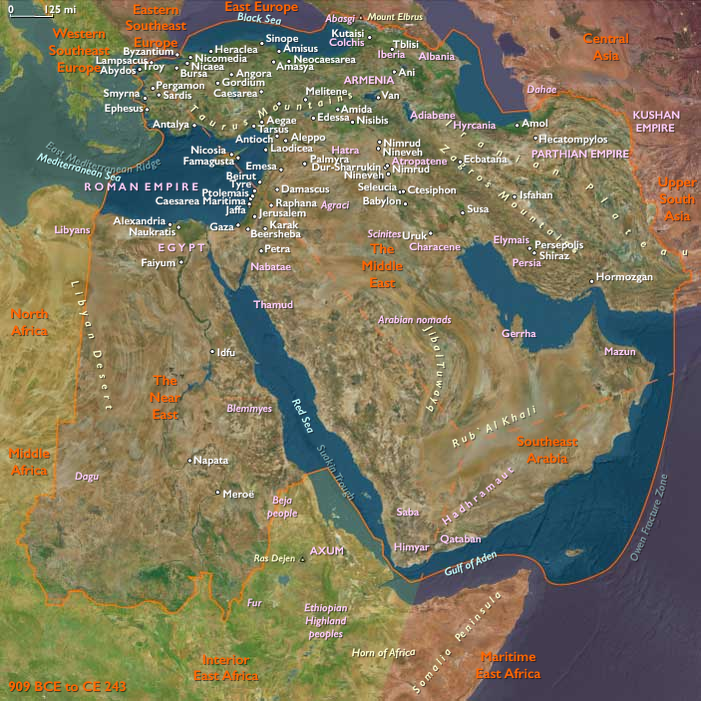
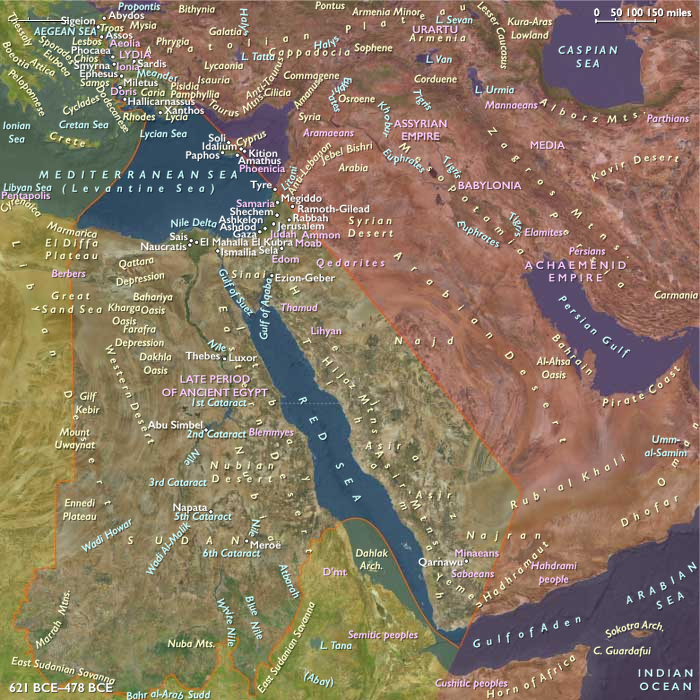
Napata has remained the center of the Kingdom of Kush for another two generations following the Saite dynasty’s consolidation of Upper Egypt in 656 BCE.
Its economy is essentially based on gold, with Twenty-sixth Dynasty Egypt an important economic ally.
The people of Napata at this time are culturally Egyptianized.
Napatan architecture, paintings, writing script, and other artistic and cultural forms are in the Egyptian style.
Egyptian burial customs are practiced, including the resurrection of pyramid building.
The Napatan dynasty and their successors had built the first pyramids the Nile Valley had seen since the Middle Kingdom.
Also, several Egyptian gods are worshiped.
The most important god is Amun, a Theban deity, whose temple is the most important at Napata, located at the foot of Jebel Barkal.
After the Persian conquest of Egypt, Napata loses its economic influence.
The Napatan region itself is desiccating, leading to less cattle and agriculture.
Finally, Napata is losing its role of economic capital to Meroë.
The Island of Meroë, the peninsula formed by the Nile and the Atbara courses, is an area rich in iron, which is becoming an essential source of wealth.
A Kushite king named Anlamani had revived the power of the kingdom of Napata.
Psamtik II's campaign was likely initiated to destroy any future aspirations the Kushites may have had to reconquer Egypt.
The Egyptian army advances to Pnubs (Kerma) and the capital city of Napata in a series of fierce battles, where they loot its temples and destroy the royal Kushite statues.
The Kushite capital is sacked under the reign of the native Kushite king Aspelta, who was the younger brother of Anlamani and the son of Senkamanisken.
The Year Three Karnak stela is dated to II Shemu day 10 of Psamtik II's reign and states, “The army that your Majesty sent to Nubia has reached the land of Pnubs....Nubians from all parts [of Kush] had arisen against him, their hearts full of anger when he attacked those who had rebelled against him there; because he was furious at those who had arisen against him.
His Majesty took part in the combat as soon as he reached the battle.
The rebels capitulated before a single arrow was unleashed against them....Those who tried to flee did not succeed and were brought back as prisoners: four thousand two hundred men.
As a result of Psamtik's devastating campaign, Kush's power is crushed, and its kings from Aspelta onward lose any opportunity of ever regaining control of Egypt.
Instead, the Nubian rulers decide to shift their capital further south from Napata to the relative safety of Meroë.
Curiously, however, Psamtik II does not appear to have capitalized on his victory.
His troops retreat back to the First Cataract, and Elephantine continues to be the southern border of Egypt.
Locations
Groups
Topics
Commodoties
Subjects
- Commerce
- Symbols
- Environment
- Labor and Service
- Fashion
- Conflict
- Faith
- Government
- Technology
- Economics
Regions
Subregions
Years: 597BCE - 586BCE
Locations
Groups
Topics
Commodoties
Subjects
- Commerce
- Symbols
- Environment
- Labor and Service
- Fashion
- Conflict
- Faith
- Government
- Technology
- Economics
Regions
Subregions