
Nako, having turned to Christianity after his …
Years: 1043 - 1043
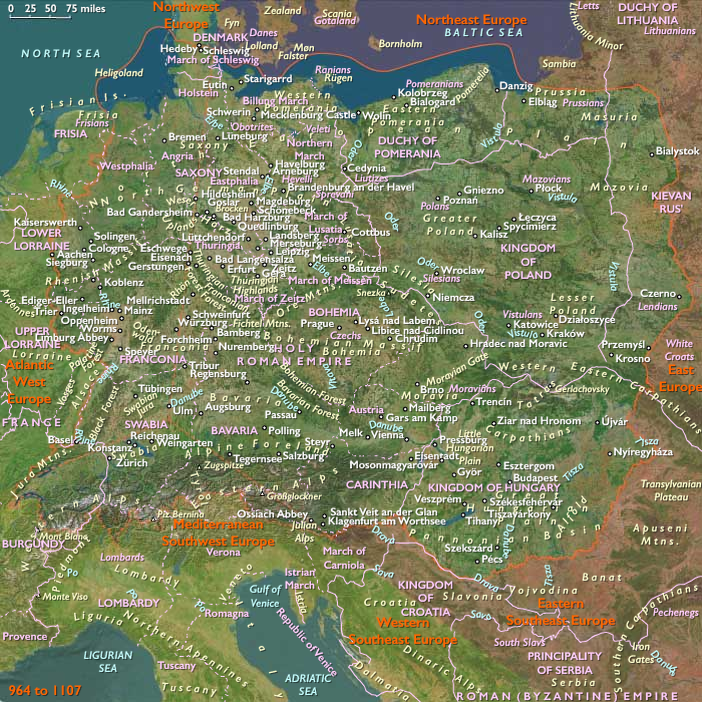
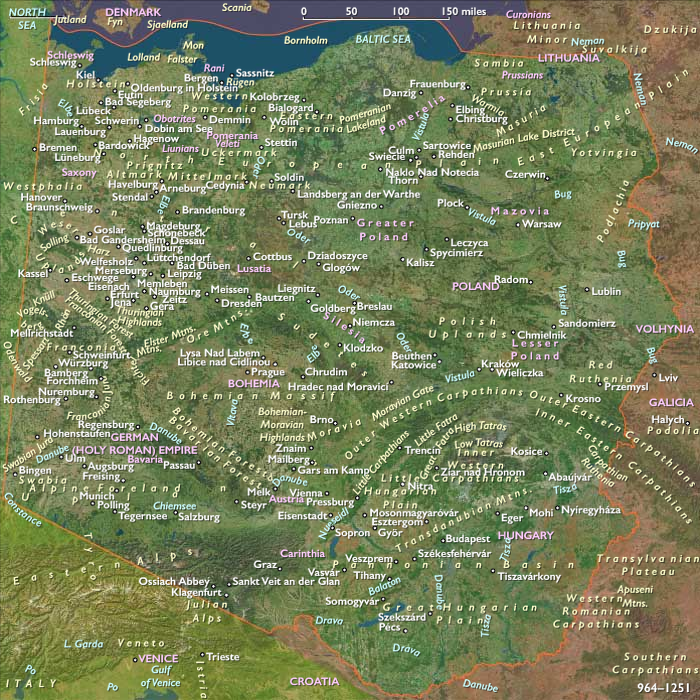
Nako, having turned to Christianity after his defeat in the Battle of Recknitz in 955, had established his seat at Mecklenburg.
His sons Mstivoj and Mstidrag and grandsons Mstislaw and Udo are mostly associated with the Slavic uprising of 983.
All of them had either abandoned Christianity or were "bad Christians" (at least for a time).
Udo was a bad Christian (male christianus according to Adam of Bremen) whose own father, Mistiwoi, had renounced the new religion for the old Slavic paganism.
Udo had sent his son to be educated at the monastery of St. Michael at Lenzen and later at Lüneburg.
After a Saxon murdered Udo in 1028, Gottschalk had renounced Christianity and assumed the leadership of the Liutici to avenge his father, killing many Saxons before Duke Bernard II of Saxony defeated and captured him; his lands had gone to Ratibor of the Polabians.
Reconverted to Christianity, Gottschalk had been released and sent to Denmark with many of his people to serve King Cnut in his wars with Norway.
Sveyn Estridson, Jarl of Denmark, desired independence from King Magnus I of Norway in 1042.
Because Magnus is supported by his brother-in-law, Bernard II, Sveyn achieves an alliance with the Obotrites through the mediation of Gottschalk.
However, the Obotrite chief Ratibor is killed in a siege by Magnus in 1043.
In an attempt to avenge their father, his sons are killed in the same year in a battle at Lürschau Heath on 28 September.
The death of Ratibor and his sons allows Gottschalk, who marries Sveyn's daughter Sigrid, to seek the inheritance of his father Udo as Prince of the Obodrites.
Locations
People
Groups
- Polytheism (“paganism”)
- Saxons
- Germans
- Rani (Slavic tribe)
- Polabian Slavs (West Slavs)
- Wends, or Sorbs (West Slavs)
- Christianity, Chalcedonian
- Obotrites (Slavic tribal confederation)
- Denmark, Kingdom of
- Saxony, Duchy of
- German, or Ottonian (Roman) Empire
- Lutici (West Slavic Polabian tribe)
- Meissen, March of
- Magdeburg, Archbishopric of
- Norway, independent Kingdom of
Commodoties
Subjects
Regions
Subregions
Years: 1043 - 1043
Locations
People
Groups
- Polytheism (“paganism”)
- Saxons
- Germans
- Rani (Slavic tribe)
- Polabian Slavs (West Slavs)
- Wends, or Sorbs (West Slavs)
- Christianity, Chalcedonian
- Obotrites (Slavic tribal confederation)
- Denmark, Kingdom of
- Saxony, Duchy of
- German, or Ottonian (Roman) Empire
- Lutici (West Slavic Polabian tribe)
- Meissen, March of
- Magdeburg, Archbishopric of
- Norway, independent Kingdom of
Commodoties
Subjects
Regions
Subregions