The Illyrians produce and trade cattle, horses, …
Years: 477BCE - 334BCE
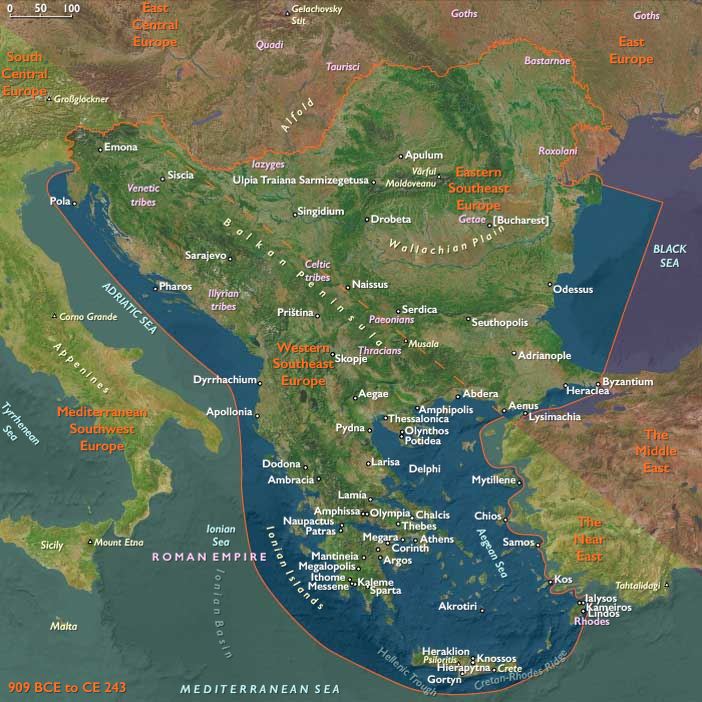
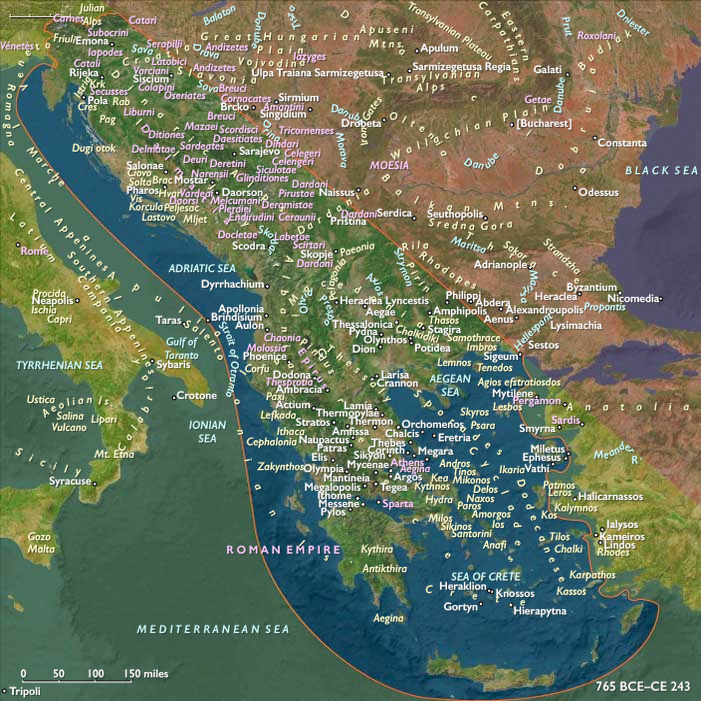
The Illyrians produce and trade cattle, horses, agricultural goods, and wares fashioned from locally mined copper and iron.
Feuds and warfare are constant facts of life for the Illyrian tribes, and Illyrian pirates plague shipping on the Adriatic Sea.
Councils of elders choose the chieftains who head each of the numerous Illyrian tribes.
From time to time, local chieftains extend their rule over other tribes and form short-lived kingdoms.
During the fifth century BCE, a well-developed Illyrian population center exists as far north as the upper Sava River valley in what is now Slovenia.
Illyrian friezes discovered near the present-day Slovenian city of Ljubljana depict ritual sacrifices, feasts, battles, sporting events, and other activities.
Locations
Groups
Topics
Commodoties
Subjects
Regions
Subregions
Related Events
Filter results
Showing 10 events out of 65541 total
Eastern Southeast Europe (477–334 BCE): Political Realignments and Cultural Evolution
Settlement and Migration Patterns
Greek Political Expansion
Between 477 and 334 BCE, Greek political influence in Eastern Southeast Europe strengthened significantly. Prominent city-states, notably Athens and Sparta, vied for influence through political alliances, trade networks, and military campaigns extending into the region, particularly impacting settlements around the Aegean Sea and along the Black Sea coast.
Thracian and Macedonian Ascendancy
The Thracian Odrysian Kingdom reached its zenith during this era, asserting substantial control across present-day Bulgaria, parts of Romania, and northern Greece. Concurrently, the rise of Macedonian power under Philip II significantly reshaped political boundaries and dynamics in northern Greece and surrounding territories.
Economic and Technological Developments
Trade Expansion and Economic Prosperity
Regional trade networks continued flourishing, enhancing economic prosperity across Eastern Southeast Europe. Commodities such as grain, timber, precious metals, and luxury goods flowed extensively, supported by improved maritime technology and infrastructure.
Innovations in Metallurgy and Warfare
Technological advancements in ironworking and metallurgy improved weaponry and agricultural tools, enhancing military efficiency and agricultural productivity. Innovations in siege warfare and military strategy notably transformed regional power structures.
Slavery and Economic Systems
Slavery was integral to the economic systems of both Greek city-states and Thracian kingdoms. Enslaved individuals were commonly acquired through warfare, trade, and piracy, performing labor in agriculture, mining, domestic service, and craftsmanship, significantly underpinning regional economies.
Cultural and Artistic Developments
Classical Greek Artistic Influence
Greek artistic traditions reached new levels of refinement, significantly influencing regional artistic expressions in sculpture, pottery, and architecture. Monumental structures and public works projects became emblematic of city-state pride and cultural achievement.
Thracian Artistic Continuity and Integration
Thracian craftsmanship maintained its sophistication, with intricate metalwork and ceremonial artifacts reflecting both indigenous styles and Greek influences. Artistic integration between Thracian and Greek cultures became increasingly prominent.
Social and Religious Developments
Development of Sophisticated Governance Structures
Political entities in Eastern Southeast Europe further refined governance systems, including democratic experiments in Greek city-states and centralized monarchy models within Thracian and Macedonian realms. These diverse political structures demonstrated advanced administrative capabilities and societal complexity.
Religious Practices and Syncretism
Religious beliefs and practices continued to evolve, blending Greek and indigenous Thracian elements into increasingly syncretic traditions. Major sanctuaries, temples, and ceremonial practices underscored communal identities and facilitated intercultural religious dialogue.
Long-Term Consequences and Historical Significance
The era from 477 to 334 BCE was transformative for Eastern Southeast Europe, characterized by significant political realignments, cultural evolution, and economic prosperity. These developments established critical precedents for subsequent Hellenistic and Roman periods, shaping enduring regional identities and historical trajectories.
The Hung kings rule Van Lang in feudal fashion with the aid of the Lac lords, who control the communal settlements around each irrigated area, organize construction and maintenance of the dikes, and regulate the supply of water.
Besides cultivating rice, the people of Van Lang grow other grains and beans and raise stock, mainly buffalo, chickens, and pigs.
Pottery-making and bamboo-working are highly developed crafts, as are basketry, leather-working, and the weaving of hemp, jute, and silk.
Both transport and communication are provided by dugout canoes, which ply the network of rivers and canals.
Maritime East Asia (477–334 BCE): Warring States and Intellectual Flourishing
Between 477 BCE and 334 BCE, Maritime East Asia—comprising lower Primorsky Krai, the Korean Peninsula, the Japanese Archipelago below northern Hokkaido, Taiwan, and southern, central, and northeastern China—enters the intense Warring States Period, characterized by continuous warfare among competing regional kingdoms. This age, however, simultaneously represents a profound era of intellectual and technological advancement.
Rise of Confucian Humanism: Mencius
During this turbulent time, Confucianism is further developed by Mencius (372–289 BCE), or Meng Zi, who becomes one of Confucius's most influential disciples. Mencius elaborates on Confucian humanism, asserting the inherent goodness of human nature and emphasizing the ruler's obligation to govern with the people's consent. According to Mencius, despotic rulers risk losing the Mandate of Heaven, thus morally justifying rebellion and change in leadership.
Military Evolution and The Art of War
Ironworking becomes widespread, transforming military practices. Armies increasingly rely on iron weaponry rather than bronze, and warfare tactics shift significantly, moving from chariot-based combat toward combined infantry and cavalry strategies. The use of dagger-axes and notably long iron pikes by kingdoms like the Qin underscores technological advances in warfare.
This period also witnesses the production of pivotal military treatises. The legendary strategist Sun Tzu writes The Art of War, the oldest and most influential military strategy text, emphasizing positioning, adaptability, and intelligence gathering. Alongside this seminal work, other significant military texts, collectively known as the Seven Military Classics, are compiled, profoundly influencing military thinking for centuries.
Intellectual Dynamism: Hundred Schools of Thought
The Hundred Schools of Thought flourish, encompassing diverse philosophical traditions such as:
-
Confucianism, further enriched by Mencius's teachings.
-
Taoism, articulated by Lao Zi and expanded by Zhuang Zi, promoting harmony with nature and simplicity.
-
Mohism, established by Mozi, advocating universal love, pacifism, and logical reasoning.
-
Legalism, emerging in the late Warring States period, emphasizing strict laws and state control as articulated by Han Feizi.
The interplay among these schools shapes the ethical, social, and political landscape of East Asia profoundly, impacting education and governance for generations.
Economic Expansion and Technological Innovations
Trade flourishes, enabling merchants to wield considerable economic and political influence. Notable technological innovations include the practical harnessing of natural gas, conveyed through bamboo pipes from natural seeps, for salt production via evaporation.
Despite advancements, Chinese cast iron production remains hindered by brittleness due to high phosphorus content, a unique feature allowing melting but reducing quality. Furthermore, Chinese understanding of music theory deepens, particularly regarding the cycle of fifths and the chromatic scale, although their practical musical tradition remains rooted primarily in pentatonic scales.
Cultural and Religious Developments
In Japan, significant religious and cultural developments occur, exemplified by the establishment of the Hikawa Shrine in 473 BCE at Omiya, near modern Saitama. This shrine, dedicated to kami—animistic spirits worshiped in Shinto, Japan’s indigenous religion—marks the earliest known evidence of formal Shinto practices. The shrine's influence extends widely, spawning numerous daughter shrines across Japan, reinforcing Shinto's central role in Japanese cultural identity.
Legacy of the Age: Foundation of Classical East Asian Civilization
Thus, the age from 477 to 334 BCE encapsulates the dynamic contrast of destructive warfare and extraordinary intellectual, technological, and cultural achievements. The era's philosophical debates, military innovations, economic growth, and religious expressions lay foundational elements for subsequent classical East Asian civilizations.

Similarities include an engagement in the quest for human meaning and the rise of a new elite class of religious leaders and thinkers in China, India and the Mediterranean.
These spiritual foundations are laid by individual thinkers within a framework of a changing social environment.
Jaspers will argue that the characteristics appeared under similar political circumstances: China, India, the Middle East and the Occident each comprised multiple small states engaged in internal and external struggles.
The three regions all give birth to, and then institutionalize, a tradition of traveling scholars, who roam from city to city to exchange ideas.
Taoism and Confucianism emerge in China after the Spring and Autumn period and the Warring States period.
In other regions, the scholars are largely from extant religious traditions; in India, from Hinduism, Buddhism, and Jainism; in Persia, from Zoroastrianism; in the Levant, from Judaism; and in Greece, from Sophism and other classical philosophies.
Mencius (372-289 BCE), or Meng Zi, is a Confucian disciple who makes major contributions to the humanism of Confucian thought.
Mencius declares that man is by nature good.
He expostulates the idea that a ruler cannot govern without the people's tacit consent and that the penalty for unpopular, despotic rule is the loss of the "mandate of heaven."
Trade also becomes important, and some merchants have considerable power in politics.
The Warring States Period sees the proliferation of iron-working in China, iron replacing bronze as the dominant metal used in warfare.
Arms of soldiers gradually change from bronze to unified iron arms.
Dagger-axes are an extremely popular weapon in various kingdoms, especially for the Qin, who produce eighteen-foot long pikes.
Military tactics also change.
Most armies in the Warring States Period, unlike in the Spring and Autumn Period, make combined use of infantry and cavalry, and the use of chariots gradually falls into disfavor.
The nobles in China thus remain a literate rather than a warrior class from this period on, as the kingdoms compete by throwing masses of soldiers against each other.
Areas such as Shu (modern Sichuan) and Yue (modern Zhejiang) are also brought into the Chinese cultural sphere during this time.
The legendary military strategist Sun Tzu, thought to have lived around this time, writes The Art of War, which is recognized today as the most influential, and oldest known military strategy guide.
Other military writings of this age make up the Seven Military Classics of ancient China: T'ai Kung's Six Secret Teachings, The Methods of the Sima, Sun Bin's Art of War, Wu Qi, Wei Liaozi, Three Strategies of Huang Shigong, and The Questions and Replies of Tang Taizong and Li Weigong (the last being made some eight hundred years after this era ends).
These seven military classics will be locked away once China is unified, and access will be restricted due to their tendency to promote revolution.
Different philosophies develop into the Hundred Schools of Thought, including Confucianism (elaborated by Mencius), Taoism (elaborated by Lao Zi and to a lesser extent Zhuang Zi, in that it is possible to see the philosophy espoused in the text of the Zhuang Zi as separate from what could be considered "classical Taoism"), Mohism (formulated by Mozi) and he later-appearing Legalism (formulated in the third century BCE by Han Feizi).