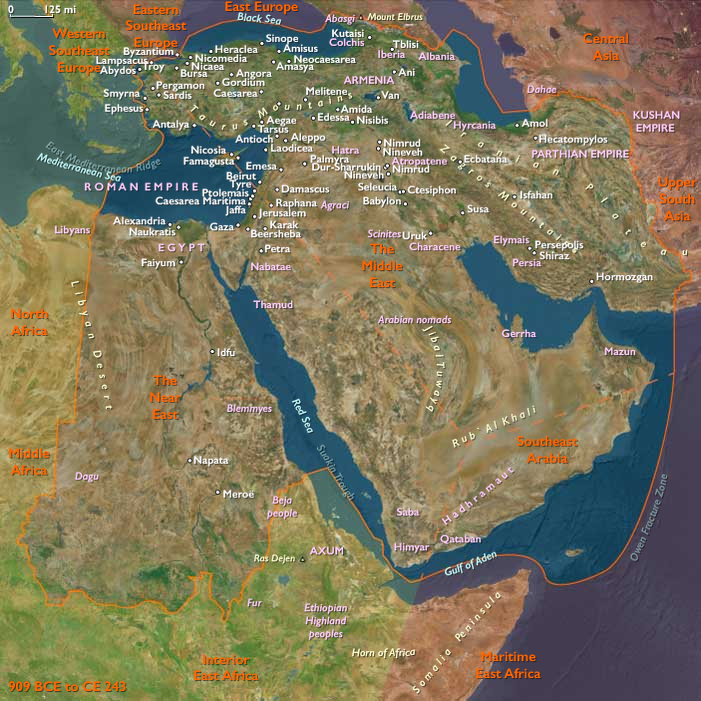
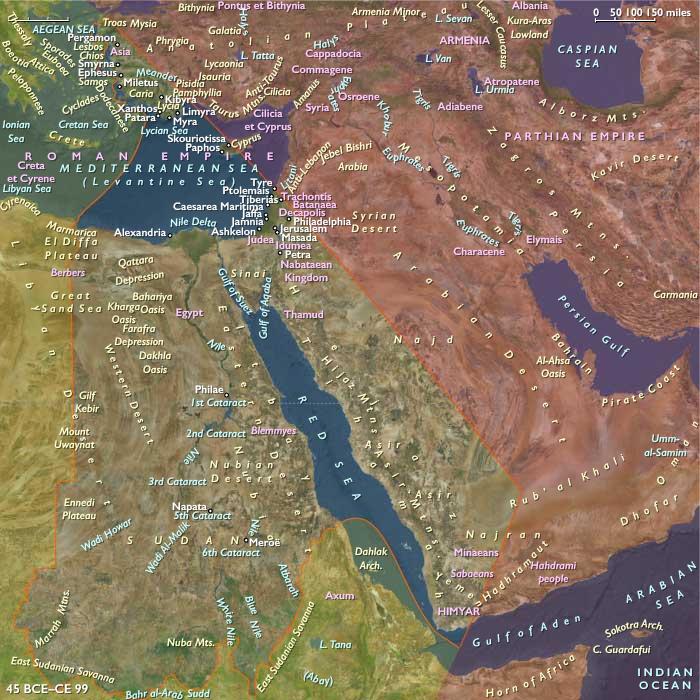
…Myra is the largest member, although Patara …
Years: 43BCE - 43BCE
…Myra is the largest member, although Patara serves as the league’s capital.
Locations
People
Groups
Topics
Commodoties
Subjects
Regions
Subregions
Related Events
Filter results
Showing 10 events out of 62343 total
The Emerald Buddha, a figurine of the sitting Buddha made of green jade (rather than emerald), clothed in gold, and about forty-five centimeters tall, is created in India in 43 BCE, according to legend, by the Buddhist sage Nagasena in the city of Pataliputra (today Patna).
The Sculpture rests today in the Chapel of the Emerald Buddha (Wat Phra Kaew) on the grounds of the Grand Palace in Bangkok.
The legends state that after remaining in Pataliputra for three hundred years, it was taken to Sri Lanka to save it from a civil war.
In 457, King Anuruth of Burma sent a mission to Ceylon to ask for Buddhist scriptures and the Emerald Buddha, in order to support Buddhism in his country.
These requests were granted, but the ship lost its way in a storm during the return voyage and landed in Cambodia.
When the Thais captured Angkor Wat in 1432 (following the ravage of the bubonic plague), the Emerald Buddha was taken to Ayutthaya, Kamphaeng Phet, Laos and finally Chiang Rai, where the ruler of the city hid it.
Cambodian historians recorded the capture of the Buddha statue in their famous Preah Ko Preah Keo legend.
However, some art historians describe the Emerald Buddha as belonging to the Chiang Saen Style of the fifteenth century CE, which would mean it is actually of Lannathai origin.
Publius Cornelius Dolabella at Caesar's death in 44 BCE had seized the insignia of the consulship (which had already been conditionally promised him) and, by making friends with Marcus Junius Brutus and the other assassins, had been confirmed in his office.
When, however, Mark Antony had offered him the command of the expedition against the Parthians and the province of Syria, he had changed sides at once.
His journey to the province is marked by plundering, extortion, and the murder of Gaius Trebonius, proconsul of Asia, who had refused to allow him to enter Smyrna.
Dolabella is thereupon declared a public enemy and superseded by Gaius Cassius Longinus, who had been a principal among Casear’s forty-odd assassins.
Cassius attacks Dolabella in Laodicea.
Strabo mentions that Dolabella, when he fled to Laodicea before Cassius, had distressed Laodicea greatly, and that, being besieged there until his death, he had destroyed many parts of the city with him.
When Cassius's troops capture the place, Dolabella orders one of his soldiers to kill him.
Cassius is now secure enough to march on Egypt, but Brutus requests his assistance upon the formation of the new triumvirate of Marcus Aemilius Lepidus, Mark Antony, and Octavian,.
Cassius quickly joins Brutus in Smyrna with most of his army, leaving his nephew behind to govern Syria.
The conspirators decide to attack the triumvir’s allies in Asia.
Brutus ravages Lycia.
Appian, Dio Cassius, and Plutarch each report that the city of Xanthos is once again destroyed. (Appian will note that it was rebuilt under Mark Antony).
Patara, captured also, is spared the massacres inflicted on nearby Xanthos.
Both cities, together with Pinara, Tlos, Olympos, and Phaselis, are members of the Lycian League, of which …
Antipater the Idumaean had been a high ranked official of Judea under the later Hasmonean kings and subsequently became a client of Pompey the Great when the Roman general conquered Judea in the name of Roman Republic.
The power of Antipater and his family had greatly increased after the death of Pompey.
Hyrcanus II had become a figurehead of no importance, and Antipater himself, in return for services to Julius Caesar, had received Roman citizenship and been awarded the title of “procurator of Judaea.” Hyrcanus, who is to be the last of the Hasmonean kings, had been restored to his position as High Priest but not to the Kingship.
Political authority rests with the Romans whose interests are represented by Antipater, who primarily promoted the interests of his own house.
Julius Caesar in 47 BCE had restored some political authority to Hyrcanus by appointing him ethnarch.
This however has had little practical effect, since Hyrcanus yields to Antipater in everything.
Antipater had appointed Phasael and Herod, his two sons by Cypros, a Nabatean princess, as governors, respectively, of Jerusalem and Galilee.
Herod has enjoyed the backing of Rome but his excessive brutality has been condemned by the Sanhedrin, the assembly of Jewish judges who constitute the supreme court and legislative body.
When summoned to be tried by the Sanhedrin, Herod meant to come to Jerusalem with an army and make war; however, Antipater and Phasael had managed to persuade him to be satisfied with making threats of force.
Antipater after the assassination of Caesar had been forced to side with Gaius Cassius Longinus against Mark Antony.
Antipater's pro-Roman politics lead to his increasing unpopularity among the devout, non-Hellenized Jews, and he is poisoned.
Herod, backed by the Roman Army, executes his father's murderer.

Rhodes, having signed a treaty with Rome in 164 BCE, has become a major schooling center for Roman noble families, and is especially noted for its teachers of rhetoric, such as Hermagoras of Temnos and the author of the Rhetorica ad Herennium.
At first the state had been an important ally of Rome and enjoyed numerous privileges, but these have gradually been lost in various machinations of Roman politics.
After Caesar's murder, Gaius Cassius, one of the assassins, had joined the party of Marcus Junius Brutus and Gaius Cassius Longinus (the more famous Cassius and prime mover of the assassination).
Commanding the fleet that engaged Dolabella off the coast of Asia, Cassius plunders Rhodes for refusal to support him. (Rhodes will continue for another century as a free city, but it will never recover its former prosperity.)
The reputation of Cassius in the East has made it easy to amass an army from other governors in the area, and by 43 BCE he is ready to take on Dolabella with twelve legions.
The Senate by this point has split with Antony and cast its lot with Cassius, confirming him as governor of the province.
Brutus, disappointed by the events after Caesar’s assassination, has also come to Greece and, in addressing the Romans in Athens, stumps for his aristocratic version of a free republic.
Decimus Brutus, with the siege of Mutina raised, had cautiously thanked Octavian, now commander of the legions that had rescued him, from the other side of the river.
Octavian coldly indicated he had come to oppose Antony, not aid Caesar's murderers.
Decimus had then been given the command to wage war against Antony, but many of his soldiers desert to Octavian.
His position deteriorating by the day, Decimus flees Italy, abandoning his legions and attempting to reach Macedonia, where Brutus and Cassius have stationed themselves.
Executed en route by a Gallic chief loyal to Mark Antony, Decimus Brutus becomes the first of Caesar's assassins to be killed.
Colonia Copia Felix Munatia, a name invoking prosperity and the blessing of the gods, is founded in 43 BCE by Lucius Munatius Plancus to serve as the capital of the Roman province Gallia Lugdunensis.
The city will become increasingly referred to as Lugdunum (and occasionally Lugudunum) by the end of the first century CE.
For three hundred years after its foundation Lugdunum will be the most important city in northwestern Europe, being also the birthplace of two emperors, Claudius and Caracalla.
During the Middle Ages, Lugdunum will transform by natural sound change to Lyon, the name it bears today.
Antony had besieged Decimus Brutus at Mutina (modern Modena) after he refused to give up Cisalpine Gaul.
Rebuilt by the Romans after its sack by the Ligurians in 177 BCE, Mutina had quickly become the most important center in Cisalpine Gaul, both because of its strategic importance and because it is on an important crossroads between Via Aemilia and the road going to Verona.
The city had been besieged by Pompey in 78, when it was defended by Marcus Junius Brutus (a populist leader, not to be confused with his son, Caesar's most well known assassin).
The city had eventually surrendered out of hunger, and Brutus had fled, only to be slain in Regium Lepidi.
Cicero had defined it Mutina splendidissima ("most beautiful Mutina") in his Philippics of 44 BCE.