
Muhammad ibn Falah and his followers had …
Years: 1441 - 1441
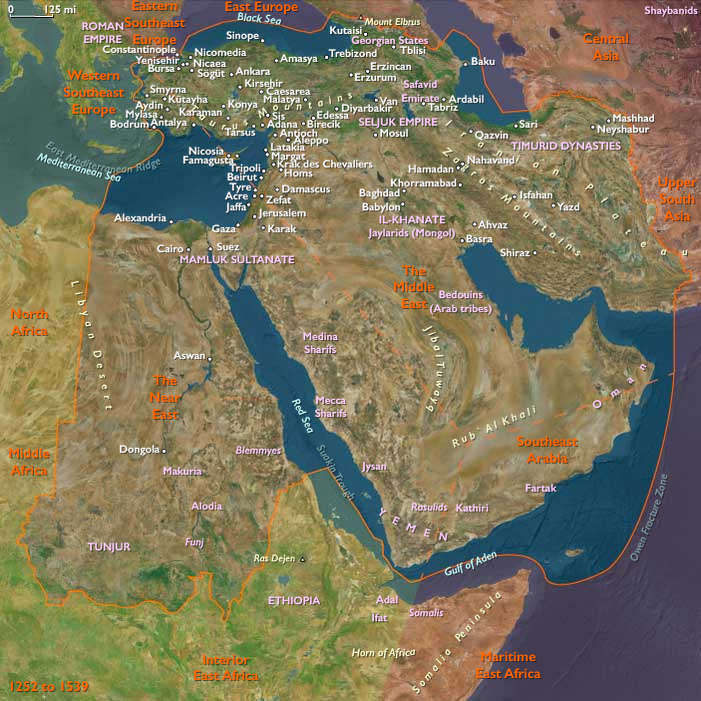
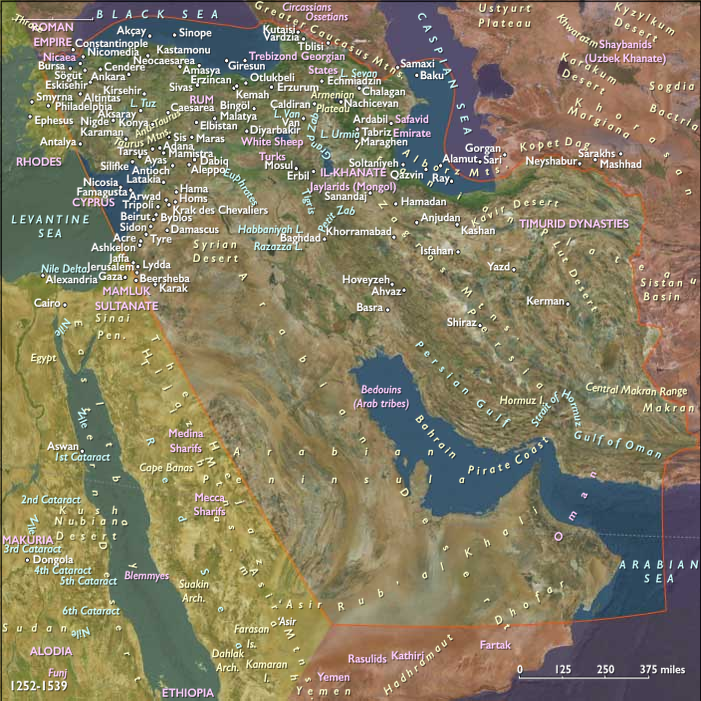
Muhammad ibn Falah and his followers had been defeated in 1440 in a clash with the authorities, but in February 1441 they manage to capture the city of Hoveyzeh, which becomes the seat of the extremist Musha'sha' movement.
Warfare persists, but Muhammad ibn Falah is able to consolidate his power in the vicinity of Hoveyzeh and the Tigris River.
He owes his success as much to the weakness and division of his opponents as to his own messianic zeal and doctrinal propaganda.
The doctrinal foundations of the Musha'sha' are found in Muhammad ibn Falah's Kalam al-mahdi (“The Words of the Mahdi”).
Written in the style of the Qur'an, the book contains a rigid code of conduct regulating the affairs of the community.
Beside acting as the spiritual leader of the Musha'sha', he is also the military and temporal ruler of the movement.
A theologian reputed to be descended from the seventh Shi'ite imam, Musa al-Kazim, Muhammad ibn Fala had received a traditional Islamic religious education in al-Hillah, a famous center for Shi'ite studies.
As a student he had been noted for his extremist religious views, which bordered on heresy, and he had been excommunicated from the faith by his teacher, himself a noted Shi'ite theologian.
Muhammad ibn Falah from 1436 onward has actively propagated his views among Arab tribesmen, trying to create a coalition of discontented Arab tribes on what is now the border between Iraq and Iran.
This coalition is held together by his contention that he is the mahdi (the “divinely guided one”) and the representative of 'Ali (whom the Shi'ites regard as the legitimate successor to the Prophet Muhammad).
Locations
Groups
Commodoties
Subjects
Regions
Subregions
Related Events
Showing 10 events out of 41809 total
Years: 1441 - 1441
Locations
Groups
Commodoties
Subjects
Regions
Subregions