Murong Chao holds the traditional imperial gathering …
Years: 409 - 409
March
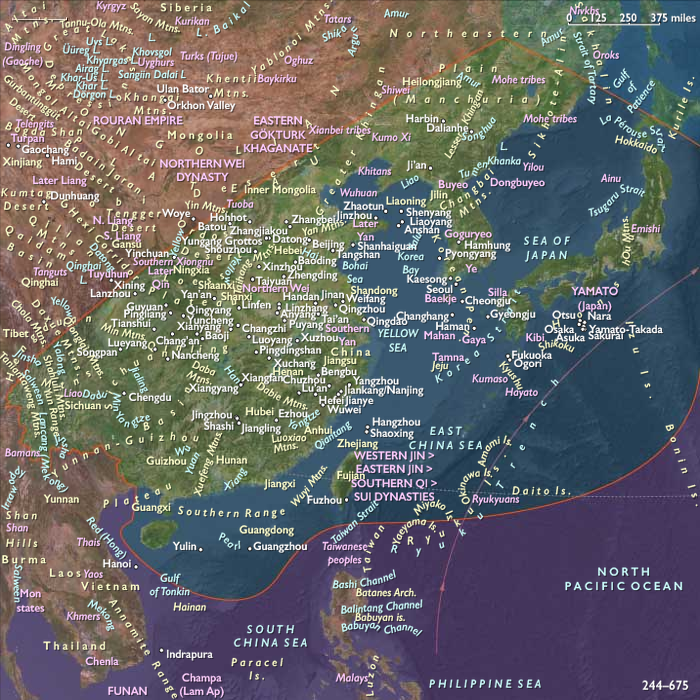
Murong Chao holds the traditional imperial gathering on lunar new year 409.
Lamenting the lack of imperial musicians, he proposes an attack on Jin to capture people to be trained as musicians, despite the opposition from Han Zhuo (Han Fan's brother).
A month later, Murong Chao sends the generals Murong Xingzong, Hugu Ti, and Gongsun Gui (Gongsun Wulou's brother) to attack Jin, capturing Suyu (in modern Suqian, Jiangsu) and twenty-five hundred men and women, who are given to the music director to be taught music.
Encouraged by the success, Murong Chao carries out more raids against Jin.
Locations
People
Groups
- Xianbei
- Chinese (Han) people
- Chinese Empire, Tung (Eastern) Jin Dynasty
- Southern Yan, Xianbei “Empire” of
Topics
- Six Dynasties Period in China
- Sixteen Kingdoms Period in China
- Civil Wars in China triggered by the Wu Hu Invasion
Commodoties
Subjects
Regions
Subregions
Related Events
Filter results
Showing 10 events out of 10 total
Eastern Southeast Europe (832–843 CE): Icon Restoration and Regional Conflicts
Settlement and Migration Patterns
Continued Stability Amid Renewed Conflicts
From 832 to 843 CE, Eastern Southeast Europe maintained relative demographic stability despite increased regional tensions and renewed conflicts. The region continued adapting to shifting political realities, marked by Byzantine diplomatic maneuvers and military campaigns.
Political and Military Developments
Restoration of Icons Under Michael III
The reign of Emperor Michael III, the last ruler of the Amorian (Phrygian) dynasty, along with his regents, was notably marked by the restoration of icon veneration within the Greek Church in 843 CE. This restoration significantly impacted religious and political unity within the Byzantine Empire.
Successful Campaigns Against Arabs and Slavs
Under Michael III’s regency and subsequent reign, the Byzantine Empire conducted successful military campaigns against Arab incursions and Slavic tribes. These victories temporarily strengthened the empire’s defenses and restored some of its regional prestige.
Bulgarian-Serbian Conflict
The period witnessed the first recorded conflict between Bulgarians and Serbs, prompted by Byzantine diplomatic strategy. This war, occurring during the reign of Bulgarian Khan Presian between 839 and 842, underscored the complexities of regional politics and Byzantine influence in local disputes.
Economic and Technological Developments
Continued Economic Adaptation
Economic adjustments continued, reflecting territorial shifts and military dynamics. Despite geopolitical turbulence, economic resilience persisted, supported by strategic trade and fortified infrastructures that protected vital economic interests.
Reinforced Defensive Strategies
Strategic military fortifications continued to be a priority, with ongoing efforts to strengthen defensive structures around critical frontier and urban regions, notably Constantinople. These fortifications were essential in maintaining regional stability against external threats.
Cultural and Artistic Developments
Revitalized Religious Art and Iconography
The restoration of icons in 843 CE revitalized religious art and significantly shaped cultural and spiritual practices within the Byzantine Empire. Artistic production flourished, emphasizing renewed expressions of faith and communal identity.
Scholarly and Intellectual Continuity
Educational institutions and scholarly communities remained active, preserving and advancing classical, theological, and philosophical traditions. Intellectual continuity supported cultural resilience during a period marked by significant religious and political shifts.
Social and Religious Developments
Impact of Icon Restoration
The official restoration of icon veneration had profound social and religious implications, reinforcing Eastern Orthodoxy's role in societal cohesion and spiritual life. Religious institutions regained prominence, further shaping regional identity and community stability.
Ecclesiastical Strength and Community Resilience
The renewed emphasis on icon veneration strengthened ecclesiastical influence, guiding social dynamics and fortifying community resilience amidst geopolitical uncertainties and regional conflicts.
Long-Term Consequences and Historical Significance
The period from 832 to 843 CE was characterized by significant religious restoration, successful military actions against external threats, and the emergence of notable regional conflicts. These developments significantly reshaped Eastern Southeast Europe’s religious, political, and cultural landscapes, setting enduring foundations for future historical trajectories.

The first war between Bulgarians and Serbs, precipitated by East Roman diplomacy, occurs during the reign of Khan Presian between 839 and 842.
Presian, who succeeds Malamir in 836 as Khan of Bulgaria, may have been young and inexperienced at the time of his accession, and state affairs may have been dominated by the minister (Kavkhan) Isbul, as under Presian's uncle Malamir.
The Slavs in the vicinity of Thessalonica rebel against the Empire in 837, soon after Presian's accession.
Emperor Theophilos seeks Bulgarian support in putting down the rebellion, but simultaneously arranges for his fleet to sail through the Danube delta and undertake a clandestine evacuation of some of the Greek captives settled in trans-Danubian Bulgaria by Krum and Omurtag.
Isbul, in retaliation for Theophilus’s clandestine rescue mission to trans-Danubian Bulgaria, campaigns along the Aegean coasts of Thrace and Macedonia and captures the city of Philippi, where he sets up a surviving memorial inscription set up in a local church.
Isbul's campaign may have resulted in the establishment of Bulgarian suzerainty over the Slavic tribe of the Smoljani.
Presian's reign coincides with the extension of Bulgarian control over the Slavic tribes in and around Macedonia.
It is known that the Serbs and Bulgars lived in peace until the invasion in 839 (the last years of Theophilos).
Vlastimir, the Knez of Serbia, had united several Serbian tribes, and Emperor Theophilos (r. 829–842) grants the Serbs independence, thus the Serbs acknowledge nominal overlordship of the Emperor.
The annexation of western Macedonia by the Bulgars changes the political situation: Presian may have seen a threat in the Serb consolidation, and opted to subjugate them in midst of the conquest of Slav lands.
Another cause might have been that the Empire wanted to divert the attention so that they could cope with the Slav Uprising in the Peloponnese, meaning they would have sent the Serbs to instigate the war.
Presian invades Serbian territory between 839–842 .
The invasion leads to a three-year war, in which Vlastimir is victorious; Presian makes no territorial gains, is heavily defeated and loses many of his men as the Serbs have a tactical advantage in the hills; he is driven out by the army of Vlastimir.
The war ends with the death of Theophilos in 842, which releases Vlastimir from his obligations to the Empire.
Eastern Southeast Europe (844–855 CE): Cultural Revival and Scholarly Advances
Settlement and Migration Patterns
Continued Stability and Cultural Integration
From 844 to 855 CE, Eastern Southeast Europe maintained demographic stability, with settlements continuing to consolidate. Cultural integration among diverse communities persisted, reflecting regional resilience amid broader political developments.
Political and Military Developments
Continued Regional Stability
The Byzantine Empire maintained a period of relative military stability, sustaining the gains achieved through earlier campaigns against Arab and Slavic threats. This stability enabled increased focus on internal developments and cultural projects.
Economic and Technological Developments
Sustained Economic Prosperity
Economic conditions remained stable, with fortified trade routes and infrastructure continuing to support regional commerce and productivity. This ongoing economic resilience facilitated further cultural and scholarly endeavors.
Ongoing Defensive Enhancements
Military fortifications continued to be maintained and improved, ensuring regional security and the protection of economic and cultural interests throughout the Byzantine-controlled territories.
Cultural and Artistic Developments
Byzantine Cultural Revival
The period was marked by notable advances in classical studies under the Byzantine cultural revival. Significant developments included the gradual substitution of the minuscule, or smaller cursive handwriting, for the traditional uncial script, as well as an increase in the number of scriptoria—copyists' workshops—which supported scholarly and literary production.
Flourishing of Intellectual and Artistic Life
Artistic and scholarly activities flourished, driven by the enhanced capabilities of these scriptoria. This growth significantly contributed to the preservation and dissemination of classical and theological knowledge, reinforcing cultural continuity and resilience.
Social and Religious Developments
Ongoing Influence of Icon Restoration
The restoration of icon veneration continued to profoundly influence social and religious practices. This period further solidified the role of Eastern Orthodox institutions, contributing to regional cohesion and cultural identity.
Strengthened Community Cohesion
The cultural revival, including scholarly and literary advancements, supported greater community cohesion. Religious institutions remained central to societal stability, reinforcing regional identity and spiritual unity.
Long-Term Consequences and Historical Significance
The period from 844 to 855 CE saw significant cultural and scholarly advancements, exemplified by developments in manuscript production and classical studies. These scholarly contributions enriched Byzantine cultural heritage and reinforced the region’s intellectual resilience, leaving enduring impacts on Eastern Southeast Europe’s historical trajectory.
Boris inherits the Bulgarian throne from his father, Khan Presijan.
Bulgaria's territorial, military, and political potential have made it one of the largest states in Europe.
Bulgaria's approximate frontiers are the Dnieper River in the northeast, the Carpathian Mountains in the north, the Tisa (Tisza) River in the northwest, the Adriatic Sea in the west, and the Tomorr (Tomor), Belasica, Pirin, Rhodope, and Strandzha mountains in the south.
Many Slavic tribes had settled within the boundaries of the state, together with the proto-Bulgarians, a tribe of Turkic origin that had settled in the Balkan Peninsula at the end of the seventh century.
In view of the religious, ethnic, and language difficulties between the Slavs and the Bulgars, the introduction of a common and compulsory religion for all subjects is one of the principal preconditions for the formation of a united Bulgaria.
Pagan Bulgaria needs to join the “family of Christian states,” but the existence of two competing centers of Christianity—Rome and Constantinople—make it difficult for Boris to make his choice.
In 852, he sends emissaries to Eastern Francia to confirm the peace treaty of 845.
At the time of his accession he threatens Constantinople with an invasion, but his armies do not attack, and he receives a small area in Strandzha to the southeast.
The peace treaty is not signed, however, although both states exchange temporary delegations.
The Moravian Prince Rastislav persuades Boris I to help him against East Francia in 854.
According to some sources, some Franks bribed the Bulgarian monarch to attack Louis the German.
The Bulgarian-Slav campaign is a disaster, and Louis scores a great victory and invades Bulgaria.
At the same time, the Pannonian Croats wage a war against the Bulgarians.
Both peoples had coexisted peacefully up to that time, suggesting that the Croats had been paid by Louis to attack Bulgaria and distract Boris' attention from his alliance with Great Moravia.
Boris cannot achieve any success, and both sides exchange gifts and settle for peace.
The peace between Bulgaria and Eastern Francia is restored as a result of the military actions in 855, and Rastislav is forced to fight against Louis alone.
Years: 409 - 409
March
Locations
People
Groups
- Xianbei
- Chinese (Han) people
- Chinese Empire, Tung (Eastern) Jin Dynasty
- Southern Yan, Xianbei “Empire” of
Topics
- Six Dynasties Period in China
- Sixteen Kingdoms Period in China
- Civil Wars in China triggered by the Wu Hu Invasion